
Capsule supplement formulation is the process a contract manufacturer uses to turn your product concept into a fillable powder blend, a shell choice and a fixed fill weight.
You approve the result in a Finished Product Specification before production begins. This guide covers what to specify, what drives cost and timeline, and what to ask a capsule manufacturer before you sign.
KEY TAKEAWAYS
- Capsule supplement formulation is the contract manufacturer’s work of turning your concept into a fillable blend, a shell and a fixed fill weight.
- Your brief decides the quote. Specify serving size, capsule count, shell, claims, bottle and target monthly volume.
- WB Blends runs sizes 1, 0, 00 and 00EL (about 200 to 900 mg fill) in gelatin, HPMC and pullulan, at 150,000,000 capsules per month.
- A pilot run and an approved Finished Product Specification (FPS) lock the formula before production.
- New capsule projects run 10 to 12 weeks. Returning projects run 8 to 10.
What Is Capsule Supplement Formulation?
Capsule supplement formulation is the engineering of a fill blend and its shell so every capsule holds the labeled dose at a repeatable weight. Your manufacturer sets the blend, the capsule size and the fill weight. You set the product goals, claims and volume.
Who does what
You define the product: actives, serving size, claims and channel. The manufacturer makes it fill, flow and test within spec. At WB Blends, the work runs through our in-house R&D team and is documented in the FPS.
Why formulation sits before the quote
Fill weight, shell and claims change production cost and lead time. A preliminary quote built on a clear brief holds up. A quote built on a vague one gets revised.
What Should You Specify in a Capsule Formulation Brief?
A strong brief names the format, serving size, capsule count, shell, claims, bottle and target monthly volume. WB Blends returns a preliminary quote within 5 to 6 business days. The more complete the brief, the fewer revisions follow.
| Brief item | What to state | Why it matters |
|---|---|---|
| Existing formula | Locked, needs refinement, or none | Decides how much R&D the project needs |
| Serving size | Capsules per serving and per bottle (30, 60, 90, 120 or 180 count) | Sets capsule count and fill weight |
| Shell | Gelatin, HPMC (vegan) or pullulan (organic) | Fixes the label claim path |
| Capsule size | Size 1, 0, 00 and 00EL, or “not sure yet” | Sets the fill range |
| Bottle | 100cc to 500cc in HDPE, PET or glass | Drives packaging spec and sourcing |
| Claims | Organic, gluten-free, vegan, Non-GMO Project Verified, Formulated Without the 9 Major Allergens, confirmed during quoting | Locked at quote |
| Target monthly volume | From capsule projects from 20,000 units to 100,000+ unit programs | Shapes scheduling and pricing |
| Service model | Turnkey or tolling | Decides who sources what |
How Does Capsule Size Set Fill Weight and Cost per Serving?
Capsule size sets the internal volume. Fill weight equals that volume times the packed density of your blend. Fill weight decides how many actives fit in one capsule, which decides capsules per serving and cost per serving.
| Capsule size | WB Blends fill range | Illustrative fill at 0.8 g/mL |
|---|---|---|
| Size 1 | ~200 to 400 mg | ~400 mg |
| Size O | ~400 to 600 mg | ~544 mg |
| Size OO | ~600 to 800 mg | ~760 mg |
| Size OOEL | ~700 to 900 mg | ~816 mg |
The right column illustrates the volume-times-density calculation. Real fill weights are confirmed in formulation and locked into the FPS.
Packed density changes the capsule size
Two blends with the same active weight can need different capsules. Particle size, moisture and excipients move density. This is why bench work comes before a size commitment.
When the formula does not fit
If actives exceed the capsule’s capacity, you have three options. Raise the capsule count per serving. Move to a larger size. Reduce or swap excipients. Each changes cost per serving, so decide it before the quote, not after.
Which Capsule Shell Should You Specify?
Specify gelatin for standard formulas, HPMC for vegan formulas and pullulan for organic products. The shell fixes which claims your label can carry. WB Blends runs all three in clear or colored versions.
| Shell | Source | Best for | Label fit |
|---|---|---|---|
| Gelatin | Animal-derived | Standard nutraceutical formulas | Not vegan |
| HPMC | Plant cellulose | Vegan and vegetarian products | Vegan |
| Pullulan | Fermented plant starch | Organic products | Organic |
Gelatin
Gelatin is the long-standing default and runs well on encapsulation equipment. It cannot carry a vegan or vegetarian claim.
HPMC (vegan)
HPMC is a plant-derived polymer. It carries a vegan claim. Its lower moisture content than gelatin also makes it a common choice for moisture-sensitive fills.
Pullulan (organic)
Pullulan is a polysaccharide produced by fermentation. WB Blends uses it for organic products. Its low oxygen permeability suits oxygen-sensitive blends.
How Do Excipients and Claims Affect Your Quote?
Excipients are non-active ingredients that keep a blend flowing and filling at a steady weight. Every excipient must meet the same claims as your actives. Claims are locked at quote, and adding one later requires a re-quote.
Flow agents and fillers
Flow agents such as silicon dioxide improve powder movement through the machine. Fillers such as microcrystalline cellulose or rice flour give low-dose actives a fillable weight. Each must appear on the label.
Claims narrow the approved list
An organic, vegan, gluten-free or Formulated Without the 9 Major Allergens claim shrinks the list of usable excipients. WB Blends supports Organic, Gluten-Free, Vegan, Non-GMO Project Verified and Formulated Without the 9 Major Allergens claims, all confirmed during quoting. State the claims you need in the brief.
Who owns claim compliance
Under tolling, you are responsible for meeting claim requirements on the ingredients you supply. Under turnkey, WB Blends sources to the claims locked at quote.
How Does a Manufacturer Keep Every Capsule Consistent?
Consistency comes from blend uniformity, matched particle properties and documented testing on every lot. A uniform blend puts the same dose in every capsule. Testing proves it.
The regulatory baseline
The FDA’s dietary supplement cGMP rule, 21 CFR Part 111, governs manufacturing, packaging, labeling and holding. USP General Chapter <2091> defines weight variation testing for dietary supplement dosage forms.
Testing on every lot
WB Blends tests each finished lot in-house. The panel covers identity, color, heavy metals by ICP/MS, total aerobic plate count, yeast and mold, coliforms, E. coli and salmonella. Results are documented in a Certificate of Analysis (COA) that ships with the order.
What Does the Formulation Process Look Like?
Capsule formulation runs in six steps: preliminary quote, R&D, purchase order, FPS and deposit, production and delivery. Each step reduces risk before volume is committed.
- Preliminary quote. Submit your formula or work from the WB Blends catalog. The quote returns in 5 to 6 business days.
- R&D. If needed, the team develops, sources and tests the formula.
- Purchase order. You cut the PO to start the Finished Product Specification.
- FPS and deposit. You approve the full spec covering formulation, potency, testing criteria, packaging and palletization. A deposit is triggered on approval if required.
- Production. The order enters the queue with weekly status updates.
- Delivery. It ships on time with a COA and shipping spec.
The pilot run
Pilot runs validate your formula before you commit to a full production order. Most issues get caught and fixed here, when changes cost the least.
Why in-house R&D shortens the cycle
R&D sits inside the same facility as production. Revisions happen in days, not weeks, and your FPS is built during R&D, not assembled after.
Can a Capsule Manufacturer Handle Your Volume?
WB Blends encapsulates 150,000,000 capsules per month and stores about 5,000 pallet spaces. That supports launch quantities and ongoing retail replenishment without splitting production across vendors. We manufacture for brands sold through Walmart, Amazon, Target, The Vitamin Shoppe and Vitacost.
How long does it take?
New capsule projects run 10 to 12 weeks. Returning projects run 8 to 10 weeks, because formulation and specifications are already locked.
What visibility do you get?
You receive a weekly open order report with promise dates and production status, plus Friday status updates. Our team responds in under one business day. This is how capsule contract manufacturing at WB Blends stays predictable for brand owners who sell at scale.
Turnkey or Tolling: Which Model Fits?
Choose turnkey if you want WB Blends to source ingredients and packaging, then encapsulate and bottle. Choose tolling if you supply ingredients, packaging or both. Both run in the same facility, and you own your formula either way.
Which fits which brand
Turnkey suits brands that want one accountable partner from sourcing to shelf. Tolling suits brands with established supplier relationships. Our turnkey and tolling programs share the same production, testing and documentation.
Which Formulas Need Extra Development Time?
Hygroscopic powders, bulky botanical extracts, high-dose actives and moisture-sensitive cultures need extra development. Flag them in your brief so the quote reflects the work.
- Hygroscopic and sticky powders clump and stall flow. They need controlled handling, the right flow agent and a low-moisture shell.
- Bulky botanical extracts fill poorly and cap the dose per capsule. Density work raises the fill. If it cannot rise far enough, the capsule size or count changes.
- Probiotic and sports nutrition formulas carry moisture and dose pressures. WB Blends manufactures both, with in-house R&D support.
When Should You Choose Powder or Liquid Instead?
Choose powder or liquid when the daily dose is too large for a practical capsule count, or when the product needs flavor, mixability or a liquid delivery. WB Blends manufactures both.
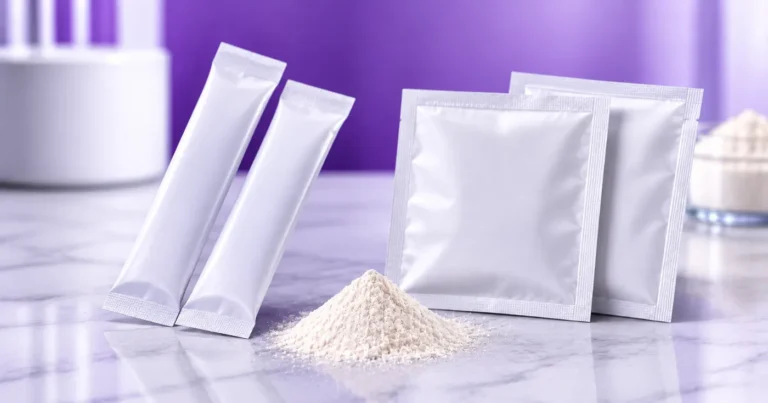
A capsule tops out at about 900 mg of fill at the largest size we run. Powders carry larger doses and custom flavor in canisters, stick packs and gusset bags. Liquids cover tinctures, botanical extracts, syrups, suspensions and oil blends. Decide the format before the quote so you do not rebuild the project mid-stream.
What Should You Ask a Capsule Contract Manufacturer Before You Sign?
Ask about certification, formula ownership, testing, visibility and response time. These five answers cover trust, compliance and delivery risk.
- Certification. Is the facility NSF/ANSI 455-2 GMP certified, and how recent is the audit?
- Formula ownership. Who owns the formula? At WB Blends, you do.
- Testing. Is every lot tested in-house and shipped with a COA? Ours is.
- Visibility. Do you get order status without chasing? We send a weekly open order report.
- Response time. Under one business day.
When your brief is ready, Request a Quote.
FAQ
What is capsule supplement formulation?
It is the design of a powder blend, shell and fill weight so every capsule delivers the labeled dose. A contract manufacturer develops it and documents it in a Finished Product Specification that you approve before production.
How do you calculate capsule fill weight?
Fill weight equals the capsule’s internal volume multiplied by the packed density of the blend. Bench trials confirm the real number. WB Blends fills about 200 to 900 mg across sizes 1, 0, 00 and 00EL.
What is the difference between HPMC and gelatin capsules?
HPMC is plant-derived and supports vegan claims. Gelatin is animal-derived and does not. HPMC also carries less moisture, which suits moisture-sensitive fills.
Do I need excipients in a capsule formula?
Most formulas do. Flow agents and fillers keep the blend moving and the fill weight steady. Each must be justified and listed on the label.
Can I bring my own formula to a contract manufacturer?
Yes. Submit your formula for a preliminary quote, or work from the WB Blends catalog. If the formula needs refinement, the R&D team develops it. You retain ownership either way.
How long does a new capsule project take?
New capsule projects run 10 to 12 weeks. Returning projects run 8 to 10 weeks. Preliminary quotes return in 5 to 6 business days.
Ready to formulate? Request a Quote. Tell us your format, volume and timeline.