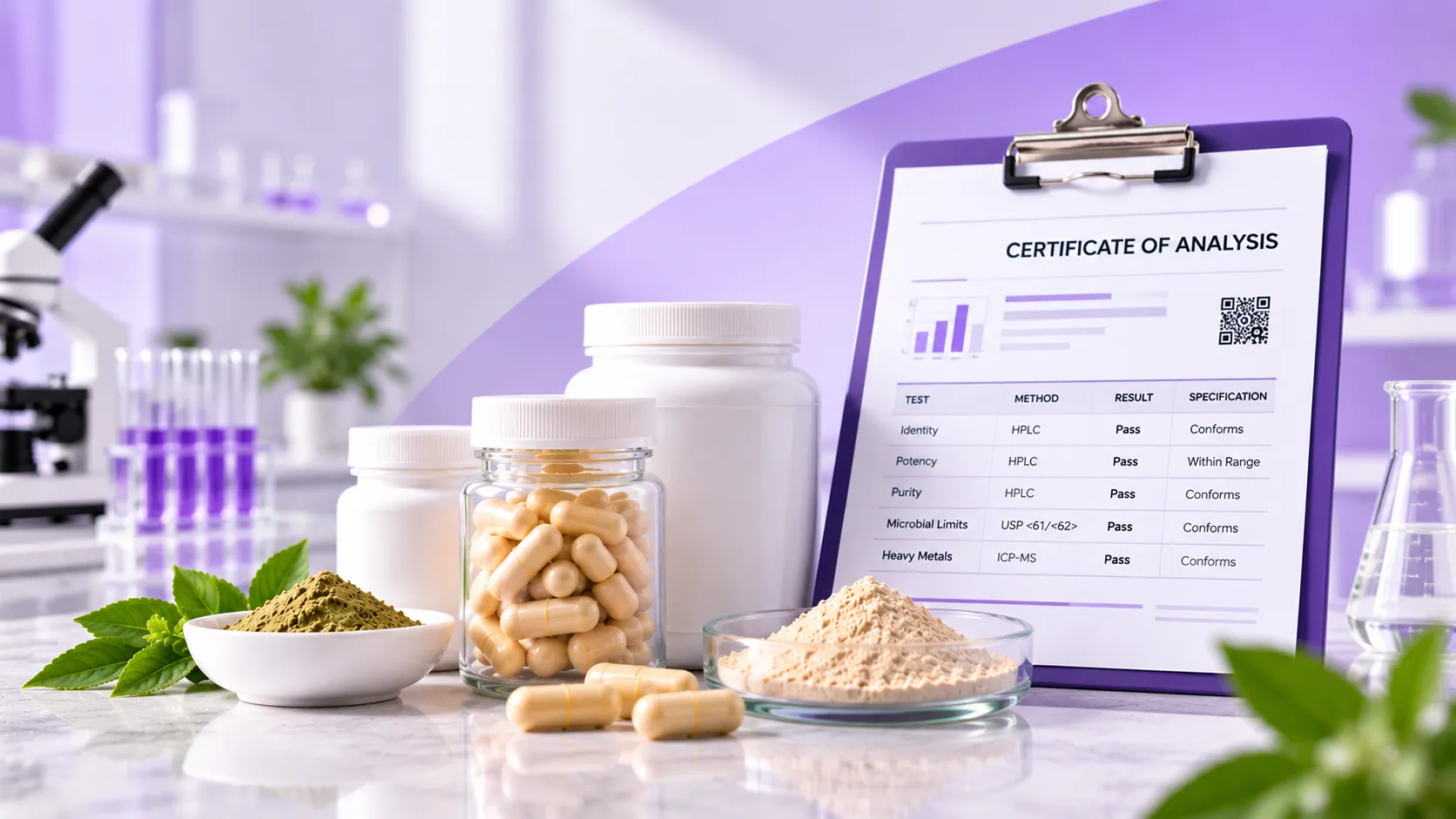

A COA, or certificate of analysis, is a lot-specific document that reports test results against a written specification. That makes the answer to “what is a COA” a practical one for your brand: it is the record that shows what was tested, by which method, against which limit, and who signed off.
Key takeaways
- A COA covers one lot. It is not a certification, and it says nothing about the next lot.
- A usable COA shows product, lot number, spec, method, limit, result, date and sign-off.
- A raw material COA and a finished product COA answer different questions. Your spec should say which ones you need.
- Under 21 CFR Part 111, a manufacturer can rely on a supplier’s COA for some component specifications only after meeting five conditions.
- Read every COA against your approved spec, not on its own.
What is a COA in supplement manufacturing?
In supplement manufacturing, a certificate of analysis is a document that reports the results of tests on one lot of an ingredient or finished product against a written specification. The abbreviation COA is also used for unrelated terms in other fields, so this post writes out “certificate of analysis” where the meaning matters.
Three features define a COA:
- It is lot-specific. It names one lot, and its results apply to that lot only.
- It reports measured results. A line that says “conforms” with no method, limit or result is a statement, not an analysis.
- It compares results to a specification. The spec is the target. The COA is the evidence.
A COA is also not a certification. A certification program reviews a facility or a product program over time. A COA reports on one lot.
For your brand, the COA is the document you file with each lot record. It is the first thing to pull when anyone questions that lot.
What does a COA include?
A COA lists the product, lot number, specification, test method, limit, result, test date and a named sign-off. Each field answers a question your quality team will ask when it reviews a lot.
| Field | What it shows | What to check |
|---|---|---|
| Product | Name, grade and form of the material or finished product | Matches the name and version in your spec |
| Lot number | The one lot the results cover | Matches your PO, shipping documents and container labels |
| Specification | The document and version the results are measured against | Matches the spec your brand approved |
| Method | The test or examination used | A method is named (for example ICP-MS, HPTLC or FTIR), not left blank |
| Limit | The accepted range or maximum for each test | Matches your spec, with units stated |
| Result | The measured value for this lot | A real value, not only “pass” |
| Date | When the test was run and when the COA was issued | Present, and earlier than the lot release |
| Sign-off | The named person or unit that approved the results | Named, dated and traceable to the issuing lab |
Caption: The eight fields to check on a COA. For a supplier COA that a manufacturer relies on, 21 CFR 111.75(a)(2)(ii)(B) calls for the test methods, the limits and the actual results.
Most COAs also carry a header with the issuing company’s name, address and contact details. A COA with no traceable issuer cannot be verified.
What tests appear on a COA?
A supplement COA usually reports identity, heavy metals and microbial tests, plus any physical or strength tests written into the spec. The test list depends on the material and on the specification your brand approves.
Identity tests
Identity tests confirm that a material is what its name says. Common methods include visual inspection, HPTLC (high-performance thin-layer chromatography) and FTIR (Fourier-transform infrared spectroscopy). The COA should name the method used.
Heavy metals tests
Heavy metals tests report arsenic, cadmium, mercury and lead. A common method is ICP-MS (inductively coupled plasma mass spectrometry). Results are reported in units such as ppm or ppb, and each result should sit next to its limit.
Microbial tests
Microbial tests report total aerobic count, yeast and mold, coliforms, E. coli and Salmonella. Counts are usually reported in CFU/g (colony-forming units per gram). Pathogen results are usually reported as absent or present in a stated sample weight. The COA should name the method and the procedure it follows.
Other tests in your spec
Many specs also include physical tests, such as appearance and moisture, and a strength or assay test for ingredients that carry a labeled amount. If a test is in your spec, it belongs on the COA. A COA with fewer tests than the spec is incomplete.
What is the difference between a raw material COA and a finished product COA?
A raw material COA reports one lot of an ingredient before it enters production. A finished product COA reports one lot of the product after it is made. They answer different questions, and one does not replace the other.
| Item | Raw material COA | Finished product COA |
|---|---|---|
| Covers | One lot of one ingredient or component | One lot of the capsules, powder or liquid |
| Usually issued by | The ingredient supplier or its lab | The manufacturer’s lab or a partner lab |
| Measured against | Component specification | Product specification |
| Question it answers | Did the input meet its spec? | Does this lot meet the spec your brand approved? |
| Relevant rule | 21 CFR 111.75(a) | 21 CFR 111.75(c) |
A clean raw material COA does not confirm a conforming finished lot. Blending, filling, packing and storage all happen after the ingredient COA is issued. The reverse also holds: a finished product COA does not show which ingredient lots went into the batch. Ask for the raw material COAs on file and the finished product COA for each lot.
When you compare partners, ask to see a sample of each type. Our guide on how to choose a supplement contract manufacturer lists the quality questions to cover.
Does FDA require a COA?
FDA’s dietary supplement cGMP rule, 21 CFR Part 111, is built on specifications, testing and records. A COA is one document inside that system, and the rule sets conditions for relying on a supplier’s COA.
The core duty is short. Section 111.73 says: “You must determine whether the specifications you establish under § 111.70 are met.” Section 111.70(b) requires specifications for each component: an identity specification, specifications needed to meet the purity, strength and composition of the finished supplement, and limits on contamination that may adulterate the finished batch.
Identity of dietary ingredients
For a component that is a dietary ingredient, § 111.75(a)(1)(i) requires the manufacturer to conduct at least one appropriate test or examination to verify identity, unless FDA grants an exemption petition. A supplier’s COA cannot replace that test.
Relying on a supplier’s COA
For other component specifications, the manufacturer can test the lot or rely on the supplier’s COA. Reliance is allowed only if all five conditions in § 111.75(a)(2)(ii) are met:
- The manufacturer first qualifies the supplier by confirming the results of the supplier’s tests or examinations.
- The COA describes the test or examination methods, the limits and the actual results.
- The manufacturer keeps documentation of how it qualified the supplier.
- The manufacturer periodically re-confirms the supplier’s COA.
- Quality control personnel review and approve the documentation behind qualification and re-qualification.
Section 111.95(b)(2) also requires a record of that supplier qualification. FDA has enforced the first condition. An April 2022 FDA warning letter cited a firm for relying on its COA for microbiological and heavy metals testing without establishing the reliability of the supplier’s COA.
Finished batches
For finished batches, § 111.75(c) requires the manufacturer to verify product specifications through appropriate tests or examinations. A manufacturer may verify a subset of batches chosen through a sound statistical sampling plan, or test every batch. Section 111.75(h)(1) requires that the methods be appropriate and scientifically valid.
Part 111 sets your manufacturer’s testing and record-keeping duties. The documents your brand receives with each lot are a matter for your spec and your agreement, so write the COA requirement into both. This post is general information, not legal advice.
How do you read a COA?
Read a COA against your approved specification, line by line. Confirm that the lot, method, limit and result match, then check the date and the sign-off. Each item below is a red flag.
- The lot number does not match your PO, shipping documents or container label.
- The issuer has no name, address or contact details.
- The spec, or the spec version, is not the one your brand approved.
- A test in your spec is missing from the COA.
- A limit differs from your spec, or no limit is shown.
- A result says only “pass” or “conforms” where a number should appear.
- The method is blank or vague.
- Units are missing, or mixed without a note, such as ppm in one line and ppb in another.
- Results are identical to the last decimal across several lots.
- The test date is missing, or falls after the release date.
- There is no named approver, or the sign-off cannot be traced to the issuing lab.
- The file shows signs of editing, such as mixed fonts or misaligned fields.
If an item fails, hold the lot. Ask the issuer for a corrected or verified COA in writing, and keep that exchange with the lot record. Where a result is in question, ask for third-party verification of the lot. Do not release a lot on a promise to fix the paperwork later.
How WB Blends handles this
WB Blends is a dietary supplement contract manufacturer in Spanish Fork, Utah. Testing runs in-house on every lot. Identity and appearance are checked by visual inspection, HPTLC and FTIR. Heavy metals (arsenic, cadmium, mercury and lead) are tested by ICP-MS against strict ppm thresholds. Microbial testing covers total aerobic count, yeast and mold, coliforms, E. coli and salmonella, using compendia-validated methods. ISO-accredited partners and Eurofins are also used, and third-party verification is available.
A Certificate of Analysis ships with every lot, together with the Finished Product Shipping Spec. The Finished Product Specification (FPS) is approved before production.
Frequently asked questions
What does COA stand for?
COA stands for certificate of analysis. In supplement manufacturing, it is a document that reports test results for one lot against a written specification. The abbreviation is also used for unrelated terms outside quality work, so write out “certificate of analysis” in purchase orders and specs to avoid confusion.
Who issues a COA?
The lab or quality unit that ran the tests issues it. For a raw material, that is usually the ingredient supplier or its lab. For a finished lot, it is the manufacturer’s lab or a partner lab. Your brand should know which party issued each COA and who signed it.
Should a brand ask for a COA for every lot?
Yes, for each lot you receive or release. A COA covers one lot, so last month’s COA says nothing about this month’s. Ask for the COA with each shipment, compare it to your approved spec, and file it with the lot record. Write the requirement into your agreement with the manufacturer.
What is the difference between a COA and an FPS?
An FPS, or Finished Product Specification, is the approved target. It lists the tests and limits a finished lot must meet. A COA is the result: it reports what testing found on one lot. At WB Blends, the FPS is approved before production and the COA ships with every lot. Compare the second against the first.
Can a COA be from an in-house lab?
Yes. A COA can come from an in-house lab, a partner lab or a third-party lab. What matters is that the methods are scientifically valid, the limits match your spec and the results are signed. Ask which lab ran each test. WB Blends tests in-house on every lot, and third-party verification is available.
Planning a launch? Request a quote. Preliminary quotes take 5-6 business days.
Sources: 21 CFR Part 111, Subpart E (eCFR); FDA warning letter, April 21, 2022.