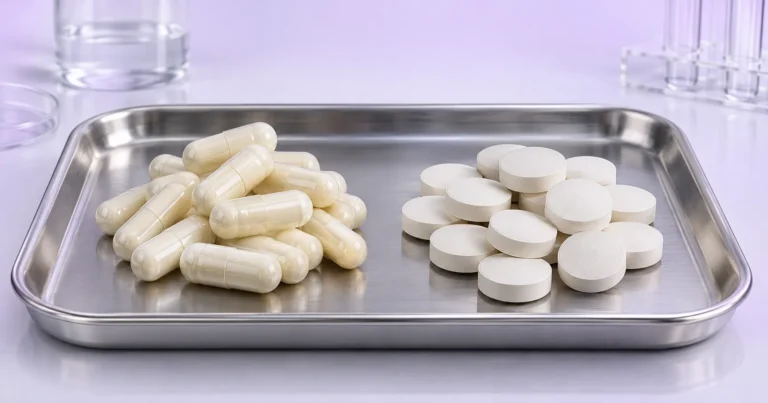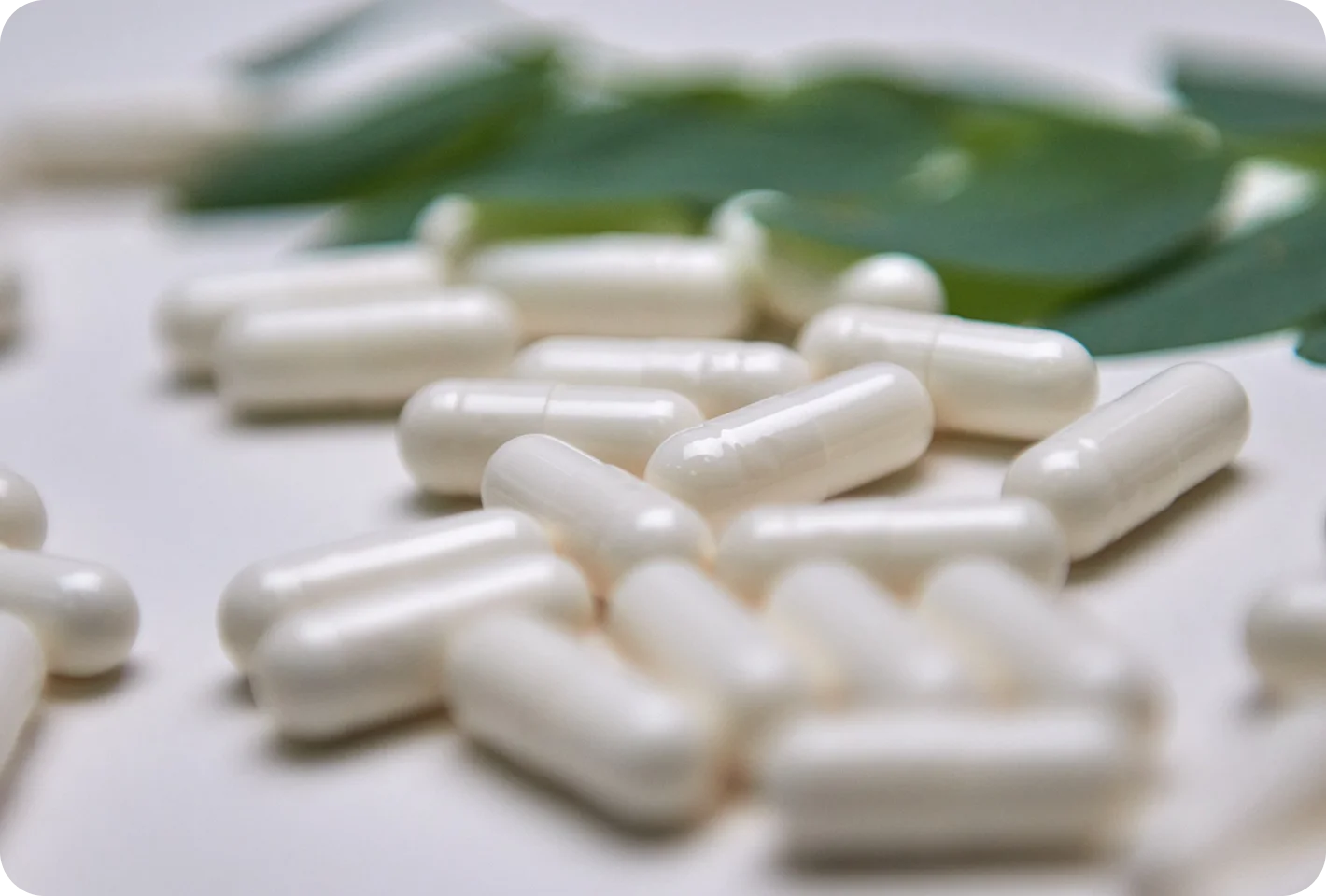

Capsule sizes are standard numbers for two-piece hard capsules, and a smaller number means a larger capsule. Your size sets dose per capsule, bottle choice and how easily your customer swallows it. Sizes 1, 0, 00, and 00EL cover fill weights of about 200-900 mg.
Key Takeaways
- Sizes 1, 0, 00, and 00EL cover fill weights from about 200 mg to 900 mg.
- Size 00 is the most commonly used supplement capsule size, according to capsule supplier LFA, with size 0 second.
- Size 00 and 00EL suit higher-dose formulas and dense powders like protein blends, mushroom extracts, and multivitamins.
- Size 1 suits potent, low-dose ingredients: botanical extracts, isolated actives, and pediatric or senior-focused products.
- The right capsule size depends on three variables: fill weight, ingredient density, and target consumer.
What is a Capsule Size?
A capsule size is a standardized two-piece shell measurement that determines how much powder, granule, or pellet a capsule can hold. Capsule sizes follow an inverse numbering system: the smaller the number, the larger the capsule. Size 000 is the largest commercially used capsule; size 5 is among the smallest.
For dietary supplements, WB Blends fills four sizes: 1, 0, 00, and 00EL. Together they cover fill weights of about 200 mg to 900 mg per capsule.
Why Capsule Sizes Are Standardized
Capsule dimensions are standardized so encapsulation machinery, bottling lines, and packaging components remain interchangeable across manufacturers. A size 0 capsule from one shell supplier fits the same tooling as a size 0 from another. This consistency is what allows contract manufacturers to scale production across millions of units per month without retooling.
Capsule Size Chart: Dimensions and Fill Weights
The table below summarizes the four sizes in this guide.
| Capsule Size | Approximate Fill Weight | Typical Use Case |
|---|---|---|
| Size 1 | 200–400 mg | Low-dose botanicals, isolated actives, pediatric formulas |
| Size 0 | 400–600 mg | Standard nutraceuticals, vitamins, sports nutrition |
| Size 00 | 600–800 mg | High-dose blends, multivitamins, mushroom extracts |
| Size 00EL | 700–900 mg | Maximum-fill formulas, dense protein blends, complex stacks |
Fill weights are approximate. Actual capacity depends on the bulk density of the powder: a fluffy herbal blend takes up more volume than a dense mineral, even at the same milligram count.
Capsule Size Dimensions in mm
The 00 capsule size measures about 23.4 mm long when closed, with a cap diameter of 8.56 mm. Size 1 is about 19.4 mm long. Length and diameter decide what fits your bottle and what your customer has to swallow.
| Size | Volume (mL) | Closed length (mm) | Cap diameter (mm) | Body diameter (mm) |
|---|---|---|---|---|
| 1 | 0.48 | 19.4 | 6.96 | 6.63 |
| 0 | 0.68 | 21.6 | 7.64 | 7.35 |
| 00 | 0.90 | 23.4 | 8.56 | 8.23 |
| 00EL | 1.00 | 25.3 | 8.58 | 8.25 |
Source: LFA Capsule Fillers capsule size chart. The source labels the extended 00 as 00E. Closed length tolerance is ±0.3 mm.
Published figures differ slightly by supplier. The Coni-Snap size chart hosted by Medisca lists a closed length of 21.7 mm for size 0 and 23.3 mm for size 00. Confirm the spec sheet for the shell your run will use.
How Does Powder Density Change Fill Weight by Size?
Denser powder puts more milligrams into the same capsule. A size 0 holds about 408 mg of a 0.6 g/mL powder and about 680 mg of a 1.0 g/mL powder. Theoretical capacity is capsule volume times powder density, so the same dose can need a different size if you change a raw material.
| Size | 0.6 g/mL | 0.8 g/mL | 1.0 g/mL | 1.2 g/mL |
|---|---|---|---|---|
| 1 | 288 mg | 384 mg | 480 mg | 576 mg |
| 0 | 408 mg | 544 mg | 680 mg | 816 mg |
| 00 | 540 mg | 720 mg | 900 mg | 1,080 mg |
| 00EL | 600 mg | 800 mg | 1,000 mg | 1,200 mg |
Theoretical capacity by powder density. Source: LFA Capsule Fillers capsule size chart, which labels the extended 00 as 00E. These are shell capacities, not a WB Blends fill range.
Real fill weight also depends on how your blend packs and flows, so test the actual formula. To pick a size:
- Measure the bulk density of the finished blend, not of each ingredient.
- Divide your target fill weight (mg) by the density (mg/mL) to get the volume you need.
- Choose the smallest size whose volume covers it.
Example: a 450 mg fill at 0.8 g/mL needs about 0.56 mL. Size 0 (0.68 mL) covers it. Size 1 (0.48 mL) does not.
What is a Size 1 Capsule Used For?
Size 1 capsules hold roughly 200–400 mg of fill and are the smallest of the four standard supplement sizes. They suit potent, low-dose ingredients where the active works at small milligram amounts.
Common Size 1 Applications
- Concentrated botanical extracts (ashwagandha extracts, curcumin isolates)
- Isolated actives (melatonin, biotin, B12)
- Pediatric and senior formulas where swallowability is a priority
- Probiotics with high CFU counts but small physical mass
The trade-off: size 1 capsules can’t carry a typical multi-ingredient stack without splitting it across multiple capsules per serving. If your formula exceeds 400 mg, size 1 is the wrong choice.
What is a size 0 Capsule Used For?
Size 0 capsules hold approximately 400–600 mg. LFA calls size 0 the second most popular size after size 00. Size 0 balances dose capacity with a length most adults can swallow without difficulty.
Where Size 0 Fits
Size 0 fits standard 100cc, 150cc, and larger HDPE and PET bottles cleanly. It suits a “two capsules per serving” label format: two size 0 capsules deliver 800–1,200 mg total fill without becoming hard to swallow.
What is Size 00 Capsule Used For?
Size 00 capsules hold approximately 600–800 mg of fill and are the standard choice for high-dose, multi-ingredient supplements. Size 00 is the most commonly used supplement capsule size, according to capsule supplier LFA.
When Size 00 Makes Sense
- Multivitamin and multimineral blends
- Mushroom extract complexes (lion’s mane, cordyceps, reishi stacks)
- Joint formulas combining glucosamine, chondroitin, and MSM
- Adaptogen blends with multiple botanical extracts
- Greens and superfood capsule formats
Size 00 is large enough to consolidate a complex formula into a single capsule, reducing pill burden, a meaningful concern for consumers who already take multiple supplements daily.
Size 0 vs 00: What Changes?
Size 00 is larger than size 0. Its volume is about 0.90 mL against 0.68 mL, and its closed length is 23.4 mm against 21.6 mm. At 0.8 g/mL, that is about 720 mg against 544 mg of theoretical capacity. Choose size 00 when your fill outgrows a size 0 and you want one capsule per serving. Stay with size 0 when a smaller capsule matters more.
What is Size 00EL Capsule Used For?
Size 00EL (“Extra Long”) capsules hold approximately 700–900 mg of fill, the largest standard capsule used in mainstream supplement manufacturing. The “EL” designation means the capsule body is elongated to carry more volume without widening the diameter.
When to Choose 00EL Over 00
Size 00EL is the right call when:
- Your formula exceeds 800 mg and you don’t want to split it across two capsules
- You’re working with low-density ingredients (powdered mushrooms, freeze-dried botanicals) that take up more volume per milligram
- You need a single-capsule serving format for a high-dose product
The trade-off: 00EL capsules are noticeably longer than size 00 and can be challenging for some consumers to swallow. Market test with your target demographic before locking in this size.
How Do You Choose the Right Capsule Size?
Capsule size selection comes down to three variables: fill weight, ingredient density, and consumer experience. Get these right in order, and the size choice becomes obvious.
Step 1: Calculate Total Fill Weight Per Capsule
Add the milligrams of every ingredient: actives, excipients, flow agents, and capsule fillers like rice flour or microcrystalline cellulose. That total dictates the minimum capsule capacity you need.
Step 2: Account for Bulk Density
A 600 mg formula made of dense minerals (magnesium citrate, calcium carbonate) fits comfortably in a size 0. The same 600 mg in fluffy botanical powders (nettle leaf, dandelion root) may need a size 00. Check capacity at your blend’s density in the table above. Always confirm fill behavior during R&D, not after production starts.
Step 3: Pressure-Test Swallowability
A capsule that holds your formula but consumers can’t swallow comfortably is a churn problem disguised as a packaging decision. Sample the capsule size with your target demographic during R&D. For senior or pediatric audiences, default smaller.
What Capsule Materials Should You Pair With Each Size?
Capsule shells come in three primary materials, each compatible with all four standard sizes.
Gelatin Capsules
Bovine or porcine-derived gelatin. The industry default: cost-efficient, fast-dissolving, and widely accepted. Not vegan or vegetarian.
HPMC (Vegan) Capsules
Hydroxypropyl methylcellulose, plant-based. The standard for vegan and vegetarian supplement lines. Slightly more expensive than gelatin but identical in fill performance.
Pullulan (Organic) Capsules
Derived from fermented tapioca. Organic and Non-GMO Project Verified claims are confirmed during quoting. Premium pricing, used for brands with organic or clean-label positioning.
All three materials are available in clear or colored shells, giving brands flexibility for shelf differentiation. Vegan claims are also confirmed during quoting. For a full comparison of the three shells, see gelatin vs HPMC vs pullulan capsules.
Capsule Sizes and Bottle Compatibility
Capsule size affects bottle selection. Larger capsules require taller, wider bottles to accommodate the same count. For example:
- 60 count of size 0 typically fits a 100cc bottle
- 60 count of size 00 typically requires a 150cc bottle
- 60 count of size 00EL typically requires a 175cc bottle or larger
Bottle compatibility matters for retail shelf positioning, freight efficiency, and unboxing experience. At WB Blends, capsule and bottle pairing is locked in during the Finished Product Specification (FPS) stage before any production runs.
How Capsule Size Affects Manufacturing and Lead Time
Capsule size doesn’t typically change lead time. New capsule projects run on a 10–12 week timeline at WB Blends; returning projects run 8–10 weeks. What capsule size does affect is yield, machinery setup, and ingredient sourcing, all settled before the production queue. R&D is step 2 of the process, if needed. See the capsule manufacturing process for the full sequence.
For brands considering a size change on an existing SKU, expect a reformulation review and a new FPS approval cycle. Any change to capsule size, capsule material, or fill weight resets the specification.
How WB Blends handles this
WB Blends fills capsules in sizes 1, 0, 00 and 00EL, in gelatin, HPMC (vegan) or pullulan (organic) shells, clear or colored. Fill weight runs about 200-900 mg. The capsule line runs about 150M capsules a month, packed in 100-500cc HDPE, PET or glass bottles. Capsule projects go from 20,000 units to 100,000+ unit programs. Claims such as Organic, Vegan and Non-GMO Project Verified are confirmed during quoting. Every lot is tested in-house for identity and appearance, heavy metals and microbial limits, and a Certificate of Analysis ships with each lot. Lead times are 10-12 weeks for new products and 8-10 weeks for returning ones. See our capsule supplement manufacturer page for the full capsule program.
FAQs
What is the most common capsule size for supplements?
Size 00 is the most commonly used supplement capsule size, according to capsule supplier LFA, with size 0 second. Size 0 holds 400–600 mg of fill and size 00 holds 600–800 mg. The right size depends on your fill weight and powder density, not popularity.
How much does a 00 capsule hold?
A size 00 capsule typically holds 600–800 mg of fill, depending on ingredient density. Dense powders like minerals fill closer to the upper range; fluffy botanical powders fill closer to the lower range. Its volume is about 0.90 mL, so theoretical capacity runs from about 540 mg at 0.6 g/mL to 900 mg at 1.0 g/mL.
What’s the difference between size 00 and 00EL capsules?
Size 00EL is an elongated version of size 00. Both have nearly the same diameter, but 00EL is longer, 25.3 mm closed against 23.4 mm, so it holds more fill: approximately 700–900 mg versus 600–800 mg for standard size 00.
Are bigger capsule sizes harder to swallow?
Yes. Capsules above size 00, particularly 00EL and 000, are noticeably longer and harder for some consumers to swallow. If your target audience includes seniors, children, or anyone with swallowing sensitivity, default to size 0 or smaller.
Can I switch capsule sizes after launching my product?
You can, but it requires a new Finished Product Specification, updated label copy, and a new production setup. Most brands lock in capsule size before production starts, specifically to avoid this.
How do I know if my formula needs size 00 or 00EL?
Compare your fill weight to the capacity of each size at your powder’s bulk density, using the density table above. If the fill outgrows size 00, move to 00EL to avoid overfilled capsules, broken shells, and inconsistent dosing in production. A pilot batch confirms the fit. R&D is step 2 of the WB Blends process, if needed.
Capsule Size is a Formulation Decision
Capsule size selection isn’t a packaging decision; it’s a formulation decision. The right size protects your dose accuracy, your consumer experience, and your production yield. The wrong size creates rework, returns, and reformulation cycles that cost time and margin. For more on building the formula around the shell, read the capsule supplement formulation guide.
Planning a launch? Request a quote. Preliminary quotes take 5-6 business days.
External Source Citations
- LFA Capsule Fillers: capsule size chart (dimensions, capacity by powder density, most common size)
- Coni-Snap capsule size chart, hosted by Medisca (supplier cross-check of closed length)