
How to start a supplement company: define your product and customer, choose a business model, partner with a cGMP-compliant manufacturer, finalize the formula and label, file the required FDA notifications, and launch. The manufacturer decision carries the most weight. It sets your quality standard, your minimum order, and your compliance risk.
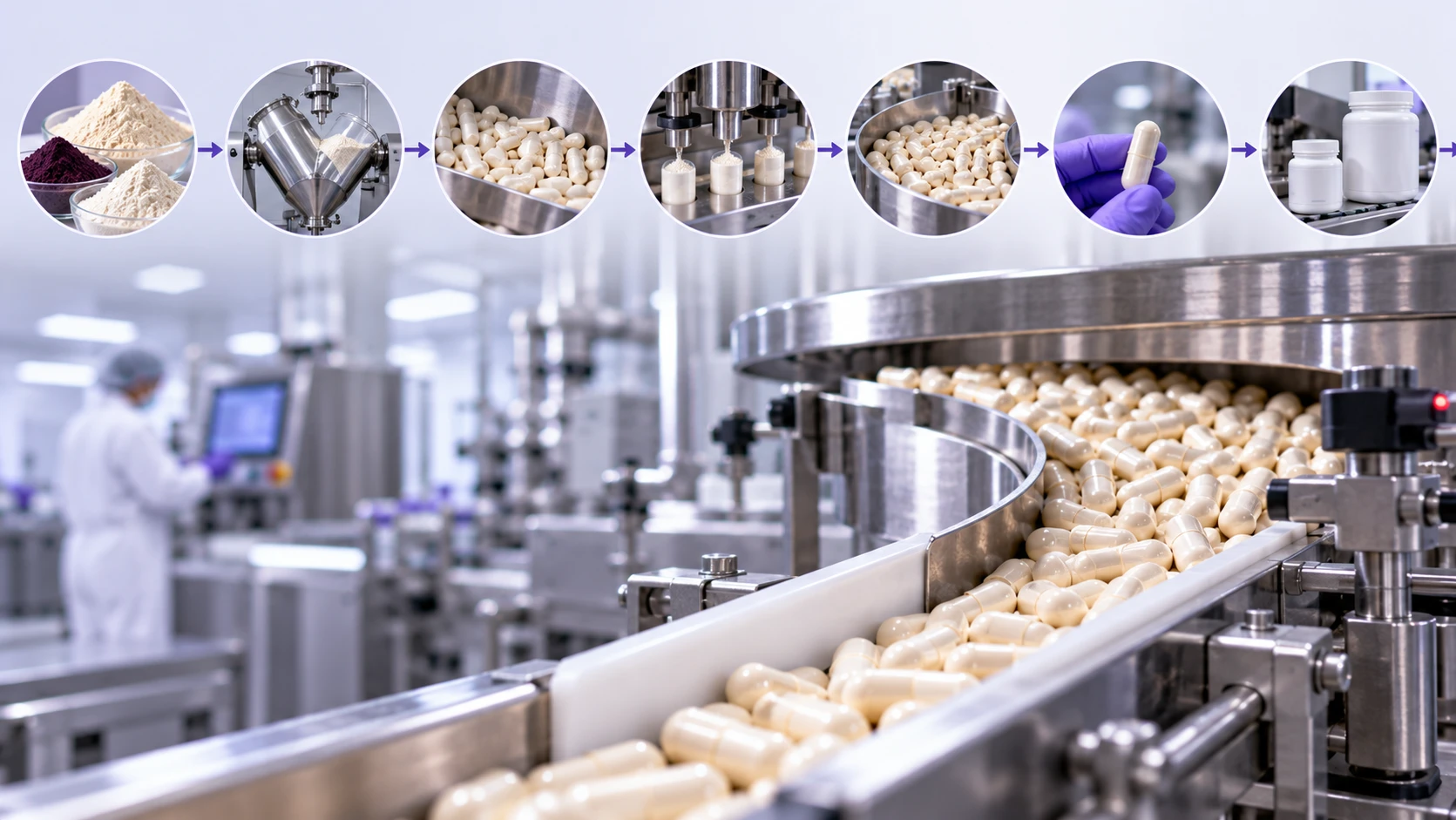
A supplement company is a brand that sells dietary supplements under its own name. Most founders do not build a factory. They partner with a contract manufacturer that formulates, produces, and packages the product under FDA’s current Good Manufacturing Practice rules.
The market rewards focused entrants. The Council for Responsible Nutrition’s 2024 consumer survey, conducted by Ipsos, found that 75% of U.S. adults use dietary supplements. Nutrition Business Journal reports U.S. supplement sales reached roughly $74 billion in 2025, up 7.1%. Specialty categories grew faster than vitamins. Narrow products outperform generic ones.
What steps do you take to start a supplement company?
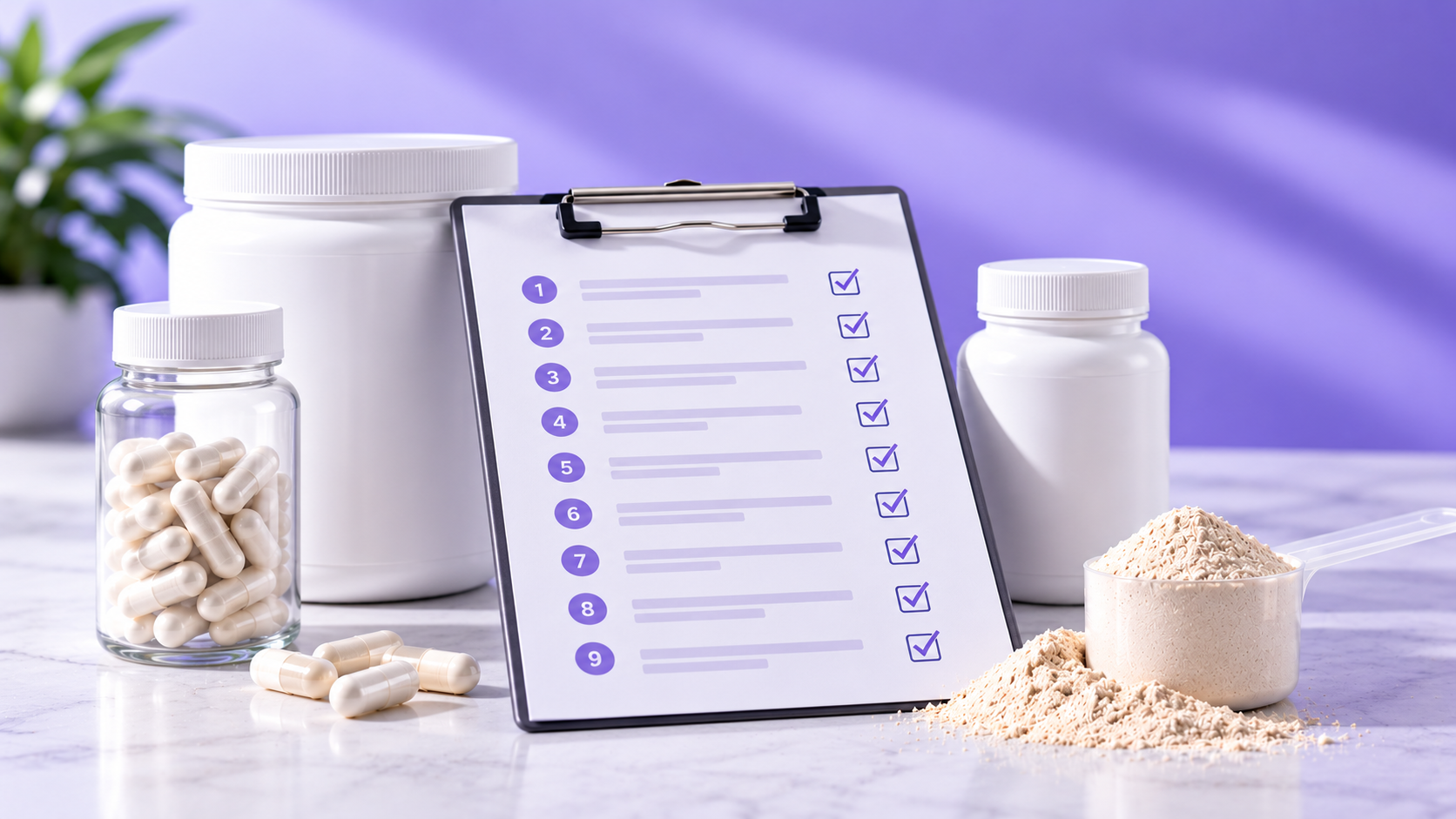
Starting a supplement company follows nine steps: pick a niche, choose a business model, develop the formula, select a manufacturer, meet FDA requirements, design compliant labels, build the brand, run quality testing, and launch. Each step depends on the one before it.
- Pick a niche. Choose a customer and a problem. “Sleep support for shift workers” beats “general wellness.”
- Choose a business model. Private label, white label, or custom formulation (compared below).
- Develop the formula. Define ingredients, doses, and the delivery format.
- Select a manufacturer. Vet certifications, formats, minimums, and capacity.
- Meet FDA requirements. cGMP, claim notifications, and new dietary ingredient rules.
- Design the label. Supplement Facts panel, ingredient list, disclaimer, and allergen statements.
- Build the brand. Name, positioning, site, and sales channel.
- Test the product. Identity, purity, strength, and composition verification.
- Launch and scale. Start with one product, collect data, then expand the line.
How long does the process take?
Timelines depend on formula complexity, ingredient sourcing, and testing. A stock formula moves fastest. A custom formula with a novel ingredient moves slowest, because ingredient safety documentation adds time. Ask every manufacturer for a written timeline by phase before you sign.
Which business model should you choose: private label, white label, or custom formulation?
Private label means a manufacturer produces a proven formula under your brand. Custom formulation means a manufacturer builds a new formula to your specification. Private label launches faster. Custom formulation differentiates better. Most serious brands move from the first to the second as they grow.
| Model | What you provide | Speed | Differentiation | Best for |
|---|---|---|---|---|
| Private label | Brand name, label design | Fastest | Low | Testing a market quickly |
| White label | Brand name, minor tweaks | Fast | Low to moderate | Budget-limited launches |
| Custom formulation | Formula brief or full spec | Slower | High | Brands with a clear point of view |
| Turnkey custom | Concept and spec | Moderate | High | Founders who want one accountable partner |
What is the difference between turnkey and tolling?
Turnkey manufacturing means the manufacturer sources ingredients, produces, packages, and ships. Tolling means you supply the ingredients and the manufacturer only processes them. Turnkey reduces your logistics burden. Tolling gives you control over ingredient sourcing and cost. New brands choose turnkey.
What is a Finished Product Specification?
A Finished Product Specification (FPS) is the written standard a finished batch must meet. It defines identity, purity, strength, and composition limits. FDA’s cGMP rule requires specifications for each product you manufacture. A clear FPS protects you from batch-to-batch variation.
How do you choose a supplement manufacturer?
Choose a manufacturer that holds independent cGMP certification, produces your intended format, offers minimums you can afford, and documents every batch. Request audit reports, certificates of analysis, and references. Do not rely on claims of compliance without paperwork.
The manufacturer is the single largest quality variable in your company. FDA’s cGMP rule applies to every firm that manufactures, packages, labels, or holds supplements. Compliance is a baseline, not a differentiator. Verification is the differentiator.
Which certifications matter?
Independent cGMP certification matters most. NSF International, USP, and the Natural Products Association run recognized programs. WB Blends holds NSF/ANSI 455-2 GMP certification. This standard audits facility controls, documentation, and quality systems beyond a basic FDA registration.
What should you ask a manufacturer before signing?
Ask these questions in your first call:
- Which formats do you produce in-house?
- What is your minimum order quantity (MOQ) for my format?
- Do you test incoming raw materials for identity?
- Can I see a sample batch record and certificate of analysis?
- Who owns the formula?
- What is your typical lead time from approved formula to finished goods?
What are the red flags?
Four red flags appear repeatedly:
- cGMP claims with no certificate or audit report.
- No identity testing on incoming raw materials.
- Vague answers on formula ownership.
- Pressure to commit before you see a written quote.
Does location matter?
Location affects freight cost, lead time, and visit logistics. WB Blends operates from Spanish Fork, Utah. Brands in the Mountain West ship in-state or short-haul and can tour the facility in person. Founders elsewhere work through documented remote processes.
Which supplement format should you launch with?
Launch with one format that matches your customer’s routine. Capsules suit precise, portable dosing. Powders suit larger servings and mixing. Liquids suit fast-use and sensitive-swallow audiences. Each format changes your minimums, packaging, and shelf-life planning.
| Format | Strength | Trade-off | Typical fit |
|---|---|---|---|
| Capsule manufacturing | Precise dosing, portable, neutral taste | Fill-weight limits per capsule | Targeted formulas, botanicals |
| Powder manufacturing | High serving weight, flexible flavoring | Requires mixing, flavor development | Protein, greens, sports nutrition |
| Liquid manufacturing | Fast use, easy swallowing | Stability and packaging complexity | Tinctures, shots, easy-dose products |
WB Blends manufactures powder, capsule, and liquid formats. Pick the format your customer already uses. Do not pick the one that is cheapest to run.
What does the FDA require when you start a supplement company?
FDA requires cGMP compliance under 21 CFR Part 111, truthful labeling, and a notification within 30 days of first marketing any structure/function claim. FDA does not approve supplements before they reach the market. You carry responsibility for safety and substantiation.
What is cGMP for supplements?
Current Good Manufacturing Practice (cGMP) is the FDA rule, codified at 21 CFR Part 111, that sets minimum requirements for manufacturing, packaging, labeling, and holding dietary supplements. It covers personnel, facilities, equipment, specifications, production records, and quality control. Your manufacturer carries most of this burden. You still carry accountability for your brand.
What are structure/function claims?
A structure/function claim describes how an ingredient affects a normal body structure or function. DSHEA, passed in 1994, permits these statements. You must notify FDA within 30 days of first marketing the claim. The label must carry the disclaimer: “This statement has not been evaluated by the Food and Drug Administration.”
Disease claims are not permitted. A supplement cannot claim to treat, cure, or prevent a disease. Claims of that kind reclassify the product as an unapproved drug.
What is a new dietary ingredient notification?
A new dietary ingredient (NDI) notification is a safety filing required at least 75 days before you market a dietary ingredient that was not sold in the U.S. before October 15, 1994. Standard, established ingredients do not trigger it. Novel ingredients do. Confirm status with your manufacturer before you finalize the formula.
Does the FTC regulate supplement marketing?
Yes. The Federal Trade Commission regulates advertising for supplements. Every claim in your ads, site copy, and social posts needs competent and reliable scientific evidence. A DSHEA disclaimer does not shield a misleading ad. Treat your marketing copy with the same rigor as your label.
What does it cost to start a supplement company?
Startup cost is driven by six variables: format, formula complexity, minimum order quantity, packaging, testing, and design. Your manufacturer quote will show most of them. Request a line-item quote so you can compare manufacturers on the same basis.
| Cost driver | What moves it |
|---|---|
| Ingredients | Raw material grade, sourcing, branded vs. generic |
| Minimum order quantity | Batch size required by the equipment |
| Format | Capsule, powder, or liquid process requirements |
| Packaging | Container type, closures, labels, cartons |
| Testing | Identity, potency, and contaminant analysis |
| Design and legal | Label design, regulatory review, trademark |
Lower minimums reduce cash at risk. Higher minimums reduce cost per unit. Match the order size to your validated demand, not your ambition.
How do you validate demand and build a brand?
Validate demand before you commit to a full production run. Test your positioning with a waitlist, pre-orders, or a small first batch. Build the brand around one customer problem, one hero product, and one sales channel you can measure.
How do you pick a niche?
Pick a niche where you have an edge: audience access, professional credibility, or a differentiated ingredient story. Consumer trends are shifting toward specific solutions. Per Nutrition Business Journal data, specialty supplements and healthy aging categories outgrew vitamins in 2025.
Which sales channel should you start with?
Start with the channel you control. Direct-to-consumer ecommerce gives you customer data and margin. Marketplaces give you reach and reduce margin. Retail needs volume and working capital. Most new brands start direct and expand after they prove repeat purchase.
How do you build trust?
Publish your testing. Show certificates of analysis. Name your manufacturer’s certification. Supplement buyers rank quality signals above design. Transparent brands earn repeat orders.
What mistakes sink new supplement brands?
The most common mistakes are choosing a manufacturer on price alone, launching multiple products at once, making disease claims, ignoring FDA notification deadlines, and skipping third-party testing. Each one is avoidable with a documented process.
- Choosing on price alone. The cheapest quote hides the most risk. Compare certifications and testing first.
- Launching too wide. Five products split your budget five ways. Launch one.
- Making disease claims. One claim can trigger an FDA warning letter.
- Missing the 30-day notification. Calendar it at first marketing.
- Skipping testing. Your brand is liable for what is in the bottle.
- Unclear formula ownership. Get it in writing before production.
FAQ
How much money do you need to start a supplement company?
Your budget depends on format, formula, and minimum order quantity. A private label launch needs the least capital. A custom formula needs more. Request line-item quotes from at least three manufacturers and compare cost per unit against minimum order size.
Do you need a license to sell supplements?
The U.S. has no federal supplement-selling license. You must register your business, follow FDA labeling rules, notify FDA of structure/function claims within 30 days, and use a manufacturer that follows 21 CFR Part 111. State and local business licenses apply.
Is it better to use private label or custom formulation?
Private label launches faster and costs less. Custom formulation builds a defensible product and a stronger brand. Start with private label to test the market. Move to custom formulation when you have proven demand and a clear differentiator.
Do you need to own a manufacturing facility?
No. Most supplement brands use a contract manufacturer. The manufacturer operates the facility, holds the cGMP systems, and produces your product. You own the brand, the marketing, and the customer relationship.
Does the FDA approve dietary supplements?
No. FDA does not approve supplements before they go to market. FDA regulates them after sale. You are responsible for product safety, accurate labels, and truthful claims. FDA can act against adulterated or misbranded products.
What is the best supplement format for a new brand?
Choose the format your target customer already prefers. Capsules suit precise dosing. Powders suit larger servings and flavor. Liquids suit fast-use products. Launch with one format, validate it, and expand.
How do you find a reliable supplement manufacturer?
Look for independent cGMP certification, documented testing, transparent minimums, and a written quote. Ask for a certificate of analysis and a sample batch record. Visit the facility if you can. Request references from current clients.