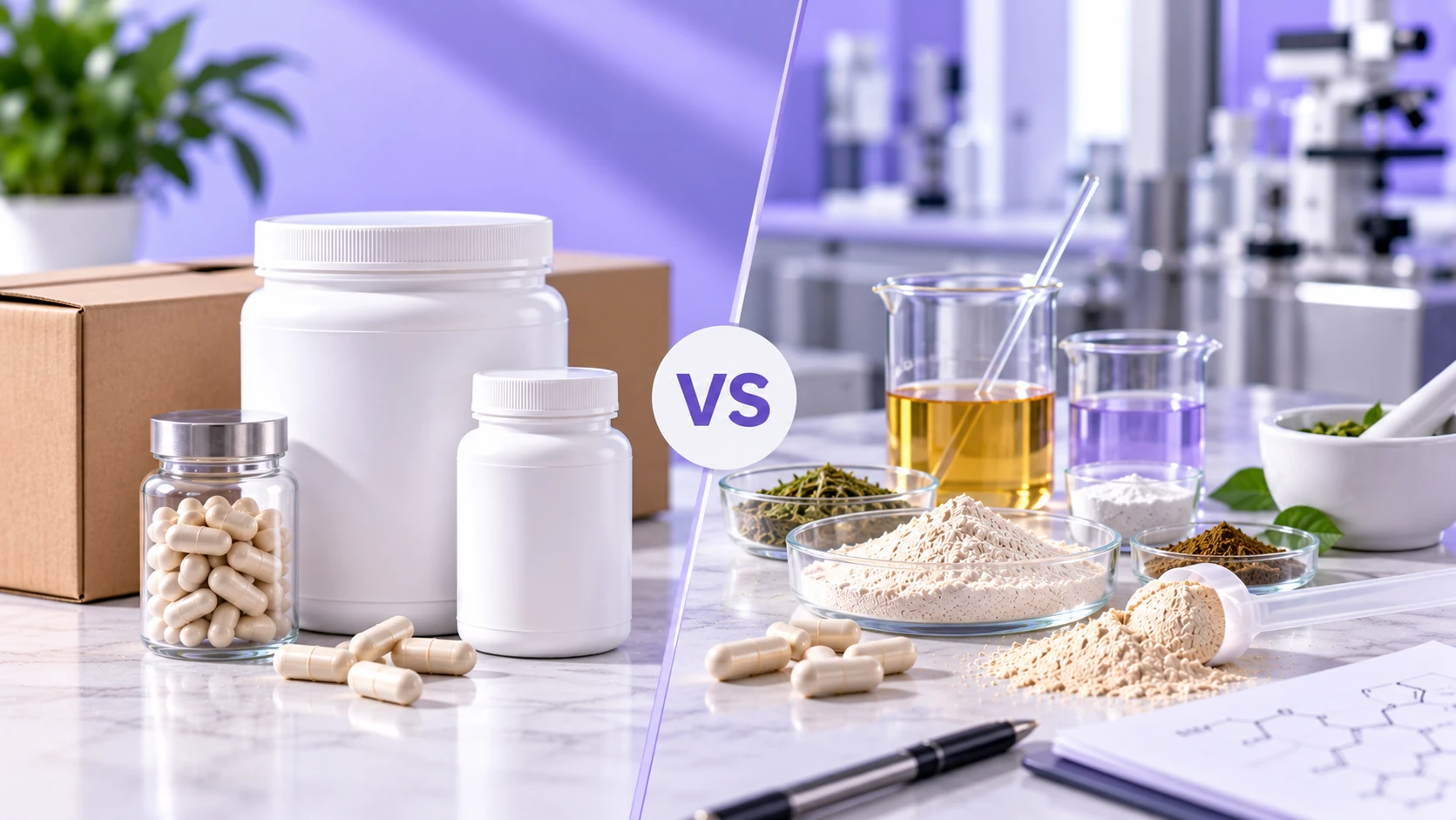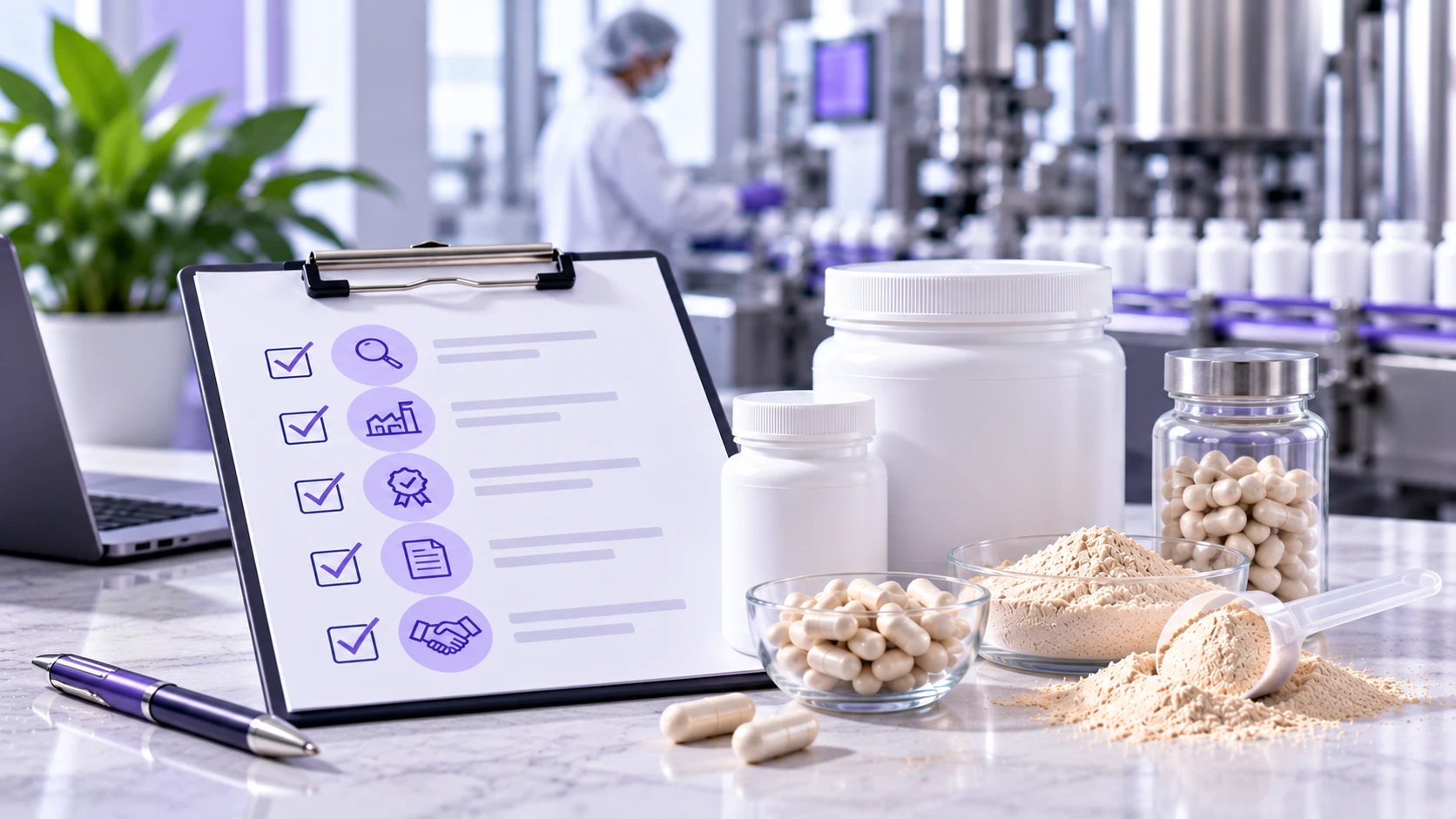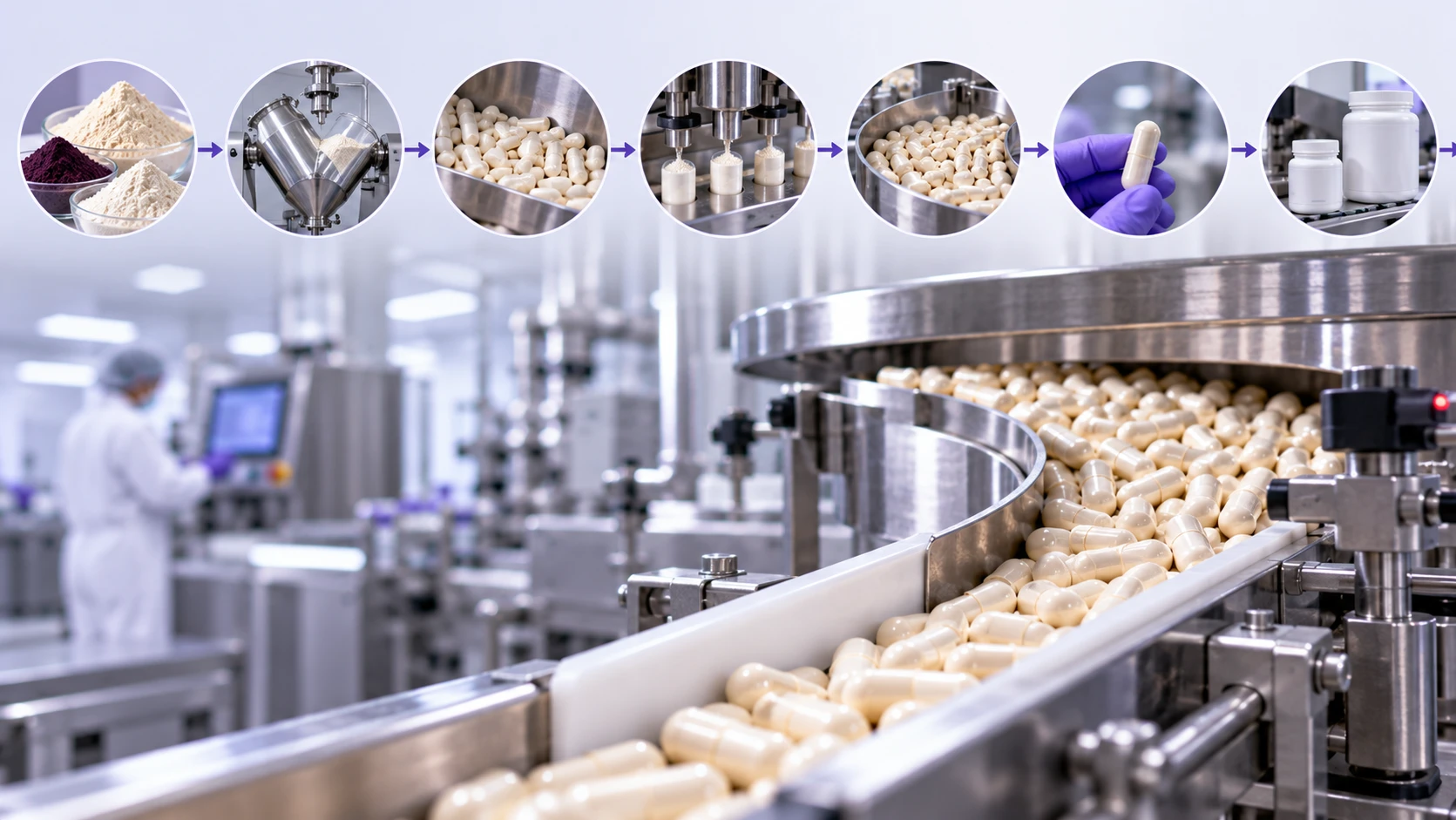

The capsule manufacturing process is the controlled sequence of formulation, blending, encapsulation, inspection, packaging and testing that turns raw ingredients into dose-accurate capsules. In dietary supplements, every stage runs under FDA 21 CFR Part 111. This guide covers all nine steps, the equipment, the shell science, the defects and the quality controls that decide whether a batch ships.
KEY TAKEAWAYS
- The capsule manufacturing process has nine stages: formulation, sourcing and testing, blending, shell preparation, encapsulation, polishing, inspection, packaging and release testing.
- Blend flow and uniformity decide fill accuracy. Most capsule defects start in the blender, not on the filling machine.
- Hard capsule shells are gelatin or plant-based HPMC. Shell choice follows the formula and the label claim.
- FDA 21 CFR Part 111 governs every stage of supplement capsule production. NSF/ANSI 455-2 verifies it.
- Capsules fit precise dosing, taste masking and stable shelf life. High-dose formulas fit powders better.
What Is the Capsule Manufacturing Process?
The capsule manufacturing process converts blended powders, granules or pellets into measured doses sealed inside a shell. A two-piece capsule has a body and a cap. A machine fills the body, then locks the cap on. The cycle repeats at high speed under tight weight control.
Capsule manufacturing for supplements follows the same discipline as pharmaceutical production. The rulebook differs. Supplements follow Part 111. Drugs follow Part 211. Both demand written procedures, trained operators and traceable batches.
What Is a Hard Capsule?
A hard capsule is a two-piece dosage form that holds dry fill inside a dissolvable shell. Shells are made from gelatin or from hydroxypropyl methylcellulose (HPMC). Hard capsules hold powders, granules and pellets.
What Does Capsule Supplement Manufacturing Include?
Capsule supplement manufacturing covers the full chain from ingredient testing to labeled bottles. A contract capsule manufacturer runs formulation support, blending, filling, packaging and release testing under one quality system. The brand owns the formula, the label and the market.
What Are the Steps in the Capsule Manufacturing Process?
There are nine steps: formulation, ingredient sourcing and testing, blending or granulation, shell preparation, encapsulation, polishing and dedusting, in-process inspection, packaging and labeling, and finished product release. Each step carries written specifications. A failure at any step holds the batch.
| Step | What Happens | Primary Control |
|---|---|---|
| 1. Formulation | Dose, excipients, shell and size are set | Finished Product Specification (FPS) |
| 2. Sourcing and testing | Raw materials are verified on receipt | Identity testing, COAs |
| 3. Blending or granulation | Ingredients are mixed to uniformity | Blend uniformity sampling |
| 4. Shell preparation | Empty shells are inspected and loaded | Size, color and defect checks |
| 5. Encapsulation | Fill is metered into shells and locked | Fill weight checks |
| 6. Polishing and dedusting | Surface powder is removed | Cleanliness and yield checks |
| 7. In-process inspection | Samples are weighed and tested | Weight variation, disintegration |
| 8. Packaging and labeling | Capsules are bottled, sealed, labeled | Label reconciliation |
| 9. Release testing | Finished lots are tested and approved | Quality unit sign-off |
What Does a Capsule Manufacturing Process Flow Chart Look Like?
A capsule manufacturing process flow chart runs left to right through nine gated stages. Each arrow marks a quality checkpoint. Material moves forward only after the prior step passes specification.
Raw material receipt → Identity and potency testing → Dispensing → Blending → Blend sampling → Encapsulation → Polishing and sorting → Weight and visual checks → Bottling and labeling → Release testing → Shipment
Rejected material exits at any gate. Reprocessing requires documented approval from the quality unit.
How Does Formulation Set Up the Capsule Process?
Formulation sets the dose per capsule, the excipients, the shell type and the capsule size. These choices determine whether production runs cleanly. A formula that flows poorly or exceeds shell volume cannot be corrected at the filling stage.
What Are Pre-Formulation Studies?
Pre-formulation studies test how ingredients behave before production. They cover particle size, bulk density, moisture and compatibility between actives and excipients. Chemists screen for reactions that degrade potency over shelf life. Early testing prevents failed scale-up runs.
How Do You Choose a Capsule Size?
Capsule size follows fill volume. Sizes run from 5 (smallest) to 000 (largest). Size 00 is the most common in supplements and holds roughly 0.9 mL. Fill weight comes from tapped density, not from estimation. Dense botanical powders and light powders fill the same shell to very different weights.
What Are Excipients and Why Do They Matter?
Excipients are non-active ingredients that improve flow, reduce sticking and fill remaining space. Common examples include rice flour, microcrystalline cellulose and magnesium stearate. Each one appears on the label and in the FPS.
Gelatin or HPMC: Which Shell Is Right?
Gelatin shells are animal-derived and lower in cost. HPMC shells are plant-based and suit vegan and vegetarian claims. HPMC also tolerates lower moisture, which helps hygroscopic fills.
| Factor | Gelatin | HPMC |
|---|---|---|
| Source | Animal collagen | Plant cellulose |
| Label claim | Not vegetarian | Vegan, vegetarian |
| Moisture sensitivity | Needs controlled humidity | Lower moisture needs |
| Cost | Lower | Higher |
| Best for | Conventional formulas | Plant-based brands, moisture-sensitive fills |
How Are Empty Capsule Shells Made?
Empty shells are made by dip molding. Stainless steel pins are dipped into a warm gelatin or HPMC solution, rotated to spread an even film, then dried under controlled temperature and humidity. The dried shells are stripped, trimmed to length and joined into closed pairs.
Supplement manufacturers buy finished shells from specialist producers. The shell supplier provides a certificate of analysis for each lot. The manufacturer inspects size, color, brittleness and deformation before loading.
How Are Raw Materials Sourced and Tested?
Raw materials come from qualified suppliers and are tested on receipt. Part 111 requires identity testing for every dietary ingredient. Facilities also review certificates of analysis (COAs) and hold material in quarantine until release.
Testing covers identity, and where required, potency, heavy metals and microbial limits. Material that fails never reaches the blending room.
How Does Blending Affect Capsule Quality?
Blending determines whether every capsule receives the same dose. A uniform blend produces steady fill weights and consistent potency. A poor blend segregates, with heavy and light particles separating during transfer.
What Equipment Is Used for Blending?
Most capsule blends run in V-blenders, ribbon blenders or bin blenders. Mixing time, load size and loading sequence are validated. Low-dose actives are pre-mixed into a portion of the carrier before the final blend.
When Is Granulation Used?
Granulation improves flow in powders that will not fill evenly. Wet granulation adds a liquid binder, then dries and mills the granules. Dry granulation compacts powder without liquid, which protects moisture-sensitive and heat-sensitive ingredients. Granulation adds a step and a validation burden. Manufacturers use it only when flow demands it.
Why Does Flowability Matter?
Flowability is how freely powder moves into the filling machine. Poor flow causes fill weight swings. Flow aids and granulation correct it. Technicians measure flow with angle of repose and Carr’s index.
How Does the Capsule Filling Process Work?
The capsule filling process orients empty shells, separates body from cap, fills the body with a measured dose and closes the shell. Industrial encapsulators run from a few thousand to several hundred thousand capsules per hour, depending on model. Makers such as Bosch, IMA and ACG build the common platforms.
The core stations run in this order:
- Loading. Empty shells feed from a hopper.
- Orientation. Shells align body down.
- Separation. Vacuum pulls the body from the cap.
- Filling. The machine meters the dose into the body.
- Closing. The cap rejoins the body and locks.
- Ejection. Filled capsules exit for polishing.
What Is the Difference Between Dosator and Tamping Pin Filling?
Two mechanisms dominate industrial filling:
- Tamping pin machines compress powder into plugs, then drop the plug into the body. They suit free-flowing and moderately sticky blends.
- Dosator machines draw powder into a nozzle, compress it and eject the plug. They offer high speed and tight control.
Formula behavior, batch size and target speed decide the choice.
Can Capsules Hold Pellets and Liquids?
Hard capsules hold powders, granules and pellets. Liquid-filled hard capsules need specialized sealing equipment. Brands with liquid-dose needs usually move to a liquid format instead. WB Blends produces capsules, powders and liquids.
What Is Capsule Band Sealing?
Band sealing applies a thin liquid band around the cap-body joint. It improves tamper resistance and prevents leakage. Most supplement capsules lock mechanically and skip banding.
What Happens After Filling: Polishing, Sorting and Inspection?
After filling, capsules are polished to remove surface powder, then sorted to cull defects. Metal detection and visual inspection follow. In-process checks sample capsules at set intervals and weigh them against specification.
Why Are Capsules Polished?
Polishing removes dust that clings to the shell. A rotating brush chamber and vacuum dedusting clean the surface. Clean capsules look uniform, pack cleanly and avoid cross-contamination in the packaging area.
How Is Weight Variation Controlled?
Operators pull samples at set intervals and weigh them. Results are compared with fill weight limits in the master manufacturing record. An out-of-range result triggers adjustment and investigation. USP general chapter <2091> sets the weight variation framework for dietary supplements.
What Is Disintegration Testing?
Disintegration testing confirms the capsule breaks apart within a set time under test conditions. USP <2040> describes the method for dietary supplements. It verifies the shell and fill release as designed.
What Are Common Capsule Defects and Their Fixes?
Most defects trace to flow, humidity or machine settings. Fixing the root cause beats adjusting the output.
| Defect | Typical Cause | Fix |
|---|---|---|
| Weight variation | Poor powder flow, wrong tamping force | Adjust lubricant, flow aid or machine speed |
| Open or split capsules | Low locking pressure, brittle shells | Reset locking, correct room humidity |
| Powder leakage | Overfill, wrong shell size | Resize shell or reduce fill weight |
| Dented or deformed shells | Vacuum imbalance, worn parts, heat exposure | Service tooling, control storage temperature |
| Sticking to tamping pins | Insufficient lubrication | Adjust lubricant level |
| Brittle or soft shells | Humidity out of range | Control room and storage conditions |
How Does Humidity Affect Capsule Production?
Humidity controls shell behavior. Hard gelatin shells hold roughly 13 to 16 percent water. Dry rooms make shells brittle. Humid rooms make them soft and sticky. Facilities commonly hold capsule rooms near 40 to 55 percent relative humidity. Warm storage also deforms shells so they no longer feed through the machine.
How Are Capsules Packaged and Labeled?
Capsules are counted, bottled, sealed, labeled and cased under controlled conditions. Desiccants, induction seals and tamper-evident closures protect stability. Label reconciliation counts every label issued against every label used, so no mislabeled bottle leaves the floor.
Packaging is a design decision. Bottle size, count, closure and label content affect shelf appeal, shipping cost and compliance. Standard container formats run on automated lines. Unusual containers force manual steps and raise cost and lead time.
What Quality Standards Govern Capsule Manufacturing?
Capsule manufacturing in the United States follows FDA 21 CFR Part 111, the current good manufacturing practice rule for dietary supplements. It requires written procedures, qualified personnel, validated processes and complete batch records. A quality unit holds authority to approve or reject every lot.
Third-party certification adds verification. WB Blends holds NSF/ANSI 455-2 GMP certification, an audit-based standard for dietary supplement manufacturing. Certification gives brand owners proof of compliance that retailers and distributors request.
What Finished Product Tests Are Required?
Part 111 requires specification testing on finished batches or a documented scientific rationale for reduced testing. Typical panels cover identity, potency, heavy metals and microbial limits. Content uniformity confirms each capsule carries the labeled dose. Stability testing sets shelf life under defined storage conditions. Results enter the batch record before release.
What Is a Finished Product Specification?
A Finished Product Specification (FPS) is the controlling document for a product. It lists ingredients, fill weight, capsule size, test methods and acceptance limits. Brand and manufacturer both sign it before production begins.
Why Does Documentation Decide Compliance?
Documentation proves the process ran as written. An undocumented fill weight adjustment is a Part 111 violation even when the product tests clean. Operators record every setting change, deviation and sample in the batch record. Equipment is qualified before commercial use, with installation, operational and performance qualification (IQ, OQ, PQ).
How Do Capsules Compare With Other Supplement Formats?
Capsules offer precise dosing, long shelf life and a neutral taste. Powders offer higher dose capacity and flexible serving. Liquids offer fast delivery and suit users who avoid pills. WB Blends produces all three formats.
| Factor | Capsules | Powders | Liquids |
|---|---|---|---|
| Dose precision | High | Moderate | Moderate |
| Dose capacity per serving | Limited by shell volume | High | Moderate |
| Taste masking | Excellent | Requires flavoring | Requires flavoring |
| Shelf stability | Strong | Strong | Requires preservation design |
| Best for | Convenience, clean labels | High-dose formulas | Fast delivery, pill-averse users |
What Are the Limits of Capsules?
Capsules cap the dose per unit. A size 00 capsule rarely holds more than about 700 to 900 mg of typical blend. High-dose products need several capsules per serving or a powder format. Hygroscopic ingredients can soften shells without proper formulation.
Why Are Capsules Growing as a Supplement Format?
Capsules are gaining share because consumers want convenience and brands want dose control. Fortune Business Insights projects the global vitamins and supplements market to grow from $154.98 billion in 2024 to $250.81 billion by 2032, a 6.2 percent compound annual rate. SPINS data from September 2024 puts capsules at 10.2 percent of supplement delivery by dollar share, up 2 percent year over year. Plant-based capsules hold 4.5 percent and grew 3.3 percent.
Demand for plant-based shells and clean labels keeps pushing HPMC volume up.
What Innovations Are Changing Capsule Manufacturing?
Three shifts are reshaping capsule production: automation, plant-based shells and digital process monitoring. Automated filling reduces operator variation. Real-time weight monitoring catches drift before it becomes a deviation. Eco-friendly and plant-based shell materials answer sustainability demand from brands and buyers.
How Long Does the Capsule Manufacturing Process Take?
Timelines vary with formulation status, ingredient lead times and testing. A new formula moves through specification, sourcing, pilot run, production and release. Established formulas with stocked materials move faster. A manufacturer gives a firm timeline after reviewing the FPS and ingredient list.
What Should Brands Ask a Contract Capsule Manufacturer?
Brands should verify six points before signing:
- Certification. Ask for current NSF/ANSI 455-2 or equivalent documentation.
- Minimum order quantities (MOQ). Confirm batch minimums match launch volume.
- Testing protocol. Request the finished product test panel.
- Formulation support. Confirm help with flow, sizing and shell selection.
- Storage and handling. Confirm temperature and humidity control for shells and finished goods.
- Scope of service. Confirm tolling (you supply materials) versus turnkey (they source everything).
FAQs
What is the capsule manufacturing process in simple terms?
It is the controlled sequence of blending ingredients, filling them into shells, inspecting output and testing finished lots. Each step follows written procedures under FDA 21 CFR Part 111.
How are capsules made?
Empty shells are dip-molded from gelatin or HPMC. Manufacturers fill those shells with a tested, blended formula on an encapsulation machine. Capsules are then polished, inspected, packaged and tested before release.
What is the hard gelatin capsule manufacturing process?
Shell makers dip steel pins in gelatin solution, dry the film, strip and trim the shells and join them in pairs. A supplement manufacturer fills the shells with powder or granules and locks them closed.
What machines are used in the capsule filling process?
Manufacturers use tamping pin or dosator encapsulators. Supporting equipment includes V-blenders, polishers, sorters and metal detectors.
What is the difference between tolling and turnkey capsule manufacturing?
Tolling means the brand supplies the ingredients and the manufacturer runs production. Turnkey means the manufacturer sources materials, produces and packages the product.
Are HPMC capsules better than gelatin capsules?
Neither wins in every case. HPMC suits plant-based claims and moisture-sensitive fills. Gelatin costs less and suits conventional positioning.
How is capsule quality verified?
Through in-process weight checks, disintegration testing, identity and potency testing, and quality unit review of the batch record.