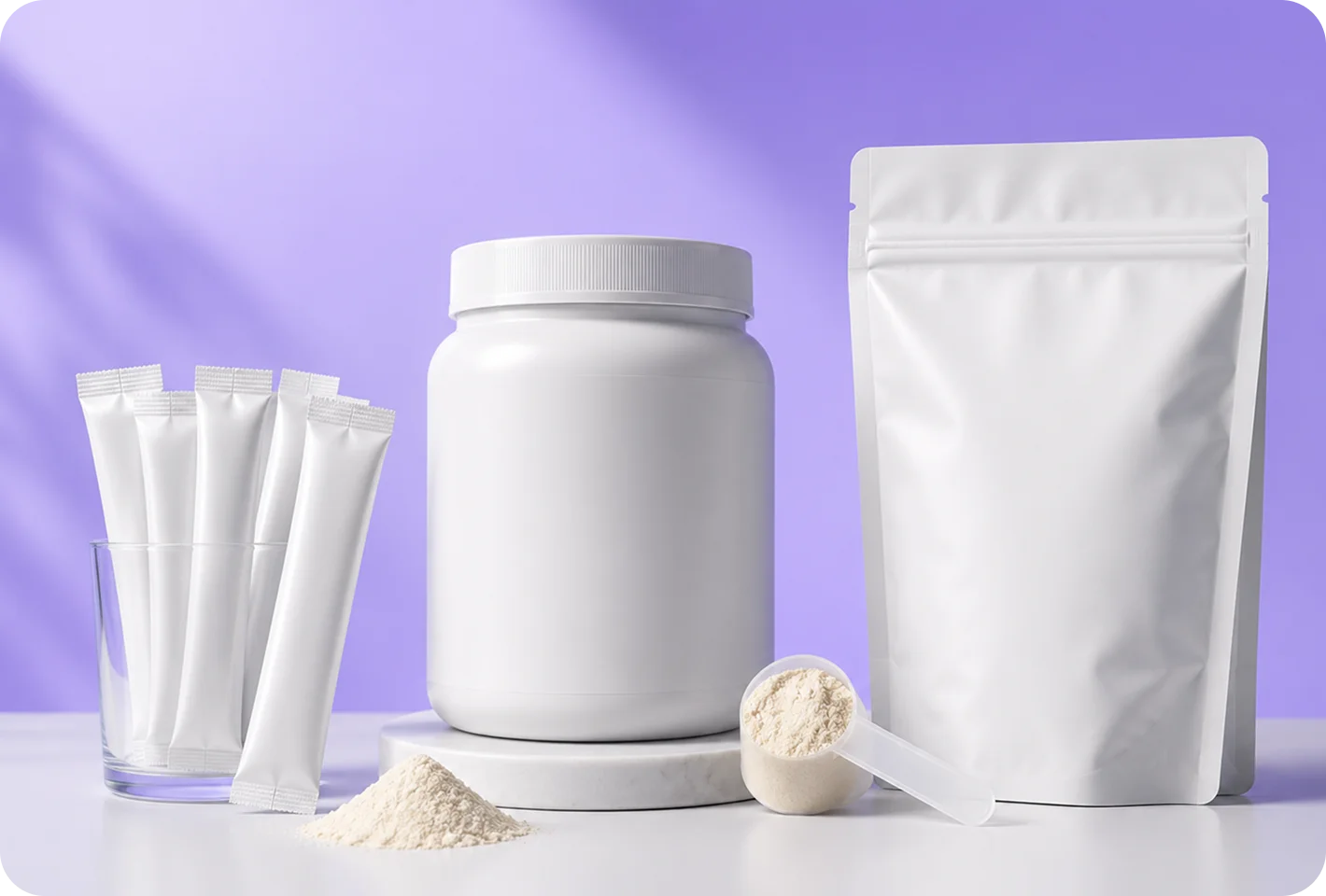

Stick packs, canisters, and gusset bags are the three primary packaging formats for supplement powders. Canisters offer the strongest shelf presence and perceived value for multi-serving products. Stick packs deliver single-serve portability ideal for on-the-go use. Gusset bags provide cost-efficient, sustainability-friendly packaging for bulk and value products. The right format depends on how your customer buys and uses the product.
This guide compares all three across cost, shelf appeal, dosing, portability, and sales channel so you can match packaging to your product and your market.
Key Takeaways
- The three primary powder packaging formats are stick packs, rigid canisters, and gusset bags each suited to a different use case and sales channel.
- Canisters win on shelf presence and perceived value, making them the default for retail-focused multi-serving products.
- Stick packs win on portability and single-serve convenience, ideal for on-the-go and trial-driven products.
- Gusset bags win on cost efficiency and sustainability perception, suiting bulk and value-positioned products.
- The right format depends on serving structure, sales channel, price point, and how the consumer uses the product.
What Are the Main Powder Packaging Formats?
The main powder packaging formats for supplements are rigid canisters, single-serve stick packs, and flexible gusset bags. Each format changes the product’s cost structure, shelf footprint, dosing method, and consumer experience. Choosing the right one is a positioning decision as much as a packaging one.
- Canisters – rigid jars (HDPE or PET) holding multiple servings
- Stick packs – single-serve sachets dosed for one use
- Gusset bags – flexible stand-up pouches with expandable bottoms for higher volume
All three are available through WB Blends, with canisters and jars produced in-house and stick packs and gusset bags offered through established partner relationships.
What Are Powder Canisters?
Powder canisters are rigid jars typically HDPE or PET that hold multiple servings of a supplement powder, measured out by the consumer with an included scoop. They’re the dominant format in retail supplement aisles because of their shelf presence and perceived value.
Advantages of Canisters
- Strong shelf presence – rigid form holds its shape and commands attention on shelf
- High perceived value – a substantial canister reads as a premium, full-size product
- Generous label real estate – room for branding, claims, and supplement facts
- Durable and resealable – protects powder and supports repeated use
Limitations of Canisters
- Higher freight cost – rigid containers take up more space and weight in transit
- Less portable – not designed for on-the-go single servings
- More packaging material – larger footprint than flexible alternatives
Canisters are the default for multi-serving retail products pre-workouts, protein blends, greens powders where shelf impact and perceived value drive the purchase.
What Are Stick Packs?
Stick packs are narrow, single-serve sachets that hold one pre-measured dose of supplement powder. They’ve become the go-to format for portability, trial sizing, and convenience-driven products that consumers take on the go.
Advantages of Stick Packs
- Single-serve convenience – one pre-measured dose, no scooping or measuring
- Highly portable – fits in a pocket, bag, or gym kit
- Built-in portion control – eliminates dosing guesswork
- Trial and sampling potential – low-commitment format for first-time buyers
Limitations of Stick Packs
- Higher per-serving cost – individual packaging costs more than bulk formats
- More packaging waste per serving
- Limited label space – small surface for branding and claims
Stick packs suit on-the-go products, electrolyte and hydration mixes, single-serve protein, and DTC brands using sampling to convert first-time buyers.
What Are Gusset Bags?
Gusset bags are flexible stand-up pouches with expandable side or bottom panels that allow them to hold larger powder volumes while standing upright. They’re a cost-efficient, lightweight alternative to rigid canisters, often positioned as the sustainable choice.
Advantages of Gusset Bags
- Lower cost – less material and lower freight weight than canisters
- Sustainability perception – flexible packaging often reads as eco-friendlier
- Space-efficient – lighter and more compact in transit and storage
- High volume capacity – expandable design holds bulk quantities
Limitations of Gusset Bags
- Lower perceived premium value than rigid canisters
- Less shelf rigidity – can sag or shift on shelf compared to canisters
- Resealing dependent on closure – requires a quality zip or seal for repeat use
Gusset bags suit bulk and value-positioned products, refill formats, and brands leaning into a sustainability story.
Stick Packs vs. Canisters vs. Gusset Bags: Comparison Table
The table below maps each format against the factors that drive packaging decisions.
| Factor | Canisters | Stick Packs | Gusset Bags |
|---|---|---|---|
| Serving structure | Multi-serve | Single-serve | Multi-serve / bulk |
| Shelf presence | Strongest | Moderate | Moderate |
| Perceived value | High | Moderate | Lower |
| Portability | Low | Highest | Low |
| Cost per unit | Higher | Highest per serving | Lowest |
| Freight efficiency | Lower | Moderate | Highest |
| Best channel | Retail | DTC / on-the-go | Bulk / value retail |
| Best for | Pre-workout, protein, greens | Hydration, single-serve, trials | Bulk, refills, eco-positioned |
How Do You Choose the Right Powder Packaging Format?
Powder packaging selection follows four questions: how is the product dosed, where is it sold, what’s the price point, and how does the customer use it? Answering them in order points to the right format.
Step 1: Define the Serving Structure
If your product is multi-serving and measured by scoop, canisters or gusset bags fit. If it’s single-serve and pre-dosed, stick packs are the answer. Serving structure is the first filter.
Step 2: Match Format to Sales Channel
Retail shelves reward canisters’ presence and perceived value. DTC and on-the-go positioning reward stick packs’ portability. Value and bulk channels reward gusset bags’ cost efficiency. Where you sell shapes what wins.
Step 3: Align With Your Price Point
A premium product loses credibility in a budget pouch; a value product erodes margin in an oversized canister. Match the packaging cost and perceived value to the shelf you’re competing on.
Step 4: Consider How the Customer Uses It
A pre-workout consumed at home suits a canister. A hydration mix taken to the gym suits a stick pack. A bulk protein refill suits a gusset bag. Design packaging around the moment of use.
Can You Offer the Same Product in Multiple Formats?
Yes. Many brands run the same powder across multiple formats a canister for the retail and primary purchase, stick packs for trials and on-the-go, and a gusset bag for a bulk or refill option. Offering multiple formats lets a single formula serve different channels and customer needs.
This multi-format approach is common among brands selling across Amazon, DTC stores, and major retailers, where each channel rewards a different package.
How Does Packaging Format Fit Into Powder Manufacturing?
Powder packaging format is finalized during the Finished Product Specification (FPS) stage, part of our manufacturing process, alongside formula, label, and palletization details.. Format choice affects bottling line setup and component sourcing but is locked in before production begins.
WB Blends produces powder blends with blending capacity around 200,000 kg/month and powder bottling capacity of roughly 600,000 jars/month. Canisters and jars (HDPE and PET) are produced in-house; stick packs and gusset pouches are offered through established partner relationships. Format-specific lead times and capabilities are confirmed at quoting.
What Powder Packaging Does WB Blends Offer?
WB Blends offers powder packaging across rigid canisters and jars (HDPE and PET), gusset pouches, sachets, and stick packs, supporting both multi-serving and single-serve products. Both turnkey and tolling manufacturing models are available WB Blends can source ingredients and packaging or process and bottle brand-supplied materials.
Every powder project includes a Finished Product Specification and full lab testing of finished products for heavy metals, microbiological contaminants, identity, and potency before shipment.
FAQs
What is the best packaging for supplement powder?
There’s no single best format. Canisters are best for retail and perceived value, stick packs for single-serve portability, and gusset bags for cost-efficient bulk and value products. The best choice depends on your serving structure, sales channel, and price point.
Are stick packs more expensive than canisters?
Stick packs typically cost more per serving than canisters because each serving is individually packaged. Canisters spread packaging cost across many servings, lowering per-serving cost but stick packs add convenience and portion control that can justify the premium.
What’s the difference between a gusset bag and a stand-up pouch?
A gusset bag is a type of stand-up pouch with expandable side or bottom panels (gussets) that let it hold more volume while standing upright. The gusset is what gives the pouch its capacity and stability for higher-volume powder products.
Which powder packaging is most sustainable?
Flexible formats like gusset bags and stick packs generally use less material by weight than rigid canisters and are lighter to ship, which can reduce freight emissions. Perceived sustainability depends on the specific materials and recyclability of each format.
Can I sell the same powder in both canisters and stick packs?
Yes. Many brands offer the same formula in multiple formats to serve different channels canisters for retail, stick packs for on-the-go and trials. A single formula can be packaged across formats to match how and where customers buy.
Match the Format to the Shelf
Powder packaging isn’t just a container it signals value, dictates how the product is used, and determines which shelf it competes on. Canisters command retail presence. Stick packs travel. Gusset bags stretch margins and lean sustainable. The format that wins is the one that fits how your customer buys and uses the product.
WB Blends manufactures powder products across canisters, jars, gusset pouches, sachets, and stick packs with in-house blending and bottling, finished product specifications, and full lab testing on every run.
Deciding on a powder format? Request a Quote or explore our powder manufacturing capabilities.