
A contract manufacturer for supplements is a third-party facility that formulates, produces, and packages dietary supplements for another company’s brand. The brand owns the product, the label, and the customer. The manufacturer owns the equipment, the production process, and the quality systems behind it.
The model separates brand building from manufacturing. A brand does not need a plant to sell a supplement. It needs a qualified partner that runs one.
KEY TAKEAWAYS
- A contract manufacturer for supplements formulates, produces, and packages your product under your brand name.
- A co-packer fills and packs finished product. A contract manufacturer does more.
- Tolling means you supply the inputs. Turnkey means the manufacturer sources them.
- FDA holds the brand owner responsible for cGMP compliance. You cannot contract that away.
- Verify certifications, quality systems, and format capability before you sign a quality agreement.
How Does Supplement Contract Manufacturing Work?
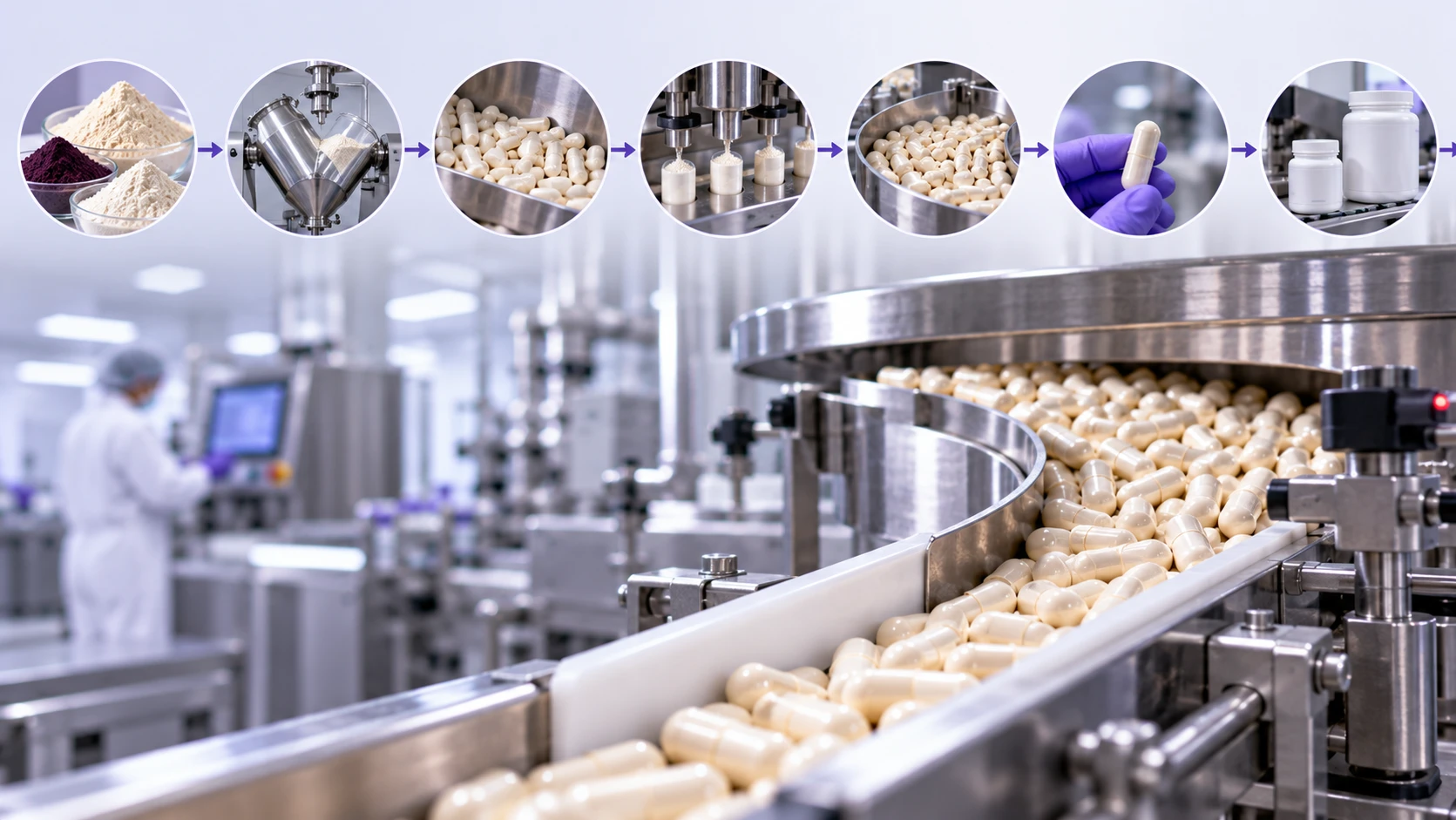
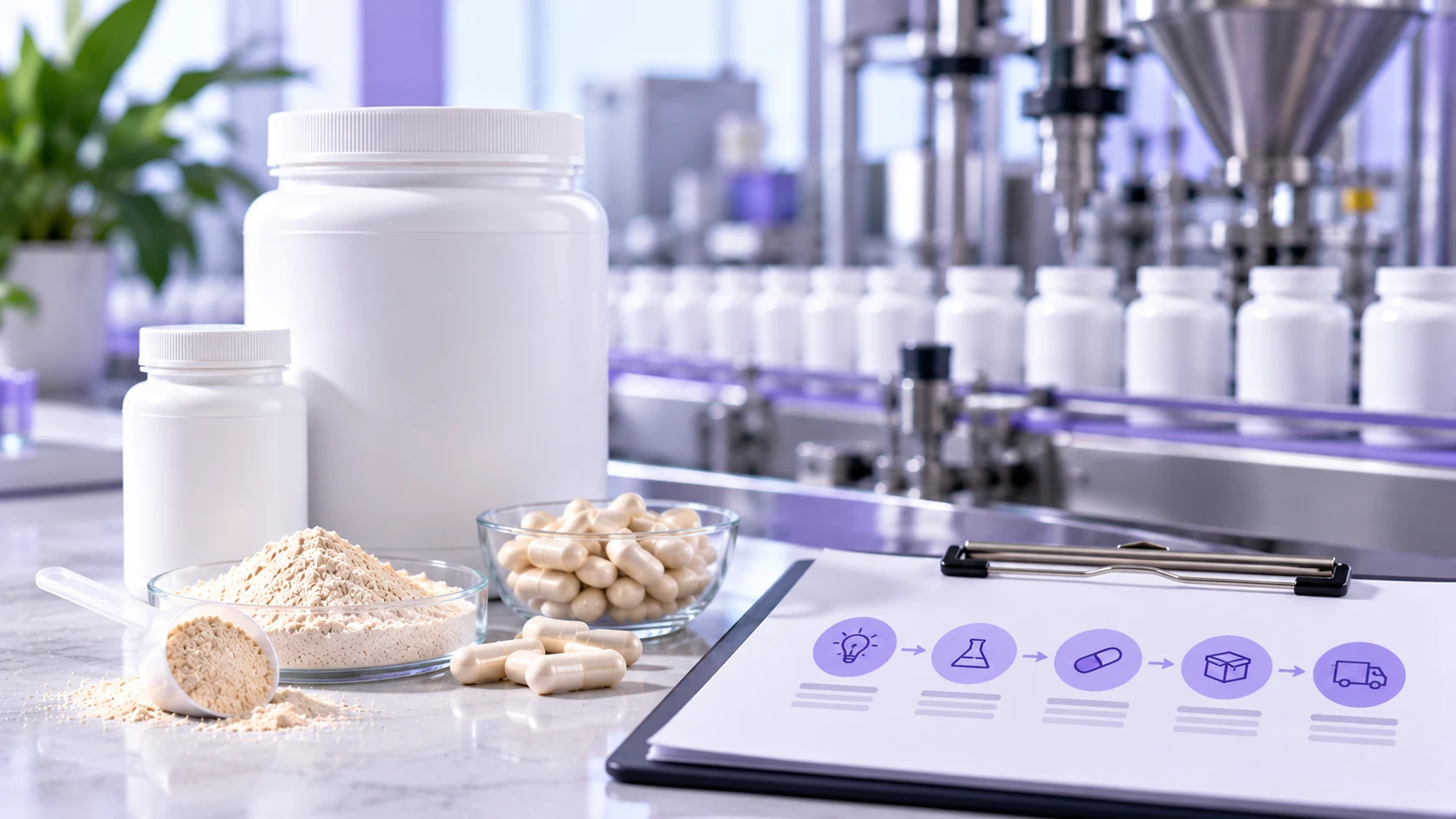
Supplement contract manufacturing moves a product from concept to finished goods in defined stages. The brand supplies the idea or formula. The manufacturer handles production under written procedures and returns packaged product ready for distribution.
The standard sequence runs as follows:
- Discovery. The brand shares its concept, target format, and volume expectations.
- Formulation. The manufacturer develops or reviews the formula and confirms it can be produced.
- Specification. Both parties lock a Finished Product Specification (FPS) covering identity, strength, and composition.
- Quote and agreement. Pricing, minimum order quantity (MOQ), and a quality agreement are signed.
- Sourcing and testing. Raw materials are purchased and tested on arrival.
- Production. The batch is made under a master manufacturing record.
- Release and ship. Quality control reviews the batch record and releases the lot.
Each stage creates a document. Those documents are your evidence of control.
What Does the Brand Provide?
The brand provides the product concept, the brand identity, and the regulatory strategy for its claims. Label content and marketing claims stay with the brand. The manufacturer produces what the specification describes.
What Does the Manufacturer Provide?
The manufacturer provides facilities, equipment, trained staff, and a quality unit. It runs incoming material testing, in-process checks, and batch documentation. A strong partner also advises on format, excipients, and scalability.
What Is the Difference Between a Contract Manufacturer and a Co-Packer?
A contract manufacturer produces the supplement. A co-packer packages it. Contract manufacturers blend, encapsulate, or fill. Co-packers take finished product and fill containers, seal, label, and box it. Many suppliers do both, and the terms overlap in daily use.
The practical difference is scope. A co-packer starts with finished product. A contract manufacturer starts with raw materials.
| Attribute | Contract Manufacturer | Co-Packer |
|---|---|---|
| Core function | Produces the supplement | Packages finished product |
| Starting point | Formula and raw materials | Finished bulk product |
| Formulation support | Often included | Rarely included |
| Quality scope | Full cGMP production controls | Packaging and labeling controls |
| Best fit | Launching or reformulating a product | Adding packaging capacity |
“Co-packing” often appears in supplier descriptions as a catch-all. Confirm the actual scope in writing.
What Is the Difference Between Tolling and Turnkey Manufacturing?
Tolling and turnkey describe who supplies the materials. In tolling, the brand sources ingredients and the manufacturer processes them for a fee. In turnkey, the manufacturer sources ingredients, produces, and packages the finished product. Turnkey transfers more work and more coordination to the manufacturer.
| Factor | Tolling | Turnkey |
|---|---|---|
| Ingredient sourcing | Brand | Manufacturer |
| Supplier qualification | Brand-led | Manufacturer-led |
| Cost structure | Processing fee | All-in price |
| Control over inputs | High | Shared |
| Operational load on brand | High | Low |
| Best fit | Experienced brands with supply chains | New and growing brands |
Tolling suits brands with proprietary ingredients or established supply chains. Turnkey suits brands that want one accountable partner.
Who Is Legally Responsible for Compliance?
The brand owner and the manufacturer share responsibility. FDA treats the company that markets a supplement as ultimately accountable for cGMP compliance, even when a contract manufacturer makes the product. Outsourcing production does not outsource liability.
FDA’s dietary supplement cGMPs sit in 21 CFR Part 111. FDA published them in 2007 under the title Good Manufacturing Practice in Manufacturing, Packaging, Labeling, or Holding Operations for Dietary Supplements. FDA has stated repeatedly in warning letters to own-label distributors that a firm may contract out manufacturing operations but not its ultimate responsibility for compliance.
What Does That Mean in Practice?
Industry guidance points to four actions for the brand owner:
- Qualify every contract manufacturer before the first order.
- Audit the facility against Part 111 requirements.
- Establish a written quality agreement that defines each party’s duties.
- Employ staff who understand the regulation.
Part 111 requires specific records. Examples include specifications for finished batches (21 CFR 111.70), master manufacturing records (111.210), and batch production records (111.255). FDA warning letters cite missing versions of these records often.
What Formats Can a Supplement Contract Manufacturer Produce?
Formats depend on the facility’s equipment. The core formats in contract supplement manufacturing are capsules, powders, and liquids. Each has its own process, minimums, and stability considerations. Match the format to the ingredient, the dose, and the customer.
- Capsules. Suit precise dosing and portable use. Powder blends are filled into shells.
- Powders. Suit larger serving sizes and flavored drink mixes. Packaging includes stick packs, pouches, and tubs.
- Liquids. Suit tinctures, extracts, and fast-absorbing formats. Liquids demand stricter handling and stability controls.
WB Blends produces capsules, powders, and liquids. In August 2026, WB Blends announced a strategic partnership with Yellow Emperor, a cGMP-certified liquid manufacturer in Eugene, Oregon, to expand liquid capacity.
What Is MOQ and What Drives It?
MOQ is the minimum order quantity a manufacturer accepts for a production run. It exists because every run carries fixed costs: setup, cleaning, testing, and documentation. Format, formulation complexity, and packaging type move the number more than any other variables.
Three factors raise or lower MOQ:
- Batch economics. Equipment runs efficiently at set batch sizes.
- Ingredient minimums. Suppliers sell raw materials in fixed lot sizes.
- Packaging minimums. Custom containers and labels carry their own thresholds.
Ask for MOQ by format and by SKU. A single quoted number rarely applies to every product.
Contract Manufacturing vs. Private Label vs. In-House: Which Model Fits?
Contract manufacturing builds a custom product. Private label relabels an existing stock formula. In-house manufacturing means owning the plant. Each model trades control, speed, and capital differently. Contract manufacturing sits between private label and in-house on all three.
| Factor | Private Label | Contract Manufacturing | In-House |
|---|---|---|---|
| Formula | Stock, shared | Custom, owned by brand | Custom, owned by brand |
| Speed to market | Fastest | Moderate | Slowest |
| Capital required | Lowest | Moderate | Highest |
| Differentiation | Low | High | High |
| Compliance burden | Shared | Shared | Full |
| Control over process | Low | Moderate | Full |
Private label works for testing a market. Contract manufacturing works for building a defensible product. In-house production works at scale with capital and expertise to match.
How Do You Choose a Supplement Contract Manufacturer?
Choose on verifiable evidence, not sales claims. Check third-party certification, the quality system, format capability, communication, and documented compliance history. A qualified partner shares documents freely and welcomes audits.
Use this checklist:
- Third-party GMP certification. NSF/ANSI 455-2 is a recognized GMP standard for dietary supplements. WB Blends holds NSF/ANSI 455-2 GMP certification.
- FDA registration and inspection history. Ask about past observations and how they were closed.
- Testing capability. Confirm identity testing, heavy metals, and microbial testing, in-house or through qualified labs.
- Format fit. Confirm the manufacturer runs your format daily, not occasionally.
- Quality agreement. Insist on one before the first order.
- MOQ and lead times. Get both in writing by SKU.
- Formulation support. Confirm who owns the formula and the specifications.
- Communication. Ask who your point of contact is and how issues escalate.
- Audit access. Confirm you may audit on site.
Location matters too. A manufacturer closer to your fulfillment center shortens freight time and cost. WB Blends operates from Spanish Fork, Utah, with direct access to Western freight lanes.
What Are the Limits of Contract Manufacturing?
Contract manufacturing trades control for capacity. Brands depend on a partner’s schedule, quality, and financial health. Formula confidentiality needs contractual protection. MOQs can strain early cash flow. These limits are manageable with the right agreement.
Plan for these risks:
- Schedule dependence. Your run competes with other customers for equipment time.
- Quality dependence. A partner’s failure becomes your recall.
- Intellectual property. Use confidentiality terms and clear formula ownership clauses.
- Cash flow. MOQs tie up capital in inventory.
The mitigation is the same in every case: diligence before signing and documentation after.
FAQs
What is a contract manufacturer in the supplement industry?
A contract manufacturer is a third-party facility that produces supplements to a brand’s specifications. The brand sells the product under its own label. The manufacturer runs production, testing, and packaging under cGMP rules.
Is a co-packer the same as a contract manufacturer?
No. A co-packer packages finished product. A contract manufacturer produces the supplement from raw materials. Many companies offer both services. Confirm scope before you sign.
Who owns the formula in contract manufacturing?
Ownership depends on the agreement. Custom formulas developed for a brand are typically owned by the brand when the contract says so. Stock formulas belong to the manufacturer. Put ownership in writing before development starts.
Does using a contract manufacturer remove FDA liability?
No. FDA holds the brand owner accountable for ensuring its supplements comply with cGMP requirements. You must qualify your manufacturer, audit it, and keep a quality agreement on file.
What is the difference between tolling and turnkey?
Tolling means the brand supplies the ingredients and the manufacturer processes them. Turnkey means the manufacturer sources ingredients and delivers finished product. Turnkey places less sourcing work on the brand.
How do I know if a manufacturer is GMP compliant?
Request third-party certification, review FDA inspection history, and audit the facility. Certifications such as NSF/ANSI 455-2 provide independent verification of GMP practices.
How long does it take to launch a supplement with a contract manufacturer?
Timelines vary by formulation complexity, ingredient availability, testing, and packaging. Custom formulas take longer than stock formulas. Ask your manufacturer for a stage-by-stage schedule.