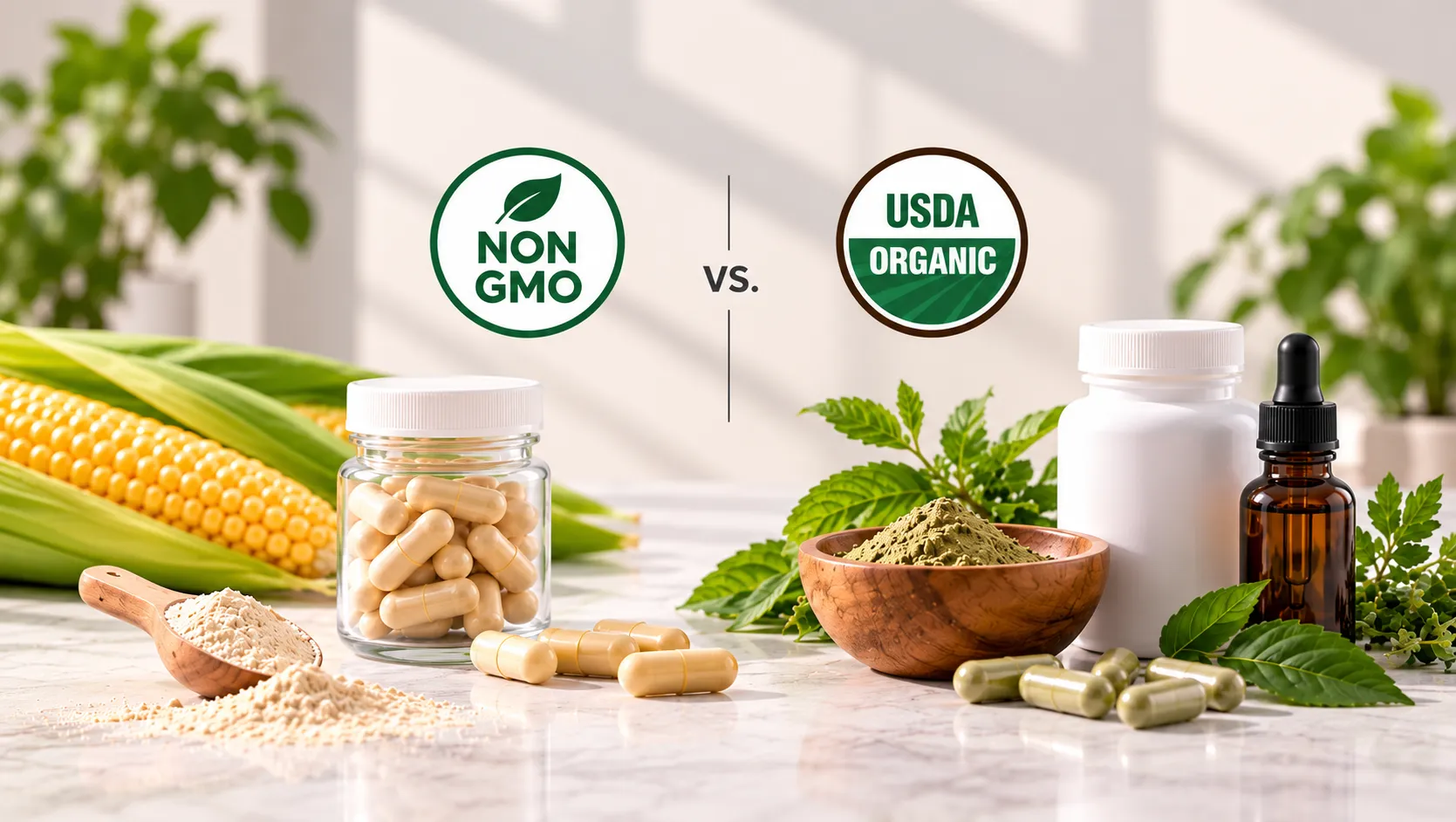

Non-GMO vs Organic is a comparison between two different claims, not two names for one. Non-GMO means a product avoids genetically engineered ingredients. Organic is a federally regulated production system that prohibits genetic engineering and also governs how ingredients are grown, handled and processed.
Organic products can carry a non-GMO claim. Non-GMO products are not organic by default. The gap between those two statements is where brands lose money, label approvals and customer trust.
KEY TAKEAWAYS
- Non-GMO means a product avoids genetically engineered ingredients. Organic is a federal production system that also prohibits genetic engineering.
- Organic covers more than GMOs: farming inputs, handling, processing and traceability. Non-GMO covers GMO avoidance only.
- Non-GMO Project Verified is private and testing-based, with a 0.9% action threshold. USDA Organic is government-regulated and process-based.
- Dietary supplements fall under the USDA bioengineered food disclosure standard, which has applied since January 1, 2022.
- Choose the claim before formulation. It decides your ingredient list, supplier pool, timeline and cost.
What is the difference between non-GMO and organic?
Non-GMO addresses one question: were the ingredients genetically engineered? Organic addresses the whole production system. It includes soil practices, approved inputs, handling, and supply chain records. Organic therefore makes a broader promise, and carries a heavier compliance load.
Think of non-GMO as a single-attribute claim. Organic is a system claim.
Scope of each claim
- Non-GMO: Ingredient origin. No genetically engineered inputs.
- Organic: Ingredient origin, farming methods, permitted substances, processing, handling and documentation.
Who sets the rules
USDA’s National Organic Program sets and enforces organic rules under 7 CFR Part 205. Non-GMO verification is a voluntary private program run by the Non-GMO Project. It is not a government standard.
What does non-GMO mean on a supplement label?
A non-GMO claim means the product, or its ingredients, were not produced from genetically engineered organisms. The claim is only as strong as the proof behind it. A brand can self-declare it from supplier documents, or earn the Non-GMO Project Verified seal through third-party review.
Self-declared vs Non-GMO Project Verified
A self-declared claim rests on your own substantiation. Supplier affidavits, specifications and internal records carry the weight. That is cheaper and faster. It is also easier to challenge.
The Non-GMO Project Verified seal requires independent evaluation. The Non-GMO Project assesses traceability, segregation, risk assessment, testing of high-risk inputs and quality control. Verification is maintained through annual audits.
What testing involves
High-risk inputs are crops with commercial GMO varieties, such as corn, soy and sugar beet. These ingredients must be tested. The Non-GMO Project applies a 0.9% action threshold, the same level that triggers mandatory GMO labeling in the European Union.
Testing happens at the ingredient level, not on the finished product. The Non-GMO Project states that finished-product testing is not a reliable measure of GMO presence. Animal-derived ingredients are assessed through their feed.
An action threshold is not a permission to include GMOs. Absence of GMOs remains the target of the standard.
What non-GMO does not cover
Non-GMO does not address pesticides, fertilizers or soil management. A non-GMO ingredient can be conventionally farmed. It does not promise “clean” or “natural” beyond GMO avoidance.
What does organic mean for supplements?
Organic means the agricultural ingredients were produced and handled under USDA National Organic Program rules. Those rules restrict synthetic pesticides and fertilizers, prohibit sewage sludge and irradiation, and prohibit genetic engineering. Certified operations are inspected and audited.
Organic labeling tiers
USDA recognizes four label categories:
| Category | Requirement |
|---|---|
| 100% Organic | All ingredients certified organic |
| Organic | At least 95% organic ingredients, excluding water and salt |
| Made with Organic Ingredients | At least 70% organic ingredients |
| Specific organic ingredients listed | Under 70%. No organic claim on the front panel |
Only the first two may use the USDA Organic seal.
Why organic is a process claim
Organic certification evaluates the system, not a test result. USDA lists genetic engineering as an “excluded method” under 7 CFR 205.105. USDA policy states that inadvertent GMO presence does not strip organic status when all organic requirements were followed. Organic therefore has no numeric GMO threshold. It relies on prevention.
Is organic non-GMO? Does organic mean non-GMO?
Yes, in standards terms. USDA prohibits genetically engineered ingredients in organic production and handling, so certified organic products meet that requirement by design. Organic ingredients are accepted as compliant with the Non-GMO Project Standard for minor ingredients under 5% of finished weight.
Two points need care. Organic is process-based, so it does not publish a testing threshold. And the Non-GMO seal is a separate certification. Many brands carry both because retailers and consumers recognize each independently.
Does non-GMO mean organic? Can a supplement be non-GMO but not organic?
Yes. Non-GMO verification looks only at GMO avoidance. A botanical powder from a conventionally farmed, non-GMO source can be non-GMO and still fail every other organic requirement.
This is the most common supplement scenario. Conventional ingredients are widely available in non-GMO form. Organic forms are narrower in supply and often longer in lead time.
Non-GMO vs organic: side-by-side comparison
| Factor | Non-GMO | Organic |
|---|---|---|
| Core promise | No genetically engineered ingredients | Defined production and handling system |
| Governing body | Non-GMO Project (private, voluntary) | USDA National Organic Program (federal) |
| Verification method | Ingredient risk review, testing, audits | Certification, inspection, audits |
| GMO threshold | 0.9% action threshold | Prohibited method, no numeric threshold |
| Pesticide rules | None | Most synthetic pesticides prohibited |
| Livestock rules | No animal welfare standards | Livestock standards apply, including no growth hormones or antibiotics |
| Documentation burden | Moderate to high | High |
| Typical sourcing | Wide supplier pool | Narrower, certified suppliers |
| Label signal | Seal or statement | USDA Organic seal |
Do supplements need a bioengineered disclosure?
Yes, when they contain bioengineered ingredients. The USDA National Bioengineered Food Disclosure Standard covers dietary supplements, and mandatory compliance began January 1, 2022. Qualifying products must carry a disclosure, such as text or the USDA bioengineered symbol.
This is a separate obligation from the voluntary non-GMO and organic claims. A product that avoids bioengineered ingredients avoids the disclosure. A product that includes them must disclose, regardless of marketing choices.
What label risk comes with each claim?
Each claim carries its own label risk. A non-GMO statement needs substantiation: supplier documents, specifications and testing records. An organic claim needs certification from a USDA-accredited certifier. An unsupported claim invites complaints and retailer rejection. Decide what proof you can hold before you print the claim.
Keep the claims separate
Do not use “organic” and “non-GMO” as synonyms in copy. They are different promises with different proof. Name the standard you meet.
How should a brand choose between non-GMO and organic?
Choose the claim your customer, channel and margin can support. Start with the buyer, then check ingredient availability, then price. Do not choose a claim after formulation. It changes which ingredients you can use.
Step 1: Define the buyer
Premium natural-channel shoppers often expect organic. Mainstream and value-focused buyers often respond to non-GMO alone.
Step 2: Check ingredient availability
Confirm that every key ingredient exists in the form you need. Organic forms of some botanicals are scarce or seasonal.
Step 3: Price the proof
Organic adds sourcing cost, documentation and audit scope. Non-GMO Project verification adds testing and annual review. Self-declared non-GMO costs least and carries the most challenge risk.
Step 4: Confirm retailer requirements
Some retailers set certification requirements for shelf placement. Confirm them before you lock the label.
Step 5: Decide on both
Dual claims serve brands that need to signal both GMO avoidance and agricultural standards. The cost is higher, and the supplier pool is the narrowest.
How do these claims affect powder, capsule and liquid manufacturing?
The claim follows the ingredient, and the ingredient follows the format. Certification adds requirements to supplier qualification, material segregation, cleaning, and records at every format.
Powders
Powder manufacturing concentrates ingredient risk. Blends carry many inputs, and every input needs documentation. Fewer ingredients make certification easier.
Capsules
In capsule manufacturing, shells count as ingredients. Confirm shell materials and excipients against your chosen claim before you commit.
Liquids
Liquid supplements depend on carriers, sweeteners and preservatives. Each can introduce a high-risk input. Review the full bill of materials.
Confirm your manufacturer’s certification status and segregation procedures before you build a launch plan around a claim. When you are ready to scope a formula, request a quote from WB Blends.
FAQs
Is non-GMO the same as organic?
No. Non-GMO addresses genetic engineering only. Organic is a regulated production system that also prohibits genetic engineering and adds rules on inputs, handling and records.
Is organic better than non-GMO?
Organic is broader, not automatically better for your product. It covers more criteria and costs more to maintain. The right claim depends on your buyer, ingredient availability and margin.
Can a product be both non-GMO and organic?
Yes. Many brands carry the USDA Organic seal and the Non-GMO Project Verified seal together. The combination signals GMO avoidance and agricultural standards.
Does USDA organic mean non-GMO?
Yes. USDA prohibits genetic engineering as an excluded method in organic production and handling. Certified organic products meet that requirement by design.
Does non-GMO mean pesticide-free?
No. Non-GMO verification does not restrict pesticides or fertilizers. Organic standards restrict most synthetic pesticides.
What is the 0.9% non-GMO threshold?
It is the Non-GMO Project’s action threshold for GMO content in ingredients that are ingested or applied to skin. It matches the European Union labeling trigger. It is an action level, not an allowance.
Do dietary supplements need a bioengineered label?
Yes, if they contain a bioengineered ingredient. The USDA disclosure standard applies to supplements and has been mandatory since January 1, 2022.
Does a “non-GMO” statement need proof?
Yes. Hold supplier documentation and testing records that support the claim. Third-party verification gives the strongest substantiation.