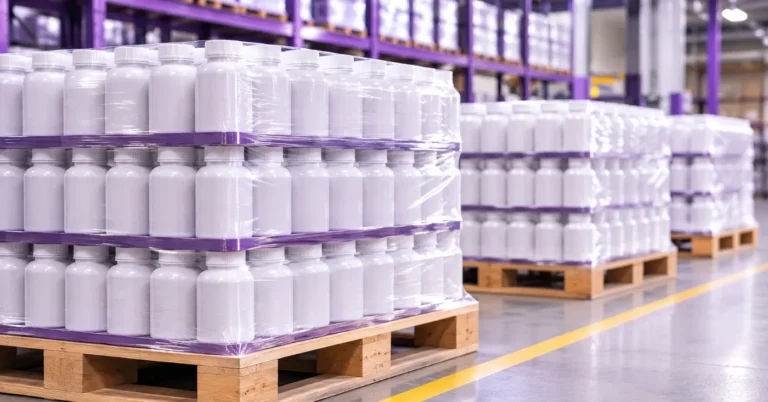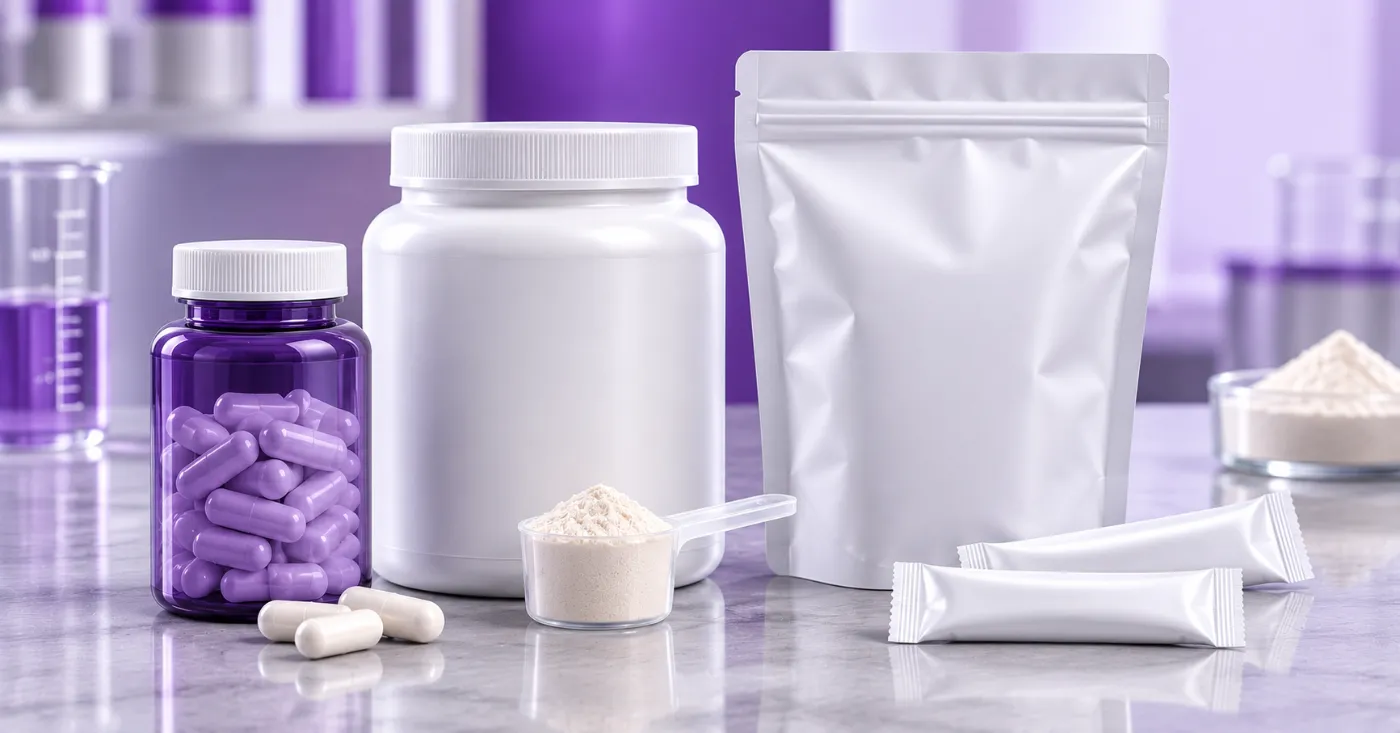

Supplement packaging is the container, closure, seal and label that hold and protect your product from the filling line to the buyer. The choice is set by your format first: capsules, powders and liquids each have a short list of containers that fit. Material, closure and barrier come next, and each one affects cost, lead time and shelf presence.
Key Takeaways
- Start with the format. Capsules go in bottles, powders in jars, pouches, stick packs or sachets, and liquids in bottles with droppers or caps.
- HDPE, PET and glass each trade weight, clarity, barrier and cost differently.
- Closures and tamper-evident seals are part of the spec, not an afterthought.
- Moisture and light protection depend on your formula, so ask about barrier before you pick a container.
- Custom components add time. Stock components keep a launch on schedule.
What is supplement packaging?
Supplement packaging is every component that touches or protects the finished product: the primary container, the closure, any inner seal or liner, desiccants, the label and the shipping case.
It does three jobs. It keeps the product stable until the last serving. It carries the label your brand approves. It survives freight and the retail shelf. A container that looks right but lets in moisture will cost more in returns than it saves in unit price.
For your brand, packaging is a spec decision. The container, fill size and closure go into the Finished Product Specification, so they need to be settled before production is scheduled.
Which packaging fits each supplement format?
Each format has a natural set of containers. Pick from that set first, then narrow by material and size.
Capsules
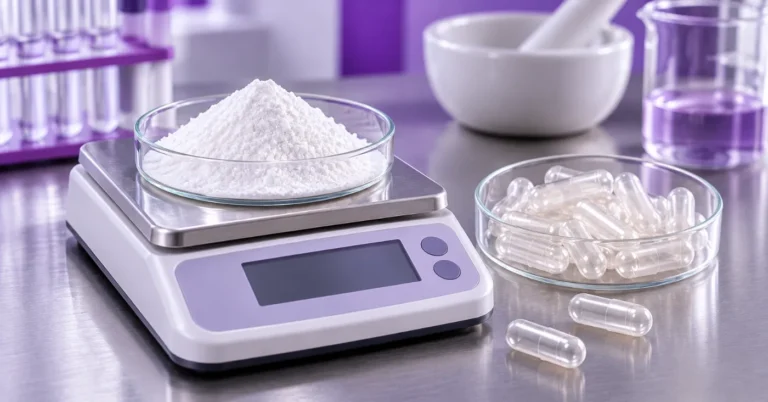
Capsules are usually filled into bottles. Common sizes run from 100cc to 500cc, in HDPE, PET or glass. Bottle size follows the count and the capsule size, so settle your capsule size and serving first. A bottle that is too large for the count leaves headspace and invites rattling in transit.
Powders
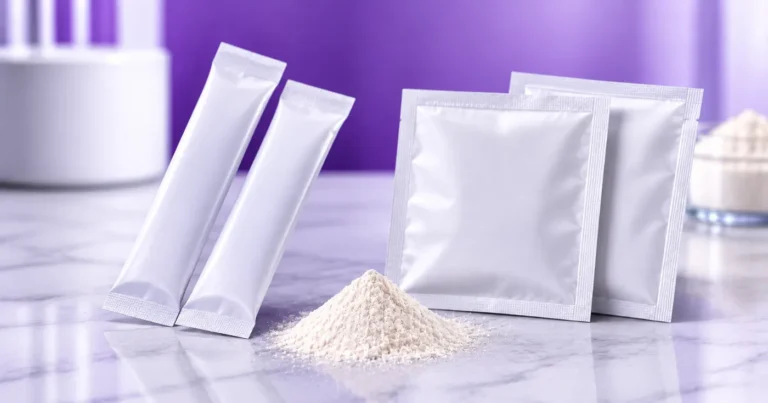
Powders have the widest choice. Jars and canisters suit multi-serving tubs with a scoop. Gusset pouches ship flat and use less space. Stick packs and sachets hold a single serving. Our comparison of stick packs vs canisters vs gusset bags covers the trade-offs on shelf.
Liquids
Liquids go into bottles from small dropper sizes up to larger syrup bottles. Tinctures and drops usually take a dropper closure. Syrups and suspensions usually take a screw cap. The solvent matters here: an alcohol or glycerin base must be compatible with the bottle and the dropper bulb. Our guide to what a tincture is explains how solvent choice shapes the rest of the spec.
How do HDPE, PET and glass compare?
HDPE is light and opaque, PET is light and clear, and glass is heavy with a premium feel. The right choice depends on your format, your channel and how your formula reacts to moisture and light.
| Material | Strengths | Trade-offs | Common use |
|---|---|---|---|
| HDPE | Light, tough and usually opaque, so it blocks light. Handles drops in freight well. | Product is not visible. Look is functional rather than premium. | Capsule bottles, powder jars and canisters, liquid bottles |
| PET | Light and clear, so the product shows. Rigid with a glossy finish. | Clear bottles let light through, so ask about light-sensitive ingredients. | Capsule bottles, powder jars, liquid bottles |
| Glass | Premium look and feel. Amber glass blocks much of the light. | Heavier, so freight costs more. Can break in transit or on the line. | Tinctures and drops, premium capsule bottles |
| Flexible film | Ships flat, light and space-saving on the pallet. | Barrier depends on the film layers, so specify them. | Gusset pouches, stick packs, sachets |
Your channel adds its own pressure. A container that sells well in a specialty store may not suit a brand shipping direct to consumers, where weight and breakage drive cost.
Which closures and tamper-evident seals should you specify?
Specify the closure type, the liner or inner seal, and the tamper-evident feature together. These three parts work as a set, and a mismatch shows up as leaks or failed seals.
- Screw caps. The standard for capsule bottles, jars and many liquid bottles.
- Dropper closures. A bulb and pipette for tinctures and drops. Match the dropper volume to the serving on your label.
- Phenolic caps. A rigid cap often used on glass liquid bottles.
- Induction seals. A foil liner bonded to the bottle rim. It shows if the bottle has been opened and adds a moisture barrier.
- Shrink bands. A printed or clear band around the cap and neck. It gives a visible tamper-evident feature on the shelf.
Tamper-evident packaging is expected by buyers and retailers alike. If your label describes the seal, confirm the label wording with your regulatory advisor.
What should you ask about moisture and light?
Ask how your formula reacts to moisture, oxygen and light, and choose a container and seal that protect against those risks. Many powders and some capsule fills pick up moisture, which shows up as clumping, caking or color change.
- Does any ingredient pull moisture from the air? If so, ask about desiccants and induction seals.
- Is any ingredient light-sensitive? If so, consider opaque HDPE or amber glass over clear PET.
- For pouches, stick packs and sachets, which film layers give the barrier you need?
- How much headspace is in the container, and does it matter for this formula?
- What stability data is available for this formula in this container?
If your powder already has clumping complaints, our guide to common powder supplement complaints shows where packaging is the cause.
How does custom supplement packaging affect lead time?
Custom supplement packaging adds lead time, because custom molds, printed film and specialty closures must be made before production. Stock bottles, jars and caps are usually faster to source.
Printed labels and cartons also need artwork approval before they are ordered. Every round of artwork changes pushes the start date. A practical approach for a first run is stock containers with custom labels. Custom shapes or printed film can follow once the product has a sales history.
Packaging also feeds into cost. Our guide on what it costs to start a supplement brand shows where components sit in a launch budget.
What belongs on your supplement packaging checklist?
Settle these items before you request a quote, so the quote reflects the real components.
- Format and fill. Count per bottle, grams per jar or pouch, or mL per bottle.
- Container. Type, size and material.
- Closure. Screw cap, dropper or phenolic cap, plus the liner.
- Tamper-evident feature. Induction seal, shrink band or both.
- Barrier. Desiccant, opaque container or barrier film if your formula needs it.
- Scoop. For powders, the scoop size that matches the serving.
- Label and cartons. Final artwork, label size and any retail carton or display box.
- Stock or custom. Which components are stock and which are custom, so lead time is clear.
- Case pack. Units per case and how cases are palletized for your channel.
How WB Blends handles this
WB Blends fills capsules into 100cc to 500cc bottles in HDPE, PET or glass, at more than 3,000,000 bottles per month. Powders run at about 600,000 jars per month, in HDPE and PET jars and canisters, gusset pouches, sachets and stick packs, with stick packs made in-house. Liquids run at about 550,000 bottles per month, from 5 mL to 32 oz in HDPE, PET or glass, with dropper and phenolic closures.
Packaging is set in the Finished Product Specification, which your brand approves before production. A Finished Product Shipping Spec ships with the Certificate of Analysis and lists the lot number, quantity, case count and pallet details. See how packaging fits into our turnkey supplement manufacturing programs.
Frequently Asked Questions
What is the most common supplement bottle material?
HDPE and PET are both widely used for capsule bottles and powder jars. HDPE is light and opaque, which blocks light. PET is clear and shows the product. Glass is used for a premium look and for many tinctures. Choose based on your formula, your channel and the barrier you need.
What is tamper evident packaging?
Tamper-evident packaging has a feature that shows clearly if the product was opened, such as an induction seal under the cap or a shrink band around the neck. Buyers and retailers expect it. Specify the feature with your closure and liner so the parts work together on the filling line.
Does custom supplement packaging take longer?
Yes, usually. Custom molds, printed film and specialty closures have to be made before production starts, and artwork must be approved first. Stock bottles, jars and caps are faster to source. Many brands launch with stock containers and custom labels, then move to custom components later.
How do I protect a powder from moisture?
Use a container and seal with a moisture barrier, such as an induction-sealed jar or a pouch made with barrier film. A desiccant can help in some formulas. Ask your manufacturer how your formula behaves and what stability data supports the container you choose.
Who supplies the packaging components?
It depends on the model. In a turnkey program, the manufacturer sources the components. In a toll program, your brand may supply some or all of them. Either way, the components are listed in the product specification before production so everyone works from the same list.
Planning a launch? Request a quote. Preliminary quotes take 5-6 business days.