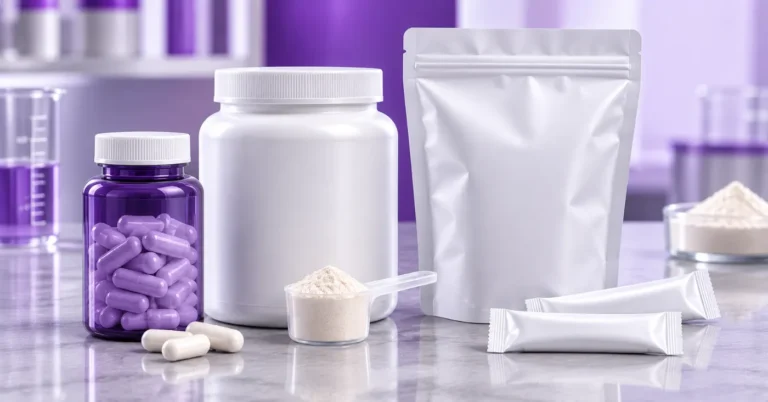

A capsule supplement manufacturer is a contract facility that blends, encapsulates, tests, and packages dietary supplements to a brand’s specification. Choose one by verifying cGMP compliance, third-party certification, testing protocols, minimum order quantities, and formula ownership. The ten questions below cover each in order of risk.
KEY TAKEAWAYS
- A capsule supplement manufacturer is a cGMP-compliant facility that formulates, fills, tests, and packages capsules for supplement brands.
- Verify compliance with FDA 21 CFR Part 111 and third-party certification such as NSF/ANSI 455-2 before anything else.
- Demand identity, potency, and contaminant testing, including ICP-MS heavy metals analysis.
- Get MOQs, lead times, and formula ownership in writing before you sign.
- The right partner answers all ten questions below without hesitation.
What Does a Capsule Supplement Manufacturer Actually Do?
A capsule supplement manufacturer turns a formula into a finished, labeled, shelf-ready product. The work spans sourcing raw materials, blending, filling capsules, quality testing, bottling, and batch documentation.
Most contract manufacturers work in one of two models.
Tolling vs. Turnkey Manufacturing
| Factor | Tolling | Turnkey |
|---|---|---|
| Who sources ingredients | The brand | The manufacturer |
| Who owns formulation | The brand | Ownership terms vary by manufacturer. Put them in the contract before development starts. With WB Blends, the formula stays your intellectual property. |
| Brand workload | High | Low |
| Best for | Established brands with supplier relationships | New brands and fast launches |
| Cost control | Higher | Moderate |
Know which model you need before you request quotes. It changes every number you receive.
Why Does Choosing the Right Capsule Manufacturer Matter?
The manufacturer determines product safety, regulatory exposure, and brand reputation. Under FDA rules, the brand carries responsibility for what reaches the consumer. Quality problems at your manufacturer affect your brand too.
Capsules also carry specific production demands. Fill weight consistency, powder flow, moisture control, and capsule shell selection all affect potency and shelf life. A weak process shows up as variable dosing.
Question 1: Are You cGMP Compliant and Third-Party Certified?
Ask for proof of compliance with 21 CFR Part 111, the FDA regulation governing current good manufacturing practice for dietary supplements. A manufacturer that claims compliance should produce documentation on request.
Look beyond the claim to independent verification.
- NSF/ANSI 455-2 is a GMP standard for dietary supplements, audited by an independent third party.
- FDA registration confirms the facility is on record, not that it is compliant.
- Audit reports show how the facility performed when someone checked.
Question 2: What Do Your Inspection and Audit Records Show?
Ask for the most recent third-party audit summary and any FDA inspection history. A clean record is a strong signal. A facility that refuses to discuss its audit history is a weak one.
Ask how the manufacturer handled past corrective actions. Mature operations document findings, fix root causes, and verify the fix. Vague answers signal a reactive quality culture.
Question 3: How Do You Test Raw Materials and Finished Capsules?
A capsule supplement manufacturer must verify the identity of every dietary ingredient it uses. FDA regulations require an identity test for each dietary ingredient before use. For other components, a manufacturer may test the lot or rely on a qualified supplier’s certificate of analysis (21 CFR 111.75(a)), and finished batches require testing against specification.
A complete testing program covers four areas.
- Identity: confirms each ingredient is what the label says.
- Potency: confirms the capsule delivers the labeled dose.
- Contaminants: screens for heavy metals, microbial load, and residual solvents.
- Stability: confirms the product holds up through its shelf life.
What Is ICP-MS Testing?
ICP-MS (inductively coupled plasma mass spectrometry) is a laboratory method that detects heavy metals such as lead, arsenic, cadmium, and mercury at trace levels. It is the standard for contaminant screening in supplements. Ask whether testing happens in-house or at an accredited outside lab, and request a sample Certificate of Analysis (COA).
Question 4: Do You Offer Tolling, Turnkey, or Both?
Match the model to your capability. A brand with trusted ingredient suppliers and a finished formula fits tolling. A brand starting from an idea fits turnkey.
Ask what the manufacturer does when a supplier fails. Turnkey partners should hold qualified backup sources. Ask how they vet suppliers and how they respond to a failed incoming lot.
Question 5: What Are Your Minimum Order Quantities and Lead Times?
MOQ is the smallest production run a manufacturer will accept. It controls your upfront cash requirement and inventory risk. Capsule MOQs vary by facility, formula complexity, and packaging.
Ask for these figures in writing.
- Minimum batch size per SKU
- Standard lead time from approved formula to delivery
- Rush options and the cost of each
- Reorder lead time once the formula is validated
Lead time matters as much as price. A cheap run that arrives eight weeks late costs more than a fair run that ships on schedule.
Question 6: How Do You Handle Formulation and Capsule Selection?
Capsule shell choice affects cost, positioning, and consumer fit. A capable partner explains the tradeoffs and recommends based on your formula and market.
| Attribute | Gelatin Capsule | HPMC (Vegetarian) Capsule |
|---|---|---|
| Source | Animal-derived | Plant-derived (cellulose) |
| Claims supported | Standard | Vegetarian, vegan |
| Moisture sensitivity | Moderate | Lower |
| Typical cost | Lower | Higher |
Ask about excipients and flow agents too. Poor powder flow causes weight variation. A formulation team solves this before the first run.
WB Blends produces capsule, powder, and liquid formats. If your line spans formats, a single partner simplifies quality control.
Question 7: What Documentation Accompanies Every Batch?
Every batch needs a paper trail. Ask for a sample batch record, a COA, and the Finished Product Specification (FPS) the manufacturer works from.
The FPS defines what “correct” means for your product: ingredients, dosage, appearance, and test limits. Without it, quality is a matter of opinion. With it, every batch is measured against the same standard.
Ask about traceability. A strong manufacturer traces any lot back to its raw material sources in minutes.
Question 8: Who Owns the Formula and Intellectual Property?
You should. Confirm in the contract that your formulation, specifications, and brand assets remain yours. Ask whether the manufacturer reserves the right to sell similar formulas to other clients.
Review these clauses before signing.
- Formula ownership and confidentiality
- Non-compete or exclusivity terms
- Transfer rights if you change manufacturers
- Liability allocation for ingredient failures
Question 9: What Is Included in the Price, and What Is Not?
Quotes are not comparable until you itemize them. A low per-unit price often hides separate charges.
Ask whether the quote includes:
- Raw materials and capsule shells
- Testing and COAs
- Bottles, caps, seals, and labels
- Setup, tooling, and formulation fees
- Freight and storage
Proximity affects freight. A domestic partner reduces transit time and shipping variability. WB Blends operates from Spanish Fork, Utah.
Question 10: How Do You Communicate, and Can You Scale With Me?
Ask who your point of contact is and how quickly they respond. Production problems are routine. Response quality during a problem separates good partners from poor ones.
Ask about scalability. Your first run may be small. Your fifth should not force a manufacturer change. Confirm the facility can support your projected volume, new SKUs, and additional formats.
How Do You Compare Capsule Supplement Manufacturers Side by Side?
Score each candidate against the same checklist. Consistent criteria remove guesswork.
| Criterion | What to Verify | Red Flag |
|---|---|---|
| Compliance | 21 CFR Part 111, NSF/ANSI 455-2 | No third-party audit |
| Testing | Identity, potency, ICP-MS, micro | Finished-product testing only |
| MOQ | Written, per SKU | Vague or shifting numbers |
| Documentation | COA, batch record, FPS | Refusal to share samples |
| IP | Brand-owned formula | Manufacturer retains rights |
| Pricing | Itemized quote | Single lump figure |
What Are the Limitations of Capsules as a Format?
Capsules suit most powders and oils, but not every formula. High-dose ingredients may require multiple capsules per serving. Very hygroscopic powders can compromise shell integrity. Consumers who struggle to swallow capsules may prefer powder or liquid formats.
A good manufacturer tells you when a different format fits better. Treat that advice as a quality signal.
FAQ
What is the minimum order for a capsule supplement manufacturer?
MOQs vary by facility, formula, and packaging. Request the figure per SKU in writing before comparing quotes.
How long does capsule supplement manufacturing take?
Timelines depend on formulation status, ingredient availability, and testing. Ask for lead time from approved formula to delivery, and separately for reorders.
What certifications should a capsule supplement manufacturer hold?
At minimum, compliance with FDA 21 CFR Part 111. Third-party certification such as NSF/ANSI 455-2 adds independent verification.
What is the difference between tolling and turnkey supplement manufacturing?
In tolling, you supply the formula and ingredients. In turnkey, the manufacturer sources materials and manages production.
Do I own my formula when I use a contract manufacturer?
You should. Confirm ownership, confidentiality, and transfer rights in the contract before production begins.
Is a vegetarian capsule better than gelatin?
Neither is universally better. HPMC supports vegetarian and vegan claims and tolerates moisture differently. Gelatin typically costs less.
How do I verify a manufacturer’s testing claims?
Request sample COAs, ask which lab performs the testing, and confirm ICP-MS screening for heavy metals.
Choose a Partner That Answers All Ten
A capsule supplement manufacturer earns your business by answering these questions with documents, not promises. WB Blends welcomes the scrutiny. Request a quote and bring your list.