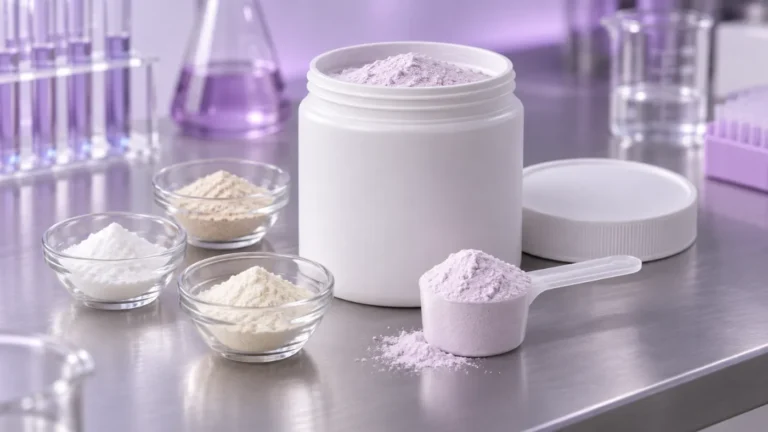

Silicon dioxide in supplements is a fine, dry excipient that helps powders flow and keeps them from caking. Formulators add small amounts so a blend fills capsules evenly and scoops cleanly from a jar. For your brand, it is a process decision that shows up on your label, so it belongs in the spec.
Key Takeaways
- Silicon dioxide, also called silica, is used as a flow agent and anti-caking agent in capsule and powder blends.
- It solves two different problems: poor flow during filling and clumping during storage.
- Alternatives such as rice flour, rice hull and microcrystalline cellulose do related jobs, with different label wording.
- Whether a formula needs it depends on the blend, the format and the run, so test before you decide.
- The excipient choice is fixed in the Finished Product Specification before production.
What is silicon dioxide in supplements?
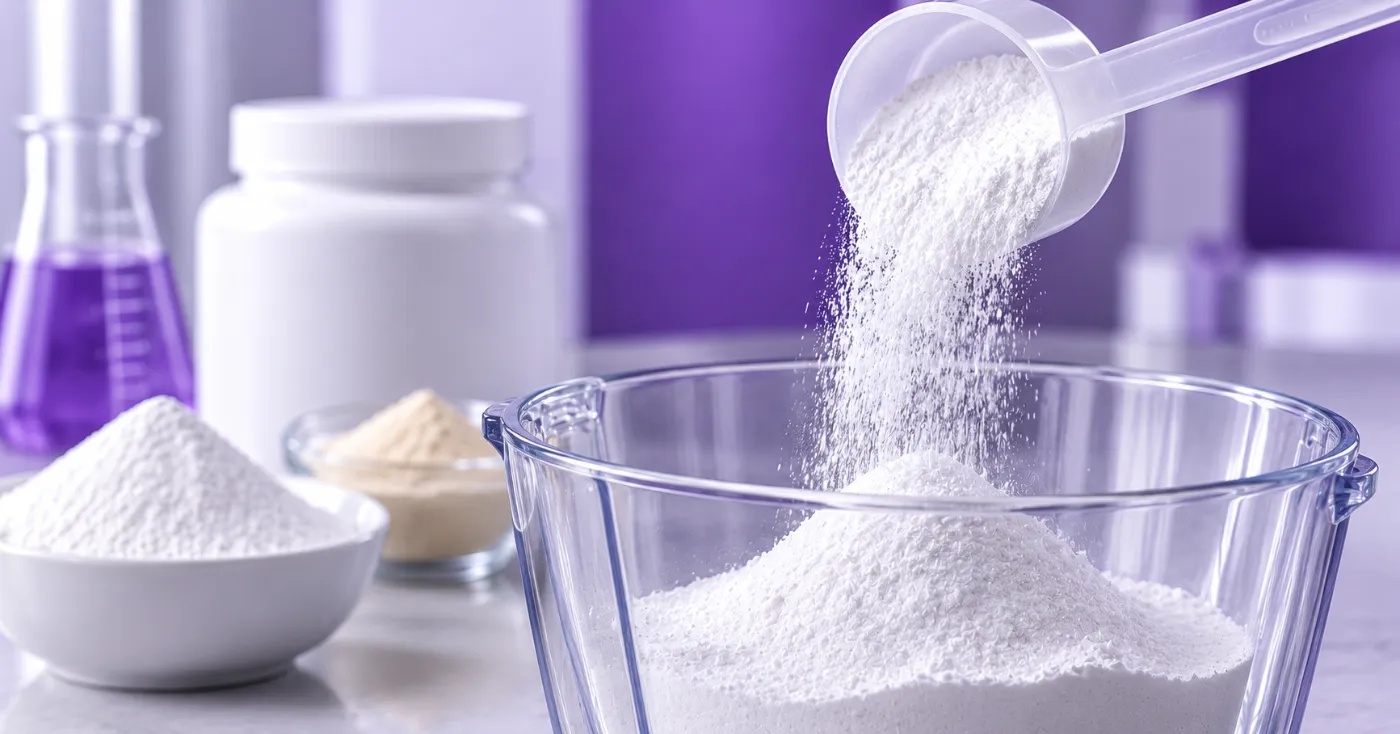
Silicon dioxide is a compound of silicon and oxygen. In supplements it is used as a very fine, light powder that coats the particles of a blend. That coating reduces how much the particles stick to each other and to equipment.
It is an excipient, which means it is in the product to help make it, not to deliver a dietary ingredient. Excipients sit in the “Other ingredients” line below the Supplement Facts panel. Common names on labels include silicon dioxide and silica.
Brands often meet the term for the first time when a buyer or a customer asks why it is on the label. The honest answer is a manufacturing one: it helps the blend behave the same way from the first capsule to the last.
Why is silicon dioxide used in capsules and powders?
It is used because many dietary ingredients do not flow well or absorb moisture from the air. Silicon dioxide helps with both, and each problem shows up at a different stage.
As a flow agent during filling
Capsule machines fill by volume. If a powder bridges, rat-holes or sticks, the fill weight drifts from one capsule to the next. A flow agent helps the blend move evenly through the hopper, so each capsule gets a consistent amount. Sticky botanicals, fine extracts and blends with oils are the usual candidates.
As an anti-caking agent in storage
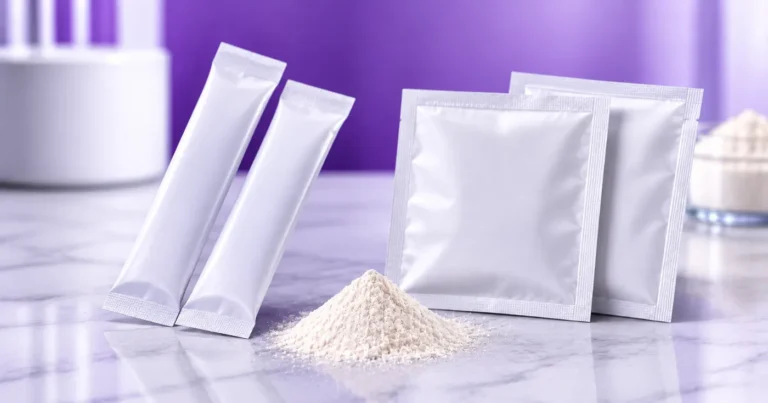
Hygroscopic ingredients pull in moisture and form lumps. In a jar, stick pack or pouch, that means clumps and uneven scoops. An anti-caking agent helps the powder stay loose through shipping and shelf time. Electrolyte, greens and some protein blends are common examples. Our guide to common powder supplement complaints covers clumping in more detail.
What are the alternatives to silicon dioxide?
The main alternatives are magnesium stearate, rice flour or rice hull, and microcrystalline cellulose. They are not direct swaps. Each does a slightly different job and reads differently on a label.
| Excipient | Main function | Typical label wording | Trade-off to weigh |
|---|---|---|---|
| Silicon dioxide | Flow agent and anti-caking agent | Silicon dioxide, silica | Small amounts work, but some buyers ask about it |
| Magnesium stearate | Lubricant that stops powder sticking to equipment | Magnesium stearate, vegetable magnesium stearate | Solves sticking more than caking; source matters for Vegan claims |
| Rice flour or rice hull | Filler and flow aid | Rice flour, rice hull, rice extract blend | Reads as familiar to shoppers; usually needs a larger share of the fill |
| Microcrystalline cellulose | Filler that improves flow and fill consistency | Microcrystalline cellulose, cellulose | Takes up capsule space that could hold active ingredients |
Caption: Common flow and fill excipients compared by function and label wording. The right choice depends on your blend and is confirmed in R&D.
Some formulas use two of these together, for example a lubricant and a flow agent. Others use none. The capsule formulation guide explains how excipients fit around your actives and capsule size.
How does silicon dioxide appear on a supplement label?
Silicon dioxide is listed under “Other ingredients,” below the Supplement Facts panel. It is not a dietary ingredient, so it does not appear in the panel itself.
Three practical points help when you plan the label:
- Agree on the name. Pick silicon dioxide or silica and use it the same way on the label, the spec and your product listing.
- Check your positioning. If your brand promises a short ingredient list, decide early whether a flow agent fits that promise.
- Confirm the wording. Confirm final label wording with your regulatory advisor before artwork is approved.
Can a formula go without silicon dioxide?
Often, yes, but removing it can change how the run behaves. Whether you can skip it depends on the ingredients, the moisture they pick up and the format.
When a flow agent comes out of a blend, watch for these changes:
- Fill weight. Capsule weights may vary more, which affects how close each unit is to the label.
- Run speed. A sticky blend may need slower filling or more stops for cleaning.
- Shelf behavior. A powder may clump in the jar or stick pack, especially in humid climates.
- Capsule size. Replacing it with a bulkier excipient may push the fill into a larger capsule. See capsule sizes explained for how fill weight maps to size.
The way to know is a test batch or pilot run on the actual blend. Ask for the result in writing before you commit to a clean-label claim.
How do manufacturers decide on a flow agent?
Manufacturers decide during formulation, based on how the blend behaves, and then lock the choice in the specification. Use this checklist to prepare.
- List every active ingredient and its form, such as extract, powder or oil.
- Flag ingredients known to be sticky or to absorb moisture.
- State your format: capsule, jar, pouch or stick pack.
- Say which excipients you want to avoid, and why.
- Note label claims you plan, such as Vegan or Organic. Claims are confirmed during quoting.
- Ask how fill weight and flow will be checked during the run.
The capsule manufacturing process shows where blending, filling and checks happen, so you can see where a flow agent makes a difference.
How WB Blends handles this
WB Blends reviews excipients during R&D when a project needs it, based on how your blend flows and fills. The chosen excipients are recorded in the Finished Product Specification, which is approved before production, and the formula stays your intellectual property. The team encapsulates about 150M capsules a month in sizes 1, 0, 00 and 00EL, with gelatin, HPMC and pullulan shells, and blends about 200,000 kg a month across 5 blenders. Every lot ships with a Certificate of Analysis. Learn more about working with a capsule contract manufacturer.
Frequently Asked Questions
Why is silicon dioxide in supplements?
It is added to help powders flow and to stop them caking. In capsules, it helps the blend fill evenly so each capsule weighs about the same. In powders, it helps keep the product loose in the jar or stick pack. It is an excipient, not a dietary ingredient.
Is silicon dioxide the same as silica?
Yes. Silica is the common name for silicon dioxide, and both names appear on supplement labels. Choose one name and use it the same way on your label, your specification and your product listings, so buyers and retailers see a consistent ingredient list.
What can replace silicon dioxide in a formula?
Rice flour, rice hull and microcrystalline cellulose can improve flow, and magnesium stearate helps with sticking. None is a direct swap. Each changes fill volume, label wording or run behavior, so test the replacement on your actual blend before you change the specification.
Where does silicon dioxide go on the label?
It goes in the Other ingredients line below the Supplement Facts panel, because it is an excipient rather than a dietary ingredient. Confirm the final wording with your regulatory advisor before your label artwork is approved for production.
When should a brand decide on flow agents?
Decide during formulation, before the specification is approved. That is when a test batch shows how the blend fills and stores. Changing excipients after approval can affect fill weight, capsule size and label artwork, and may require a new quote.
Planning a launch? Request a quote. Preliminary quotes take 5-6 business days.