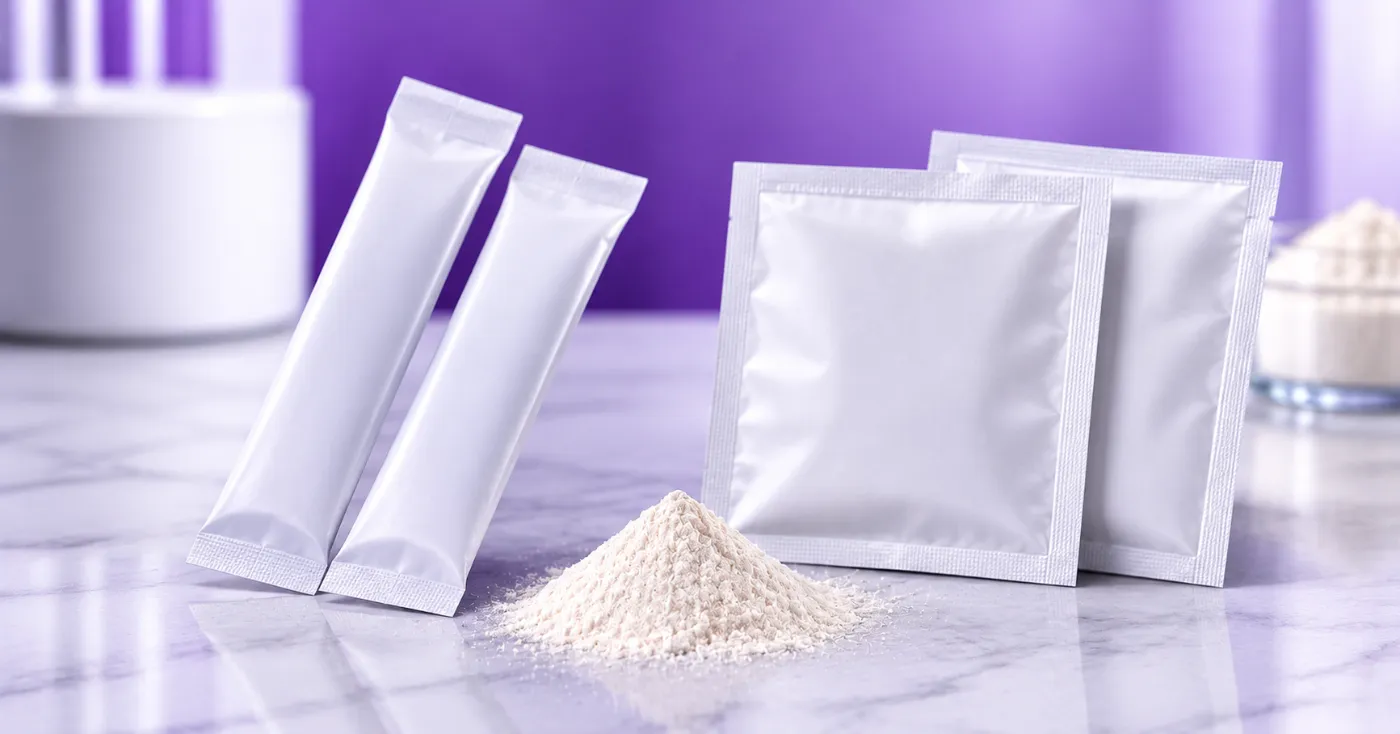

A stick pack is a narrow, tube-shaped single serving sealed at both ends and along the back. A sachet is a flat, square or rectangular pouch sealed on three or four sides. Both hold one serving of powder, so the choice comes down to how your product pours, ships, sits on shelf and fits your brand.
Key Takeaways
- Stick packs and sachets are both single-serve formats, but they are not the same thing.
- Stick packs are slim and pour from a narrow end. Sachets are flat and wider, with more face for print.
- Serving size, powder flow and moisture sensitivity decide which one fits.
- The barrier film matters as much as the shape. Specify it.
- Both are usually sold in cartons for retail, so plan the carton with the pack.
What is the difference between a stick pack and a sachet?
The difference is shape and sealing. A stick pack is a long, narrow tube with a back seal and two end seals. A sachet is a flat pouch with seals around three or four edges.
That difference changes how the buyer uses the product. A stick pack is torn at one end and poured straight into a bottle of water. A sachet is torn across a corner or edge and emptied into a glass or shaker. A stick pack fits in a pocket or gym bag. A sachet gives more flat space for branding.
The two terms are sometimes used loosely. When you brief a manufacturer, describe the shape and seal you want, not just the name.
What is a sachet?
In supplement packaging, a sachet is a small, flat, sealed pouch that holds a single serving of powder. It is made from flexible film, usually a laminate of several layers, and sealed on three or four sides.
The word also means a scented bag for drawers or a tea pouch, which is why general search results can be confusing. For a supplement brand, the sachet is a primary package for one serving, often sold in a carton of 10, 20 or 30.
How do stick packs and sachets compare?
Stick packs win on portability and pour. Sachets win on print space and wider fills. Use this table to match the format to your product.
| Factor | Stick pack | Sachet |
|---|---|---|
| Shape | Long, narrow tube | Flat square or rectangle |
| Seals | Back seal plus two end seals | Three or four edge seals |
| Fill | Suits smaller single servings that flow well | Suits wider or bulkier single servings |
| Pour | Narrow opening pours straight into a bottle | Wider tear, empties into a glass or shaker |
| Print space | Narrow face, so branding is tight | Larger flat face for branding and copy |
| Shelf presence | Usually sold in a carton or display box | Sold in a carton, or loose in sample programs |
| Material | Laminated barrier film | Laminated barrier film |
| Portability | Fits a pocket or bag easily | Flat, but wider to carry |
Neither format is better in general. A slim stick pack can look premium for a hydration product, while a sachet can suit a larger serving or a sample program where the face carries more information.
Which products suit each format?
Match the format to how the product is used and how much powder is in a serving.
- Hydration and electrolyte powders. Often in stick packs, because buyers pour them into a water bottle on the go.
- Greens powders. Either format works. Larger servings may fit a sachet better.
- Pre-workout powders. Stick packs suit grab-and-go use before training.
- Protein samples. Protein servings are bulky, so a sachet often fits a sample size better than a narrow stick.
- Collagen and vitamin powders. Either format, depending on serving size and how the powder flows.
Flow matters on the filling line. Powders that clump or bridge can be harder to fill accurately in a narrow stick. Our guide to common powder supplement complaints covers flow and clumping in more detail.
What should you ask about barrier film and moisture?
Ask what film structure protects your powder from moisture, oxygen and light for its planned shelf life. Many supplement powders pull moisture from the air, and a weak film shows up as clumping or caking inside the pack.
- Which layers are in the laminate, and is foil or a metallized layer needed?
- How sensitive is the formula to moisture? Are any ingredients hygroscopic?
- Is there a tear notch, and where does it sit on the pack?
- How are seal strength and fill weight checked during the run?
- What stability data supports the film you plan to use?
- Is the film stock or custom printed, and how does that change lead time?
How does single-serve compare with a jar or gusset pouch?
Single-serve formats trade a higher packaging cost per serving for convenience and exact dosing. A jar or gusset pouch holds many servings and costs less per serving, but the buyer measures with a scoop.
Many brands run both: a multi-serving tub for regular buyers and stick packs or sachets for travel, trials and sampling. Our comparison of stick packs vs canisters vs gusset bags covers the multi-serving options in full. If your powder is a protein, our guide to how protein powder is made shows where the fill step sits in the process.
How are stick packs and sachets packed for retail?
Both are usually packed into a printed carton or display box with a set count. The carton carries most of the label information buyers see on shelf, so plan its artwork alongside the pack itself.
Decide the count per carton, the carton style, and the case pack early. These choices set the shelf footprint and the pallet layout for your channel.
How WB Blends handles this
WB Blends makes stick packs in-house and also offers sachets, alongside HDPE and PET jars and canisters and gusset pouches. Powder bottling runs at about 600,000 jars per month, and blending runs at about 200,000 kg per month across 5 blenders.
In-house flavor and sweetener development supports hydration, pre-workout, greens, collagen, protein and vitamin powders. Each lot is tested in-house and ships with a Certificate of Analysis. The pack format, fill and film are set in the Finished Product Specification, which your brand approves before production. Learn more about our powder supplement manufacturing.
Frequently Asked Questions
Are sachets and stick packs the same?
No. Both hold a single serving, but a stick pack is a narrow tube sealed at the back and both ends, while a sachet is a flat pouch sealed on three or four sides. The shape changes how the product pours, how much print space you have and how it packs into a carton.
What can go in a stick pack?
Most free-flowing single-serve powders can go in a stick pack, including hydration, electrolyte, pre-workout, greens and vitamin powders. Bulky servings such as full protein scoops may fit a sachet or a larger pack better. Powder flow and moisture sensitivity also affect how well a formula fills.
Which is cheaper, a stick pack or a sachet?
It depends on the film, the fill, the print and the run size, so there is no single answer. Film structure, custom printing and carton style usually drive the cost more than the shape itself. Ask for a quote on both formats with the same film and count to compare them fairly.
How are stick packs packed for retail?
Stick packs are usually packed in a set count inside a printed carton or display box. The carton carries much of the shelf information, so its artwork is planned with the pack. Count per carton and case pack also set the shelf footprint and pallet layout for your channel.
Planning a launch? Request a quote. Preliminary quotes take 5-6 business days.