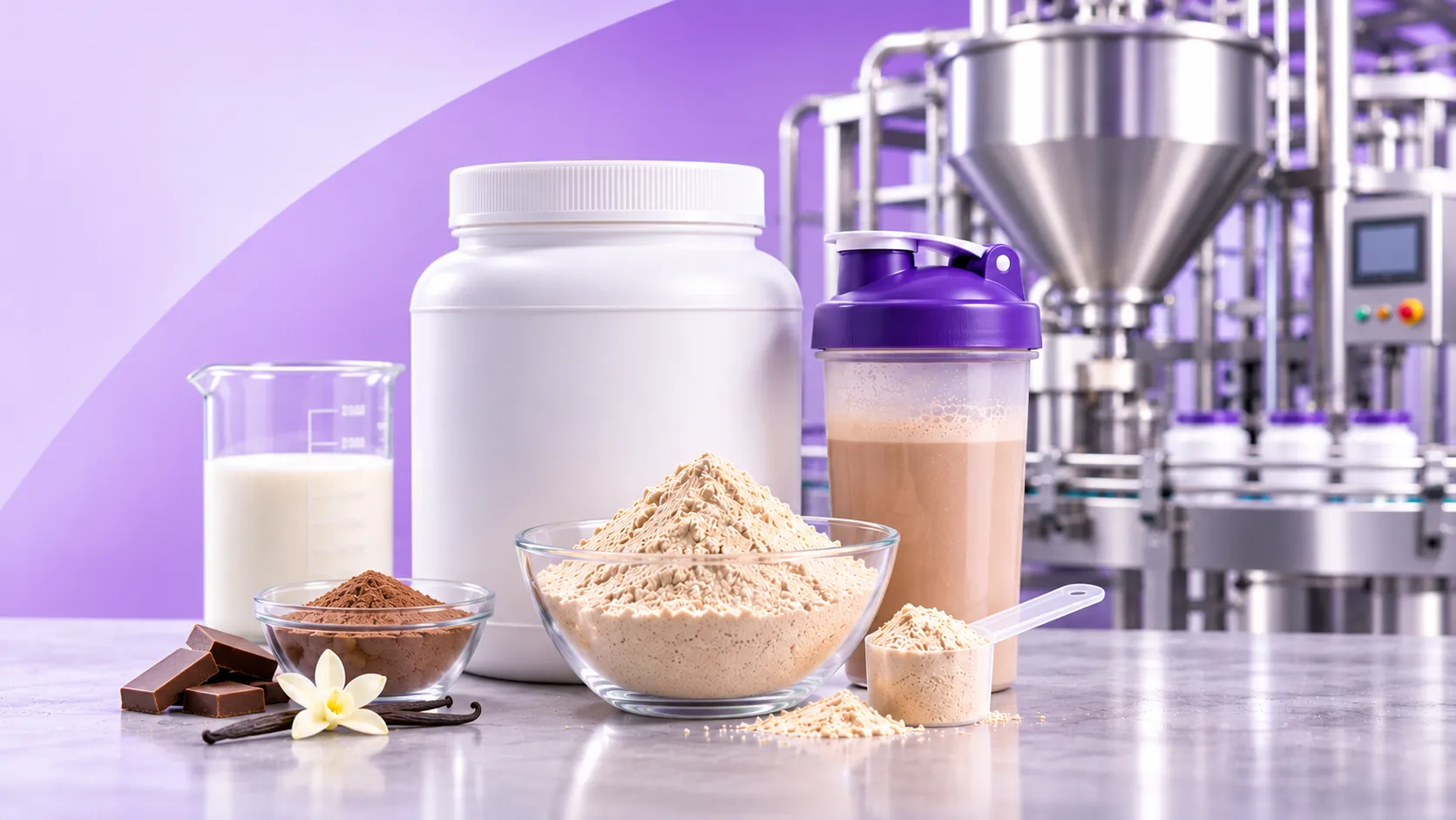

Protein powder is made by concentrating protein from a source such as milk or peas, drying it, then blending, flavoring, filling and testing it. For your brand, how protein powder is made sets your label math, your allergen statement, your taste and your lot documents.
Key Takeaways
- How is protein powder made? In two stages. An ingredient maker concentrates and dries the protein, then a manufacturer blends, flavors, fills and tests it.
- “Concentrate” and “isolate” describe protein level. Whey protein isolate has at least 90% protein on a dry basis. Whey protein concentrate runs from 34% to 80%.
- Most brands buy the protein as an ingredient. The work you hire out starts at blending.
- Your protein source changes your allergen declaration, your label math and your flavor work.
- Write five items into your spec before the first quote: protein source, protein per serving, claims, packaging and serving size.
How is protein powder made?
Protein powder is made in two stages: an ingredient maker concentrates and dries the protein, then a manufacturer blends, flavors, fills and tests it. Finished protein powder is a protein ingredient plus sweeteners, flavors and, in some formulas, mixing aids.
| Stage | Who usually does it | What comes out |
|---|---|---|
| Separate and concentrate | Dairy processor or plant protein ingredient maker | Protein in water |
| Dry | Same ingredient maker | Protein ingredient powder, such as whey protein isolate or pea protein isolate |
| Blend and flavor | Contract manufacturer | Uniform finished powder |
| Fill | Contract manufacturer | Jars, canisters, pouches, sachets or stick packs |
| Test and release | Contract manufacturer | Certificate of Analysis (COA) for the lot |
Caption: The five stages of protein powder production. Stages one and two usually happen before the powder reaches your manufacturer.
Most brands never run stages one and two. If you searched “how to make protein powder” for a brand launch, the practical route is to buy protein ingredients and hire a manufacturer for stages three to five. That is also why your spec matters: it tells the manufacturer which protein ingredient to buy and what the finished lot must meet.
How are whey and plant proteins processed?
Whey protein is recovered from the liquid left after cheese making. Plant protein is extracted from milled crops such as peas. Both are concentrated in water, then spray dried into powder.
Whey protein
Whey is, by regulation, the liquid obtained by separating the coagulum from milk in cheese making. Membrane filtration then removes much of the lactose and minerals, and drying finishes the job.
| Step | What happens | Source |
|---|---|---|
| 1. Cheese making | Casein is separated for cheese. The liquid left behind is whey. | USDA AMS technical report on whey protein concentrate |
| 2. Ultrafiltration | Membranes hold back the protein. Lactose and ash pass into the permeate. | US patent 10258064 |
| 3. Further purification (isolate) | Microfiltration, a second ultrafiltration or ion exchange removes more non-protein material. | ADPI Whey Protein Isolate Standard |
| 4. Evaporation | Water is removed to raise solids before drying. | US patent 10258064 |
| 5. Spray drying | The concentrate is sprayed into hot air and dries to a fine powder. | US patent 10258064 |
Caption: Typical whey protein processing. Exact filtration steps and temperatures vary by supplier.
Protein level separates the grades. USDA describes whey protein concentrate as 34% to 80% protein in the dry product. ADPI defines whey protein isolate as at least 90% protein on a dry matter basis, made by membrane filtration, ion exchange or both.
A hydrolyzed grade is treated with enzymes, or optionally acid, to break protein bonds, and the ADPI concentrate standard requires it to be labeled as hydrolyzed.
Plant protein
Pea protein is the common example. The peas are milled to flour, the protein is dissolved at alkaline pH, and the solids are removed. The protein is then recovered and dried.
| Step | What happens | Source |
|---|---|---|
| 1. Milling | Peas are milled to flour. | Pea protein isolation study, PMC |
| 2. Alkaline extraction | The flour is mixed with water at alkaline pH. A decanter separates insoluble material from the protein extract. | US patent 11641869 |
| 3. Recovery | Most commonly, the extract is adjusted to pH 4.5 so the protein precipitates, then neutralized. Some suppliers use ultrafiltration and diafiltration instead. | PMC study; University of Minnesota thesis |
| 4. Spray drying | The neutralized protein dispersion is spray dried. | PMC study |
Caption: Typical pea protein processing. Other crops follow the same pattern with different conditions.
The same PMC study notes that pea protein is used as concentrates at 40% to 90% protein and as isolates above 90%. Patent filings also report that the recovery route can change a pea protein’s amino acid score. That feeds protein quality scoring on your label, so ask each supplier which route it uses.
Some brands blend several protein sources in one formula. These multi-source formulas combine the steps above, and each source brings its own taste, allergen status and label math.
What happens at the contract manufacturer?
A contract manufacturer takes the protein ingredient and the other formula components through six stages: formula, receiving, blending, flavoring, filling and testing. This is the protein powder manufacturing process your brand hires out, and each stage ends with a record.
- Formula and specification. Your brand and the manufacturer agree on protein source, protein per serving, flavor, sweetener, packaging and claims. A finished product specification puts these in writing before production.
- Receiving and identity checks. Incoming protein and other components are checked against component specifications. A supplier’s certificate is a starting document, not the end of the check.
- Blending. Protein, sweetener, flavor and minor ingredients are mixed until uniform. Order of addition, batch size and blend time are set so small-dose ingredients spread evenly.
- Flavoring. Flavor and sweetener are built into the formula and confirmed in a pilot run. The next section covers this.
- Filling. Powder is filled by weight into jars, canisters, pouches, sachets or stick packs, then sealed and labeled. Serving size and servings per container set the fill weight.
- Testing and release. Samples are tested against the spec. Results go on a COA, which should ship with each lot.
Who buys the protein depends on the program. Under a turnkey program the manufacturer handles sourcing. Under a toll program your brand typically supplies materials. Programs vary, so confirm it in writing and read our guide to turnkey vs tolling manufacturing.
Creatine follows the same blend, fill and test path with a different ingredient. See how creatine powder is made for the comparison. Protein adds more flavor and mixing work. The problems that show up later, such as clumping or settling, are covered in common powder supplement complaints and how brands can avoid them.
How do flavor and mixability get built in?
Flavor and mixability are built in during formulation, then confirmed in a pilot run. Each protein source has its own taste and texture, so sweeteners, flavor systems and mixing aids are chosen to balance it.
| Decision | What to set | What a pilot run checks |
|---|---|---|
| Sweetener | Type and level | Taste at serving size and after a few minutes |
| Flavor system | Flavor, masking and color | Taste in water and in milk; color consistency |
| Texture | Gums or other thickeners, if any | Thickness and foam |
| Mixability | Particle size; instantizing or an added emulsifier such as lecithin, if used | Dissolving time, clumps and sediment |
| Allergens | Source of lecithin and flavor carriers | Allergen statement matches the formula |
Caption: Flavor and mixability decisions, and what a pilot run should check.
A pilot run is a small trial batch made before the full order. Judge it the way your customer will. Mix it in water and in the liquid you recommend, shake it and stir it, then look again after a few minutes. A flavor system tuned for one protein may not suit another, so a change of protein source means re-testing flavor.
Sweeteners and flavors also affect your label. Any change after approval can alter the ingredient statement and the allergen declaration, so lock the flavor system before you print labels.
What should a brand specify?
A brand should specify protein source, protein per serving, claims, packaging and serving size before the first quote. These five items set the formula, the label and the documents that ship with each lot.
| Item | What to decide | Why it matters |
|---|---|---|
| Protein source | Whey concentrate, whey isolate, hydrolyzed whey, plant or multi-source | Sets taste, flavor work and the allergen declaration. Milk is a major food allergen, and FDA allergen labeling rules cover dietary supplements. |
| Protein per serving | Grams per serving and the test method | Dairy standards and labeling rules can use different methods. The ADPI concentrate standard reports protein with a 6.38 nitrogen factor. Name the method in your spec. |
| Claims | Organic, Gluten-Free, Non-GMO Project Verified, Vegan and others | Claims change ingredient sourcing and documents. Name every claim in your first request. |
| Packaging | Jar, canister, gusset pouch, sachet or stick pack | Sets fill method, pack weight and shelf presence. See stick packs vs canisters vs gusset bags. |
| Serving size | Scoop weight, grams and servings per container | Sets fill weight and the Supplement Facts panel. |
Caption: The five items to put in your spec. Confirm each with your manufacturer before you quote.
Protein per serving needs extra care. FDA’s protein labeling rule, 21 CFR 101.9(c)(7), covers how protein is measured and when a quality-corrected percent Daily Value is needed. A law-firm summary of a 2023 Ninth Circuit decision notes that adding a protein claim can trigger a PDCAAS-corrected figure.
Plant proteins often score differently from whey, so the same grams can produce a different label. Ask your regulatory counsel how the rule applies to your product.
Also request these documents:
- The finished product specification, approved before production.
- A COA for every lot.
- The allergen statement for each protein and flavor ingredient.
- Supplier documents for each claim on your label.
How WB Blends handles this
WB Blends is a dietary supplement contract manufacturer in Spanish Fork, Utah. As a powder supplement manufacturer, WB Blends fills about 600,000 jars per month and blends about 200,000 kg per month on 5 blenders, the largest a 170 cu ft ribbon blender. Powder programs include whey, plant and multi-source protein.
Flavor and sweetener development is in-house. Packaging options are HDPE and PET jars and canisters, gusset pouches, sachets and stick packs, and stick packs are filled in-house. Testing runs in-house on every lot: identity and appearance, heavy metals by ICP-MS against strict ppm thresholds, and microbial limits.
The Finished Product Specification is approved before production, a COA ships with every lot, and the formula stays your intellectual property.
Frequently Asked Questions
What is protein powder made of?
Protein powder is made of a protein ingredient plus sweeteners and flavors, and in some formulas small amounts of mixing aids. The protein ingredient comes from a source such as whey or peas. The exact list depends on your formula, so your ingredient statement and Supplement Facts panel must match your approved spec.
What is the difference between isolate and concentrate?
The difference is protein level. Whey protein isolate has at least 90% protein on a dry basis, according to the ADPI standard. Whey protein concentrate runs from 34% to 80% protein. Isolates need extra filtration or ion exchange. Choose based on your protein-per-serving target, your flavor plan and your spec.
How is flavor added?
Flavor is added at the blending stage. The manufacturer blends flavor and sweetener into the protein base until the powder is uniform, then checks taste and mixing in a pilot run. Flavor systems are tuned to the protein source, so a change of protein usually means testing the flavor again.
Which packaging suits protein powder?
It depends on serving format and sales channel. Jars and canisters suit multi-serving tubs. Gusset pouches suit lighter packs. Sachets and stick packs suit single servings. Compare fill method, pack weight and shelf presence with your manufacturer, and confirm each format runs on its lines before you design artwork.
What testing should each lot get?
Each lot should get identity checks, heavy metals testing and microbial testing against limits in your spec, with results on a COA. Ask which methods and which lab ran each test. WB Blends tests in-house on every lot, and third-party verification is available.
Planning a launch? Request a quote. Preliminary quotes take 5-6 business days.