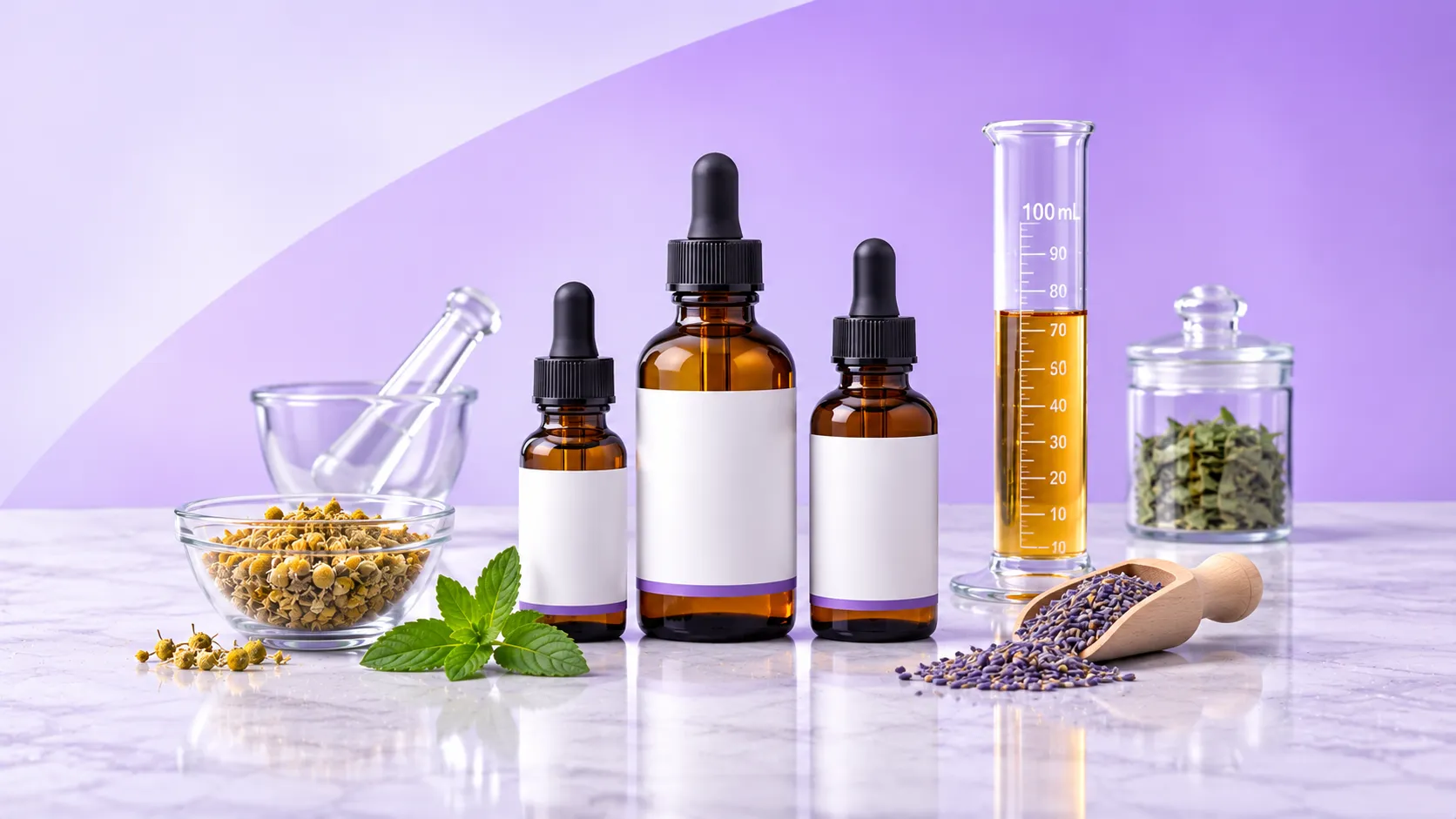

A tincture is a liquid extract made by steeping a botanical in a solvent such as alcohol, glycerin or water, then separating out the solids. That makes “what is a tincture” a specific question for your brand: the solvent, ratio and bottle shape your formula, your label and the cost of every run.
Key Takeaways
- A tincture is one type of liquid extract. “Extract” is the wider term, and this guide does not rank the two.
- In pharmacopoeial usage, a tincture uses ethanol or an ethanol-water mixture. Supplement brands also use the word for glycerin and water liquids, so define it in your spec.
- A ratio of 1:5 traditionally means 1 g of dried botanical in 5 mL of solvent. A ratio of 5:1 on an extract is read the other way. State which one you mean.
- Solvent that stays in the bottle is an ingredient and goes in the ingredient list.
- Settle botanical, solvent, strength, flavor, bottle, dropper and claims before you request a quote.
What is a tincture?
A tincture is a liquid extract made by steeping plant material in a solvent, usually ethanol or an ethanol-water mixture, and removing the solids.
In pharmacy, the term is narrow. It ties a tincture to ethanol and to two methods, maceration and percolation (Frontiers in Pharmacology, 2022). In the supplement market, the word is looser. Brands also use it for glycerin-based and water-based liquids that are served by dropper.
A tincture is a format, not an ingredient. The same botanical can go into a capsule, a powder or a tincture. Each format changes the serving, flavor, packaging and testing plan.
If a buyer or an agency says “tincture,” ask which solvent they mean. That one answer shapes the rest of the spec.
How are tinctures made?
A tincture is made in six steps: choose the botanical, choose the solvent, extract, separate the solids, test and bottle. The first three steps set the formula. The last three confirm it.
- Raw botanical. Identity is confirmed before use. The material is cut or ground so the solvent can reach it. Fresh and dried material behave differently, so your spec should say which one is used.
- Solvent. Water, glycerin, alcohol or a blend. The ratio of botanical to solvent is fixed here.
- Extraction. Maceration steeps the material in the solvent for a set time. Percolation passes the solvent through a bed of material. Both appear in the pharmacopoeial description of tinctures.
- Separation. The solids are pressed and filtered out, and the liquid is the extract. Some programs then remove part of the solvent to concentrate it. This is called reduction, and it changes the ratio.
- Testing. A manufacturer must conduct at least one test to verify the identity of each dietary ingredient before use (21 CFR 111.75(a)(1)(i)). Finished lots are checked against the spec. Heavy metals, microbial counts and appearance are common spec items.
- Bottling. The tincture is filled to volume, closed with a dropper or cap, labeled and given a lot code. Documents move with the lot.
Your brand does not run these steps. It does approve the inputs to steps one and two, and the limits used in step five. Those decisions belong in the spec.
What solvents are used?
Tinctures use water, glycerin or alcohol, alone or blended. Each solvent changes what is pulled from the botanical, how the liquid pours and tastes, and what the label must list.
| Solvent | What it does to the formula | Label considerations |
|---|---|---|
| Water | Dissolves water-soluble compounds. Thin and neutral in taste. Preservation and stability need attention, so ask for stability data. | An ingredient when it stays in the product. Listed by weight in the ingredient list. |
| Glycerin | Viscous and sweet. Often chosen for alcohol-free liquids. Changes pour, drop size and mouthfeel. | An ingredient. State the source in your spec if you plan claims such as Vegan. Claims are confirmed during quoting. |
| Alcohol | Dissolves many plant compounds that water does not. The percentage in a water blend is a spec item. | An ingredient. Decide early whether your positioning is alcohol-free, because that choice sets the solvent. |
Caption: Solvent options for a tincture. Solvent that stays in the finished product is listed in the ingredient list in descending order of predominance by weight (21 CFR 101.4).
Blends are common. A water-ethanol blend is written as a percentage of ethanol, such as 70% ethanol. Labeling examples in the same Frontiers paper state the solvent and its percentage next to the extract name.
Dietary ingredients go in the Supplement Facts panel. Other ingredients, which include a solvent that remains, go in the “Other ingredients” list below it.
What does a tincture ratio mean?
A tincture ratio compares the amount of botanical to the amount of solvent, such as 1:5. By the traditional convention, 1:5 means 1 g of dried botanical in 5 mL of solvent.
The Frontiers paper notes that tinctures of this kind traditionally represent 1 g of dry plant material in 10 mL of solvent for potent articles and in 5 mL for others. It also says ratios should be calculated on a dried basis, and that fresh starting material should be identified as fresh.
Here is a worked example for your spec. Say you plan 100 g of dried botanical at 1:5.
- The batch makes 500 mL of tincture.
- Each 1 mL carries the extract of 0.2 g (200 mg) of botanical.
- A 2 mL serving carries 400 mg botanical equivalent.
| Ratio | Botanical per 1 mL | Botanical per 2 mL serving | Volume from 100 g |
|---|---|---|---|
| 1:10 | 100 mg | 200 mg | 1,000 mL |
| 1:5 | 200 mg | 400 mg | 500 mL |
| 1:2 | 500 mg | 1,000 mg | 200 mL |
Caption: Botanical equivalent at three ratios, using the weight-to-volume convention. The arithmetic is simple division. Confirm the basis in your spec.
Two cautions keep the number honest.
- Say what the second number measures. A ratio can be written against the solvent added or against the finished volume. Write which one in your spec.
- Do not mix conventions. The paper describes the drug extract ratio (DER) as starting material per unit of native extract. Ten parts of ginseng yielding 2 parts of extract is 5:1. A 1:5 tincture and a 5:1 extract describe different things, so they are not directly comparable.
What is the difference between a tincture and an extract?
Extract is the wider term. A tincture is one kind of liquid extract, and the others include fluidextracts, soft extracts and dry extracts.
| Form | Physical state | How it is described |
|---|---|---|
| Tincture | Liquid | Made with ethanol or an ethanol-water mixture by maceration or percolation. |
| Fluidextract | Liquid | Aqueous ethanol as solvent or preservative. Each 1 mL represents the constituents of 1 g of crude dry material, unless otherwise specified. |
| Soft extract or oleoresin | Semi-solid | Between liquid and dry, because some solvent remains. |
| Dry extract | Solid | Powder, flake or granule made by evaporating the solvent. |
Caption: Extract types as classified in the Frontiers in Pharmacology paper on extract ratios.
Neither term says one product is stronger or better. Strength comes from the ratio, the solvent and the yield, and your spec states all three. If your label or sell sheet says “extract,” your buyer should be able to find the ratio and solvent.
What should a brand decide before making a tincture?
Decide seven things before you request a quote: botanical, solvent, strength, flavor, bottle, dropper and claims. Use this checklist.
- Botanical. Common name, Latin name, plant part, and fresh or dried.
- Solvent. Water, glycerin, alcohol or a blend. If alcohol is used, the percentage.
- Strength. The ratio, what it is measured against, and the serving size in mL.
- Flavor. Whether the base needs flavor development. Flavor ingredients also appear on the label.
- Bottle. Fill size and material. Liquids run from 5 mL to 32 oz in HDPE, PET or glass.
- Dropper. Dropper or phenolic closure. Match the dropper volume to the serving on your label.
- Claims. Label claims such as Organic, Non-GMO Project Verified, Vegan or Kosher. Claims are confirmed during quoting, and a claim added after quoting needs a re-quote. Keep statements within what FDA allows for supplements.
Also decide how you want the project run. Turnkey vs tolling changes who sources the botanical and the bottle. If you are earlier in the process, our 9-step founder guide shows where format choices fit.
How WB Blends handles this
WB Blends is a dietary supplement contract manufacturer in Spanish Fork, Utah. Liquid lines run about 550,000 bottles per month, from 5 mL to 32 oz, in HDPE, PET or glass, with dropper and phenolic closures.
Programs include tinctures, botanical extracts, syrups, suspensions and oil blends. Extraction is in-house, using water, glycerin or alcohol, along with reduction methods. Flavor development is also in-house. Every lot is tested in-house for identity and appearance, heavy metals and microbial counts, and a Certificate of Analysis ships with it.
The Finished Product Specification is approved before production, and the formula stays your intellectual property. Learn more about our liquid supplement manufacturer programs.
Frequently Asked Questions
What is a tincture used for in a product line?
A tincture is a liquid format. Brands use it to add a liquid option beside capsules and powders, and to offer a serving measured in mL with a dropper. It suits single-botanical and blended liquids. Set the serving, flavor, solvent and label before you commit to the format.
Is a tincture an extract?
Yes. A tincture is a type of liquid extract. Pharmacopoeial usage ties it to ethanol or an ethanol-water mixture, made by maceration or percolation. Extract is the wider term and also covers fluid, soft and dry forms. In supplements, ‘tincture’ is also used for glycerin and water liquids, so define it in your spec.
Are tinctures dietary supplements?
They can be. Under DSHEA, a dietary supplement contains a botanical or an extract of one, is intended for ingestion, is labeled as a dietary supplement, and is not represented as a conventional food or the sole item of a meal. Your label and intended use decide the category, so confirm both before launch.
What bottle does a tincture need?
It needs a bottle and closure that match the solvent, fill size and serving method. WB Blends runs liquids from 5 mL to 32 oz in HDPE, PET or glass, with dropper and phenolic closures. Confirm compatibility and stability for your formula and solvent before you order components.
How long do tinctures last?
No single answer applies. FDA does not require an expiration date on dietary supplements, and a firm may include one only if valid data supports it. Shelf life therefore comes from stability data on your own formula, solvent and bottle. Ask your manufacturer what stability data is available for your format.
Planning a launch? Request a quote. Preliminary quotes take 5-6 business days.