
To find a supplement manufacturer, define your product, shortlist contract manufacturers that run your format, and verify each one with documents before you request a quote. Check FDA cGMP compliance under 21 CFR Part 111, third-party certification, and testing records. Then compare quotes against one identical specification.
A supplement manufacturer is a facility that formulates, blends, fills, and packages dietary supplements to a brand’s specification. The choice sets your product quality, your margins, and your regulatory exposure. FDA does not approve supplements before sale, so the burden of proof sits with you and your manufacturer.
The market rewards the effort. About three quarters of U.S. adults take dietary supplements, and 55% are regular users, according to the 2023 CRN Consumer Survey. Demand is not the constraint. A reliable production partner is.
What does a contract supplement manufacturer do?
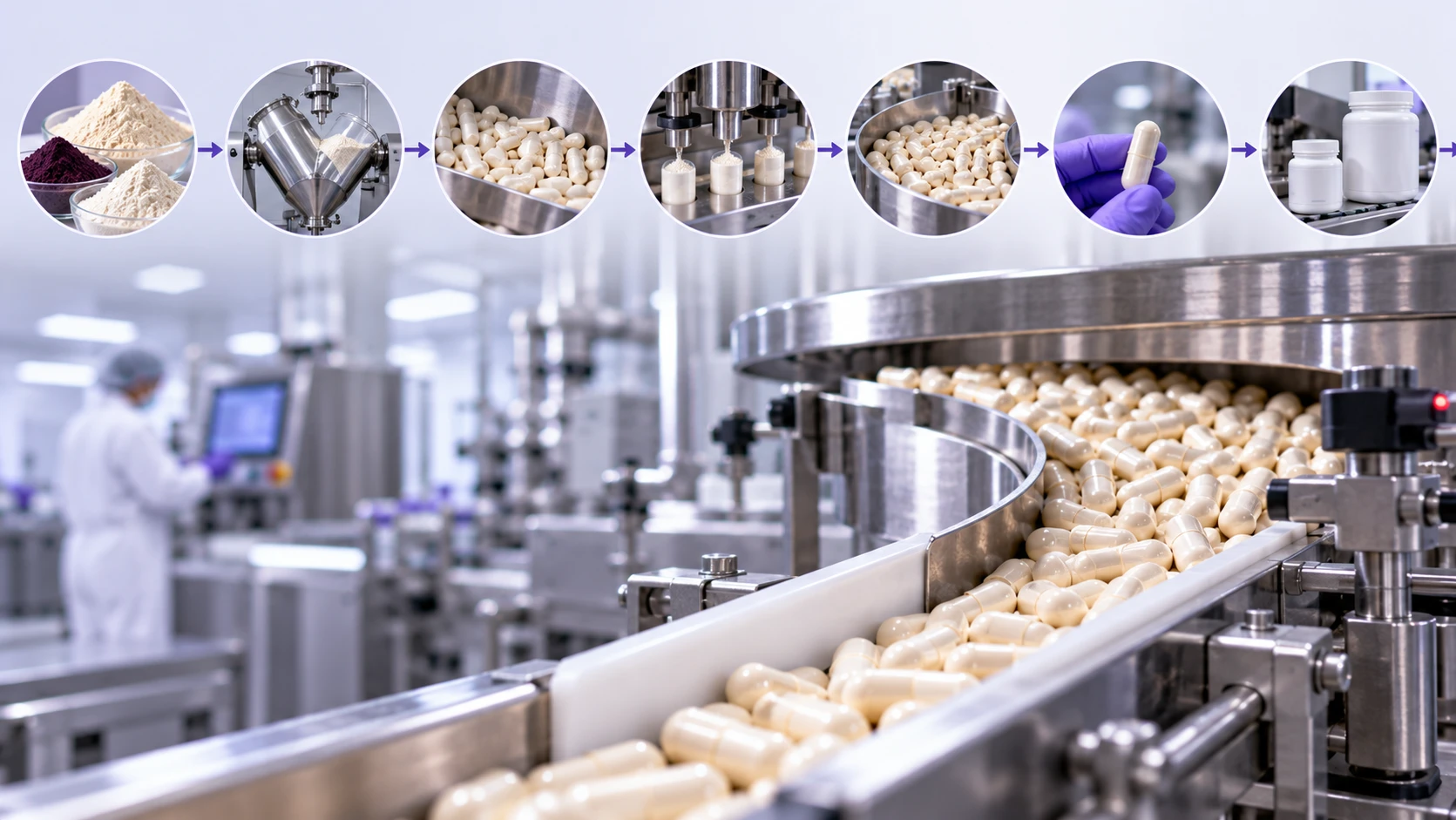
A contract supplement manufacturer produces dietary supplements for other brands. It sources ingredients, blends formulas, fills capsules, powders, or liquids, packages the finished product, and tests it for identity, purity, and potency. The brand owns the formula, label, and market. The manufacturer owns the process.
Which manufacturing model fits your brand?
Four models cover most engagements. The right one depends on who controls the formula and the supply chain.
| Model | Who sources ingredients | Who owns the formula | Best for |
|---|---|---|---|
| Custom formulation (turnkey) | Manufacturer | Brand, exclusive | Brands with a defined product concept |
| Tolling | Brand | Brand | Brands with an established supply chain |
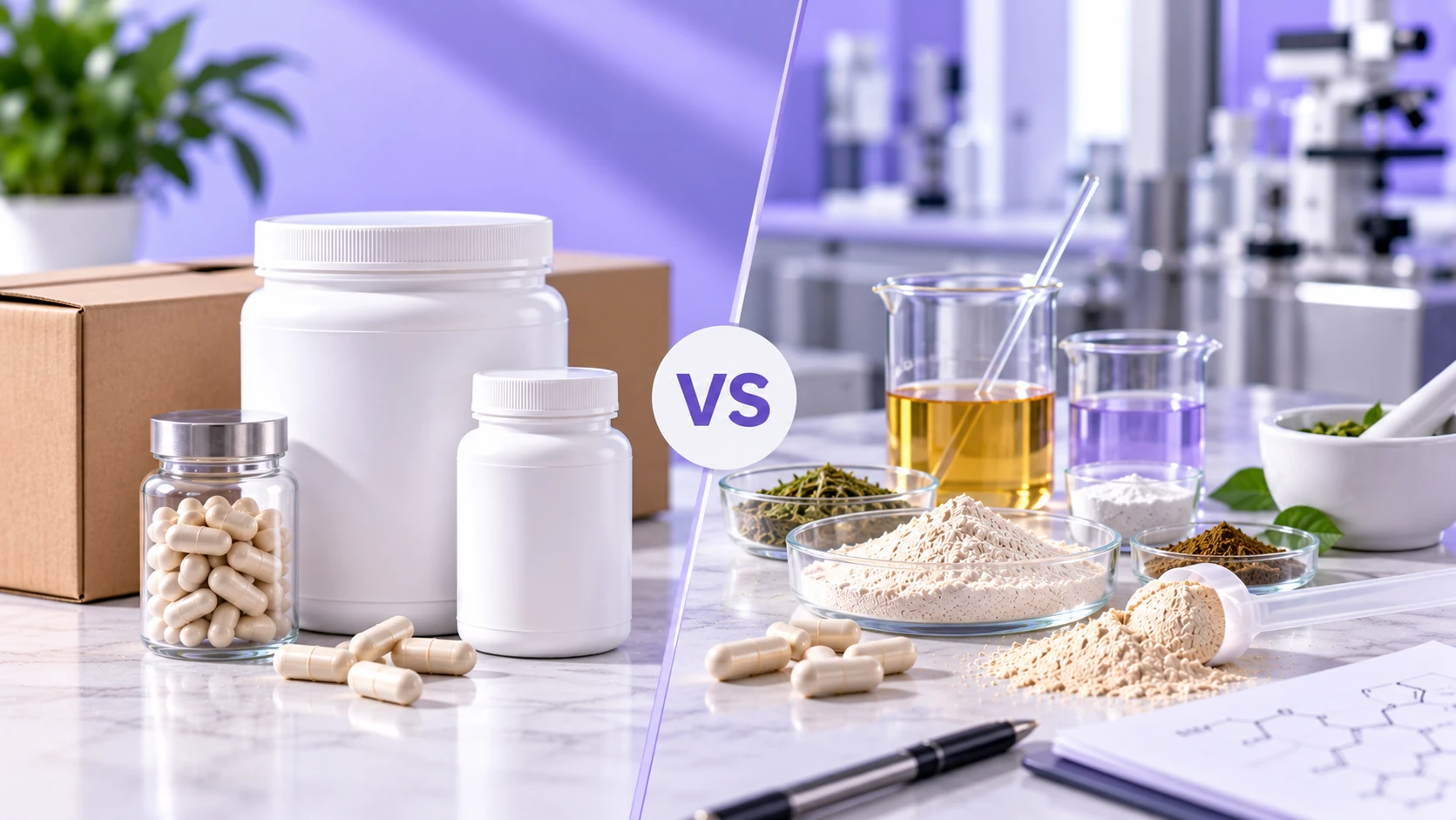
| Private label | Manufacturer | Manufacturer, stock formula | Fastest launch, least differentiation |
| Co-packing | Brand supplies finished bulk | Brand | Brands that need filling and packaging only |
Custom supplement manufacturing gives you a defensible product. Private label gives you speed. Choose based on how much differentiation your category demands.
How do you find a supplement manufacturer?
Find a supplement manufacturer in six steps: define the product, build a long list, screen credentials, request documents, quote against one spec, and audit. Each step removes weak candidates. Skipping any step moves risk onto your brand.
Step 1: Define your specification
Write a one-page brief before you contact anyone. Include format, dose per serving, ingredient list, claims, target order quantity, and packaging type. A clear brief filters out manufacturers who cannot run your product. It also makes quotes comparable.
Step 2: Build a long list
Source candidates from three places:
- Trade show exhibitor lists, such as Natural Products Expo West and SupplySide
- Trade association member lists
- Referrals from brand owners in your category
Aim for eight to ten names. Cut the list after screening.
Step 3: Screen on credentials
Remove any candidate that cannot show FDA registration, Part 111 compliance, and a current third-party audit. This step takes one email per candidate.
Step 4: Request the five documents
Ask for the five documents covered below. A strong manufacturer sends them within days. A weak one deflects.
Step 5: Quote against one specification
Send every shortlisted manufacturer the same brief. Ask for unit price, MOQ, lead time, testing scope, and payment terms in writing. Identical inputs expose real price differences.
Step 6: Audit and sample
Visit the facility or schedule a live video walkthrough of the production floor, warehouse, and lab. Order a pilot batch or samples before you commit to a full run.
What credentials should a supplement manufacturer hold?
A supplement manufacturer must register with FDA and comply with 21 CFR Part 111, the federal cGMP rule for dietary supplements. An independent certification, such as NSF/ANSI 455-2, adds third-party proof. Registration and Part 111 are legal requirements. Certification is voluntary and a strong quality signal.
| Credential | What it proves | Status |
|---|---|---|
| FDA facility registration | The facility is on file with FDA | Required |
| 21 CFR Part 111 compliance | Written procedures for specifications, production records, and quality control | Required by law |
| NSF/ANSI 455-2 GMP certification | An independent auditor verified GMP practice against a national standard | Voluntary |
| USDA Organic certification | The facility can handle certified organic claims | Needed for organic claims |
| Product liability insurance | The manufacturer carries coverage for product claims | Standard request |
FDA registration renews every two years. The current renewal window runs from October 1 to December 31, 2026, so a lapsed registration is easy to spot right now.
What does Part 111 require in practice?
Part 111 requires identity testing of dietary ingredients, written finished-product specifications, master manufacturing records, and batch production records. It also requires quality control oversight and complaint handling. A manufacturer that follows Part 111 can show you each of those records on request.
Which five documents should you request before a quote?
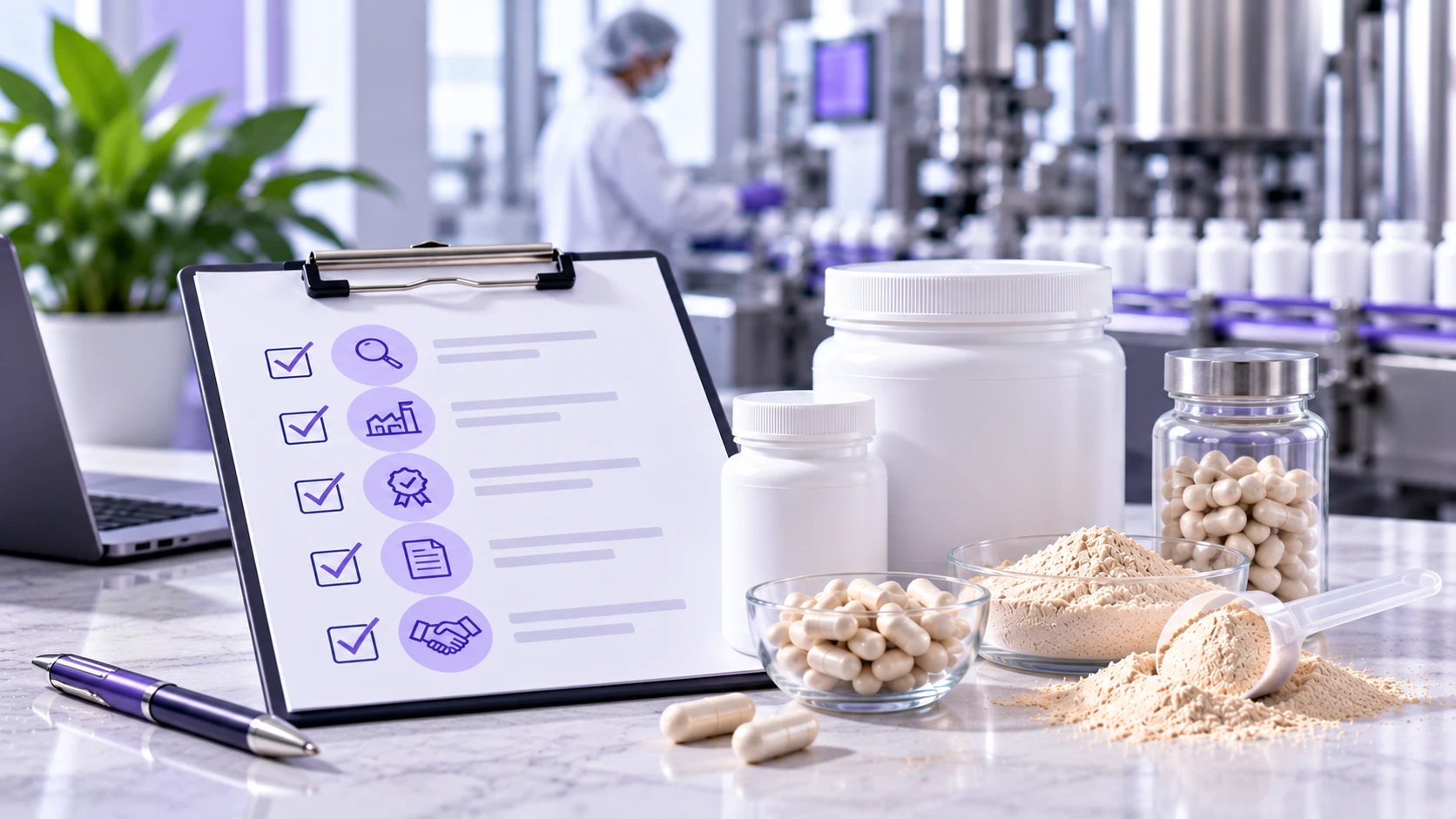
Request a GMP audit report, sample certificates of analysis, a master manufacturing record template, a testing protocol, and an insurance certificate. These five documents separate operators from marketers. Each one is routine for a compliant facility.
- GMP certificate and latest audit summary. Confirm the date, the scope, and any open corrective actions.
- Sample certificates of analysis (COAs). Request one for a raw ingredient and one for a finished product. Check that results report actual values, not only “pass.”
- Master manufacturing record and specification template. This shows how the plant controls a batch. Ask how a Finished Product Specification (FPS) is written and approved.
- Testing protocol. Confirm identity, potency, microbial, and heavy metal testing. Heavy metal panels, run by ICP/MS, should cover lead, arsenic, cadmium, and mercury.
- Insurance certificate and recall procedure. Ask for the written recall plan and the last time it was tested.
Then search FDA’s public warning letter database for the manufacturer’s name. A clean record is not proof of quality. A cited record is a flag you need to understand.
What questions should you ask a supplement manufacturer?
Ask about capacity, testing, formulation support, and ownership. These questions reveal how the manufacturer works under pressure. Prepare them in advance and ask every candidate the same set.
Capability
- Which formats do you run in-house, and which do you outsource?
- What is your minimum order quantity (MOQ) for my format?
- What is your standard lead time from approved formula to shipment?
Quality
- Which tests run in-house and which go to outside labs?
- How do you handle an out-of-specification result?
- When was your last FDA inspection, and what was the outcome?
Commercial
- Who owns the formula, and will you sign an NDA and a non-compete on it?
- What freight options and warehousing do you offer?
Specific answers signal a mature operation. Vague answers signal a broker.
How do you compare supplement manufacturers?
Compare manufacturers on the same criteria, scored from the same documents. Price is one column, not the verdict. A low unit cost that carries high rejection risk costs more than a fair price with reliable quality.
| Criteria | What strong looks like |
|---|---|
| Format capability | Runs your format in-house |
| Certification | Current third-party GMP audit |
| Testing | In-house identity and potency, outside lab for ICP/MS |
| MOQ | Fits your first-run budget with room to scale |
| Formulation support | Technical team reviews your formula for stability and flow |
| Communication | One accountable contact, written timelines |
| Logistics | Clear freight terms and lead-time commitments |
Score each candidate out of five per row. The total gives you a defensible decision to show partners or investors.
What are the red flags when choosing a supplement manufacturer?
A red flag is any behavior that suggests missing controls or hidden outsourcing. Watch for refusals, vague answers, and pressure. One flag warrants a follow-up. Three flags warrant a new shortlist.
- No facility tour or video walkthrough offered
- Refusal to share a GMP audit or COAs
- Claims of “FDA approved” or “FDA certified” supplements (FDA does not approve supplements)
- Unusually low pricing with no testing scope listed
- No NDA offered on your formula
- Pressure to sign before you receive samples
How does your format change the search?
Format determines equipment, minimums, and testing needs. Not every manufacturer runs every format well. Confirm the plant runs your format on its own lines, not through a subcontractor.
Capsule Supplement Manufacturing
Capsule production demands precise blending, encapsulation equipment, and weight control. Ask about in-process weight checks and disintegration testing.
Powder Supplement Manufacturing
Powders demand clean blending and strict cross-contact controls. Ask about blend uniformity testing and allergen segregation.
Liquid Supplement Manufacturing
Liquids add stability and microbial challenges. Ask about preservative systems, filling accuracy, and shelf-life data.
WB Blends manufactures capsules, powders, and liquids at its Spanish Fork, Utah facility under NSF/ANSI 455-2 GMP certification. One partner across three formats simplifies sourcing as your line expands.
Should you choose a domestic or overseas supplement manufacturer?
A domestic manufacturer gives you easier audits, faster communication, and shorter freight. An overseas manufacturer can lower unit cost but adds audit distance, import compliance, and longer lead times. For most U.S. brands, a domestic plant lowers the cost of a quality failure.
Foreign facilities supplying the U.S. market must also register with FDA and follow the same rules. Verify that claim with documents, not assurances.
What can credentials not tell you?
Credentials confirm process, not fit. An audit captures one point in time. A certificate does not tell you whether the team answers your calls, hits deadlines, or protects your formula. Close that gap with a site visit, a pilot batch, and a reference call with an existing customer.
Treat the first order as an extended audit. Track on-time delivery, specification match, and communication quality. Expand volume once the manufacturer earns it.
Next step
Send your specification to two or three vetted manufacturers on the same day. To see how WB Blends handles capsules, powders, and liquids, request a quote.
FAQs
What is the difference between a supplement manufacturer and a private label company?
A supplement manufacturer produces the product in its own facility. A private label company sells a stock formula under your brand, often made by a manufacturer. Ask which entity owns the production line.
Is NSF/ANSI 455-2 certification required?
No. FDA requires 21 CFR Part 111 compliance. NSF/ANSI 455-2 is a voluntary, third-party standard that verifies GMP practice through independent audit.
What is MOQ in supplement manufacturing?
MOQ is the minimum order quantity a manufacturer will run. It varies by format, ingredient cost, and equipment setup. Request the figure in writing for your exact product.
Do I need my own formula to work with a manufacturer?
No. Many manufacturers offer in-house formulations. If you bring a formula, ask for an NDA and confirm that the formula stays yours.
How do I protect my formula from being reused?
Sign an NDA before sharing the formula. Add a contract clause stating the formula is your intellectual property and cannot be sold to other brands.
Can I visit a supplement manufacturer before I sign?
Yes, and you should. A confident manufacturer welcomes an in-person or live virtual walkthrough. Refusal is a red flag.