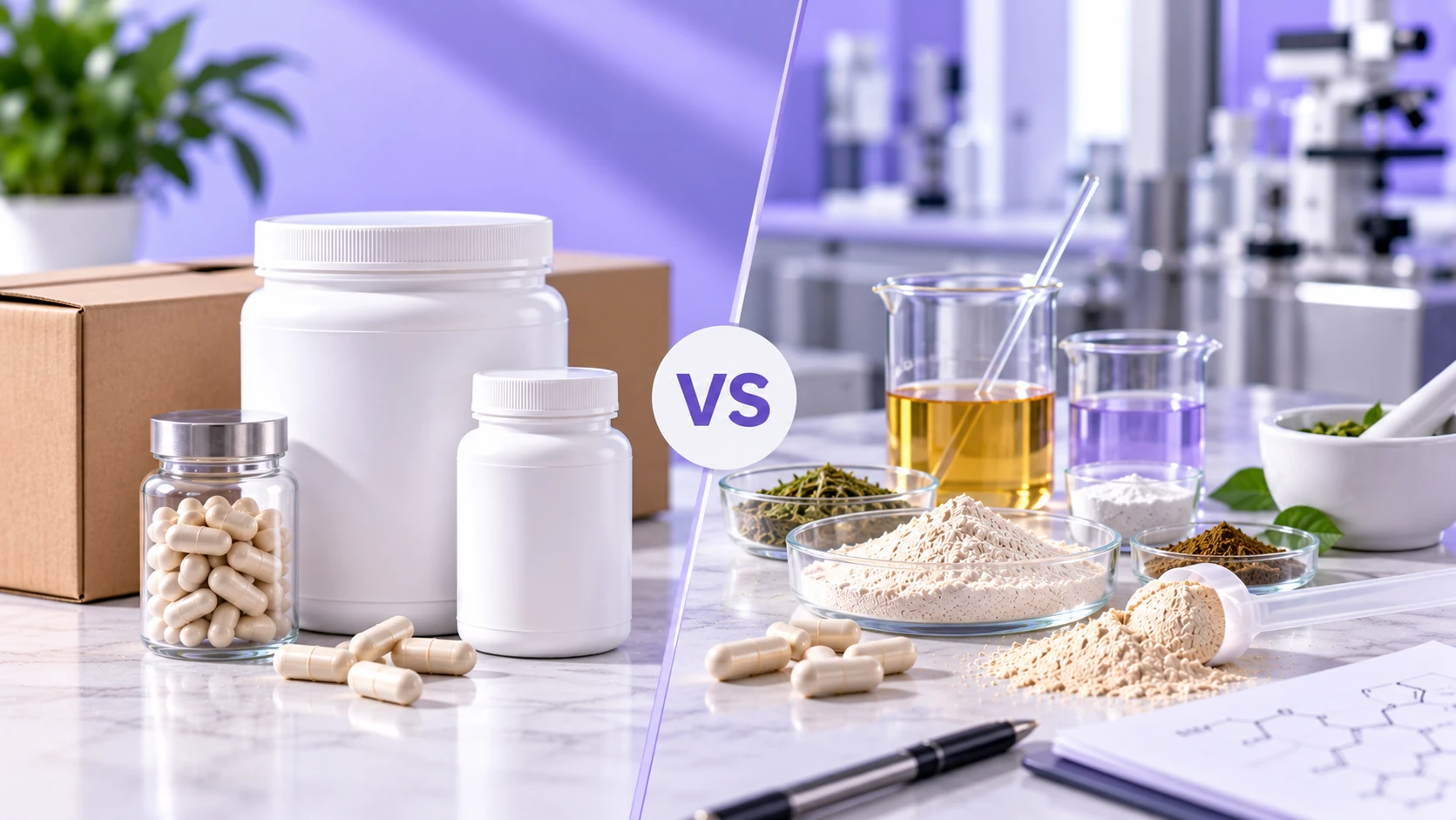

Private label vs white label is mostly a question of vocabulary. Many suppliers use both terms for the same thing: an existing stock formula that several brands sell under their own labels. Custom formulation is the real fork, because a formula built for one brand changes who can sell it, who can change it and who owns it.
Key Takeaways
- White label is an existing stock formula sold to several brands under their own labels. Private label is often used the same way, but usage varies, so clarify it with the manufacturer.
- Custom formulation is a formula developed for one brand. It costs more upfront and takes longer, and it gives you exclusivity and dose control. Many brands start with a stock formula and move to custom when sales data justifies it.
- Formula ownership depends on your agreement. A stock formula usually stays with the manufacturer. In a custom formula with WB Blends, the formula stays your intellectual property.
- Every model leaves your brand responsible for the finished product under FDA cGMP rules, labeling law and adverse event reporting.
- WB Blends makes capsules, powders and liquids on turnkey and toll programs.
Private Label vs White Label: What Is the Difference?
Usually none in the product. White label is an existing stock formula sold to several brands under their own labels, and many suppliers use private label to mean the same thing. Some suppliers use private label for a modified or exclusive stock formula, so ask what a quote includes.
How do the three models compare?
| White label | Private label | Custom formulation | |
|---|---|---|---|
| What it is | Existing stock formula | Often the same as white label. Sometimes a modified or exclusive stock formula. | Formula developed for one brand |
| Who can sell the formula | Several brands | Varies by agreement | Your brand only |
| Who owns the formula | Usually the manufacturer | Depends on the agreement | Set by contract. With WB Blends, it stays your intellectual property. |
| Ingredient and dose control | Limited | Partial, if modified | Full |
| Time to launch | Shortest | Short to moderate | Longest |
| Upfront cost | Lowest | Low to moderate | Highest |
| Minimum volume | Generally lower | Varies | Often higher |
| FDA cGMP responsibility | Your brand | Your brand | Your brand |
How do you settle the terminology with a supplier?
Ask three questions and write the answers into the quote:
- Is the formula exclusive to my brand?
- Who owns the specification?
- Can I move the formula to another manufacturer?
For the stock-formula model in depth, read how white label supplements work.
What Is Custom Formulation?
Custom formulation is the development of a formula for one brand. A formulator selects ingredients, forms and doses to your brief, and the result is a product no other brand can order from the manufacturer. In custom projects, the formula is the asset.
How is a custom formula developed?
- Brief. You define the target customer, product category, format, serving size and price position.
- Formulation. The manufacturer’s team drafts a formula and sources candidate ingredients.
- Sampling. You review prototypes for taste, flow, dissolution, appearance and mixability.
- Stability review. The formula is evaluated for shelf life under expected storage conditions.
- Specification. The approved formula becomes a Finished Product Specification (FPS) covering identity, purity, strength and composition.
- Production. The manufacturer scales the formula under cGMP controls.
What do you control in a custom formula?
You control the active ingredients, the dose per serving and the ingredient forms. You control the excipients, flavor systems and sweeteners. You decide which ingredients anchor your marketing. Dose control matters most when your claim depends on a specific level that stock formulas do not offer.
What is a proprietary formulation?
A proprietary formulation is a formula that only your brand sells. It is the result of custom formulation. A proprietary blend is different: it is a label term for ingredients listed together.
Which ingredient rules apply to custom work?
A dietary ingredient that was not marketed in the United States before October 15, 1994 is a new dietary ingredient (NDI). FDA says the manufacturer or distributor must notify FDA at least 75 days before marketing a supplement that contains an NDI, unless the NDI has been present in the food supply as an article used for food in a form that has not been chemically altered. Ask your formulator to screen every ingredient for NDI status before development starts.
What are the limits of custom formulation?
Development takes longer. Costs begin before the first unit ships. Minimum volumes are often higher because raw materials are sourced to your formula. A vague brief produces a vague product, so you need a clear position before you start.
What Is Semi-Custom Formulation?
Semi-custom formulation modifies an existing stock formula to fit your brief. Some suppliers call this private label. The manufacturer adjusts doses, swaps ingredient forms or adds an active, so you get partial differentiation without a full development cycle.
Common changes:
- Raising or lowering the dose of a key ingredient
- Switching to a different ingredient form
- Adding a complementary active to a base formula
- Changing the flavor system in a powder
- Adjusting capsule size or fill weight
Semi-custom works when a catalog formula is close to right. It shortens timelines compared with full custom work, and it gives you a documented specification that competitors cannot order. Confirm in writing what changes make the formula yours alone.
Which Model Costs Less, and Which Is Faster?
A stock formula costs less and launches faster, because the formula, specification and test methods already exist. Custom formulation adds development, sampling and stability stages before production, which raises upfront cost and time.
What drives price in every model?
- Raw material selection and grade
- Dose per serving
- Format (capsule, powder or liquid)
- Packaging and label complexity
- Order volume
- Third-party testing scope
Budget for label design and legal review, third-party lab testing, freight, storage and product liability insurance, which retailers and marketplaces often require. A formula only your brand sells reduces direct price comparison and can command a premium price.
What slows a custom project?
Delays almost always trace to the brief:
- Unclear target customer or claim
- Doses that change between sampling rounds
- Late changes to the flavor or format
- Slow approvals on your side
A locked brief is the fastest way to shorten a custom timeline. Stock formula orders slow down on packaging and labels instead: artwork revisions, claim edits and component lead times add days. Approve label content early.
Who Owns the Formula in Each Model?
Ownership depends on your agreement, not on the model name. A stock formula usually stays with the manufacturer. In a custom formula with WB Blends, the formula stays your intellectual property.
For private label, ownership depends on which meaning the supplier uses. If it means a stock formula, treat it like white label. If it means a modified or exclusive formula, ask for the terms in writing. Define these before development starts:
- Formula ownership. Who owns the final specification.
- Confidentiality. Whether the manufacturer can use your formula or its elements for other clients.
- Transfer rights. Whether you can move the formula to another manufacturer.
- Exclusivity period. How long the manufacturer will not produce the same formula for others.
- Raw material commitments. Whether you owe minimum purchases of ingredients sourced for your formula.
A formula you cannot move is a formula you do not fully own. If your manufacturer raises prices or misses delivery, transfer rights decide whether you can leave. Negotiate them early, while both sides expect to work together. For the white label side of this question, see who owns the formula in a white label supplement.
Who Is Responsible for Compliance?
You are, in every model. In warning letters, FDA says a firm can contract out manufacturing but not its ultimate responsibility to make sure the product is not adulterated for failure to follow cGMP. FDA does not approve dietary supplements before they are marketed.
- Manufacturing quality. Qualify your manufacturer, review its documentation and audit its performance.
- Labeling and claims. A structure/function claim needs the standard disclaimer and a notice to FDA within 30 days of first marketing, under 21 CFR 101.93. A disease claim can make the product subject to regulation as a drug.
- Adverse events. The firm named on the label is the responsible party and must send serious adverse event reports to FDA within 15 business days of receipt. Your manufacturer is not the responsible party unless its name is on the label, though you can authorize it to submit reports by agreement.
Verify these before you sign:
- Current cGMP certification from an independent body
- Written specifications for identity, purity, strength and composition
- Certificates of analysis (COAs) for raw materials and finished lots
- A documented complaint, recall and deviation process
- Label and claim review procedures
- Supplier qualification records
How Do You Choose Between the Models?
Choose a stock formula if you need speed, a lower entry cost or a market test. Choose custom formulation if you need exclusivity, specific dosing or a defensible brand position. Many brands start with a stock formula and move to custom as volume grows.
Choose a stock formula (white label or private label) if:
- You are validating demand for a category
- Your edge is distribution, audience or branding
- You need product within a short window
- Development spend exceeds your budget
Choose custom formulation if:
- Your claim depends on a specific ingredient, form or dose
- You sell through channels that penalize look-alike products
- You want a formula story you can trademark or defend
- You need a format or delivery system no catalog offers
Choose semi-custom if:
- A catalog formula is close but needs a different dose or ingredient form
- You want differentiation without a full development timeline
- You plan to move to a full custom formula later
What is the four-question decision test?
Answer yes or no to each question:
- Does your claim depend on a dose or ingredient form that stock formulas do not offer?
- Will competitors be able to buy the identical product and undercut your price?
- Can your budget absorb development costs and higher minimum volumes?
- Can you wait through development and sampling?
Questions 1 and 2 test need. Questions 3 and 4 test capacity.
| Your answers | Start with |
|---|---|
| Yes to question 1 or 2, and yes to both 3 and 4 | Custom formulation |
| Yes to question 1 or 2, but no to question 3 or 4 | Semi-custom now, custom formulation later |
| No to both questions 1 and 2 | A stock formula. Revisit when sales data justifies more. |
What is the hybrid path?
A brand launches a stock formula, learns what its customers repurchase, then commissions a custom formula to replace or extend it. This reduces early risk and sharpens the later brief. Validate demand before you pay for development: check search volume, marketplace listings, review language and competitor positioning.
What Formats Are Available for Each Model?
Both models are available across capsules, powders and liquids. Format affects cost, stability, shelf life and customer experience more than the model does. Match the format to the ingredient and the customer.
- Capsules suit precise dosing and taste-sensitive ingredients. Fill weight limits cap how much of each ingredient fits in a serving, so high-dose ingredients may need several capsules per serving.
- Powders suit high-dose ingredients such as proteins, greens, amino acids and electrolytes. They need attention to mixability, flow, moisture control and flavor masking.
- Liquids suit tinctures, extracts and fast-delivery formats. They demand careful decisions on preservation, stability, viscosity and packaging.
| Ingredient type | Strong format fit |
|---|---|
| High-dose amino acids, proteins | Powder |
| Botanical extracts, herbal concentrates | Liquid or capsule |
| Taste-sensitive minerals and vitamins | Capsule |
| Electrolyte and hydration blends | Powder |
| Tinctures and fast-delivery formulas | Liquid |
What Should You Ask a Manufacturer Before You Commit?
Ask about certifications, minimum volumes, development process, formula ownership and testing, and get each answer in writing. Vague answers signal operational risk.
- Which cGMP certifications do you hold, and can I see them?
- What are your minimum volumes by format?
- Who owns the formula in a custom project, and can I move it to another manufacturer?
- How do you test raw materials and finished lots?
- What is your timeline from brief to first production run?
- Do you offer tolling, turnkey or both?
- How do you handle label and claim review, complaints and recalls?
- Who is my day-to-day contact?
Tolling means you supply some or all materials and the manufacturer processes them. Turnkey means the manufacturer sources, produces and packages the finished product. Either can apply to a stock formula or a custom one. See turnkey vs tolling manufacturing, and for the wider vetting process read how to choose a supplement contract manufacturer.
Red flags:
- No written specifications
- Refusal to share certifications or COAs
- Guarantees of FDA approval, which does not exist for supplements
- Pressure to skip testing to cut cost
- No clear answer on who owns the formula
How WB Blends handles this
WB Blends is a dietary supplement contract manufacturer in Spanish Fork, Utah, with 25+ years of experience. It makes capsules, powders and liquids on turnkey and toll programs. When a formula needs development, R&D and formula development is step two of the process, and the formula stays your intellectual property. A Finished Product Specification is approved before production, and a Certificate of Analysis ships with every lot. Your Sales contact works with you before the purchase order, and an Account Manager takes over after it. Preliminary quotes take 5-6 business days.
FAQs
Are private label and white label supplements the same thing?
Often, yes. Both terms usually mean an existing stock formula sold to several brands under their own labels. Some suppliers use private label for a modified or exclusive formula. Ask what the quote includes, whether the formula is exclusive and who owns it, and get the answers in writing.
Can I switch from a stock formula to custom formulation later?
Yes. Many brands do. Use sales and review data to identify the product customers repurchase. Then brief a custom version that changes its dose, ingredient form or format. The stock launch gives you a documented baseline, and a locked brief shortens the development timeline.
Do I own a custom formula?
Ownership depends on your contract. Define formula ownership, confidentiality and transfer rights in writing before development begins. Also settle exclusivity periods and raw material commitments, because they decide how freely you can move the formula later. In a custom formula with WB Blends, the formula stays your intellectual property.
Is a stock formula lower quality than a custom formula?
No. Quality depends on the manufacturer’s raw material controls, testing and cGMP systems. A well-made stock formula can outperform a poorly specified custom formula. The real gap between the two is differentiation, not quality. Compare manufacturers on certifications, written specifications and COAs rather than on the model name.
What is a proprietary formulation?
A proprietary formulation is a formula that only your brand sells, developed through custom formulation. The formula is the asset, so ownership, confidentiality and transfer rights belong in your contract. It differs from a proprietary blend, which is a label term for ingredients listed together.
Who handles adverse event reports for a private label product?
The company named on the label is the responsible party and must send serious adverse event reports to FDA within 15 business days of receipt. Your manufacturer can assist with intake if your agreement says so, but the legal duty stays with you.
Planning a launch? Request a quote. Preliminary quotes take 5-6 business days.