
White label supplements are finished, pre-formulated dietary supplements that a contract manufacturer produces and another company sells under its own brand. The manufacturer owns the formula and the production. The brand owns the label, the pricing, and the customer relationship. It is the fastest route from idea to shelf.
This guide covers the model end to end. You will see how it works, how it compares to private label and custom formulation, which formats exist, what regulations apply, how to vet a partner, and how to launch. Each section opens with a direct answer. The detail follows.
KEY TAKEAWAYS
- White label supplements are pre-formulated products made by a contract manufacturer and sold under your brand.
- The manufacturer owns the formula and production. You own the label, marketing, pricing, and customer.
- FDA holds the brand owner accountable for cGMP compliance, even when a partner makes the product.
- Powder, capsule, and liquid are the core formats. Format drives cost, dosing, and shelf life.
- Choose a manufacturer on certification, testing, minimums, and transparency. Not on price alone.
What are white label supplements?
White label supplements are finished, pre-formulated dietary supplements produced by a contract manufacturer and sold by a brand under its own name. The manufacturer supplies the formula, ingredients, and production. The brand adds its label, packaging, and marketing. No formulation budget is required to launch.
The category sits inside a very large market. The Council for Responsible Nutrition’s 2024 consumer survey found that 75 percent of Americans continue to use dietary supplements. The 2023 edition found that 55 percent of the general population qualify as regular users. A stable, habit-driven customer base is why white label supplements remain the default entry point for new brands.
What does “white label” actually mean?
The term comes from plain, unbranded product. The manufacturer makes the product in a neutral state. The brand applies its own identity. In supplements, “white label” usually means a catalog formula the manufacturer already runs, with your label and packaging added.
The formula is typically non-exclusive. Another brand can sell the same base product under a different name. That trait defines the model and shapes every decision that follows.
How does white label supplement manufacturing work?
A brand selects an existing formula from the manufacturer’s catalog and chooses a format. The manufacturer sources ingredients, produces the batch, tests it, and packages it. The brand’s approved label goes on the finished product. The order ships to the brand or a fulfillment partner.
The brand never operates equipment, buys raw material, or manages a production floor. It manages quality oversight, compliance, and sales.
Who does what in a white label partnership?
| Task | Manufacturer | Brand |
|---|---|---|
| Formula | Provides | Selects |
| Ingredient sourcing | Handles | Approves specifications |
| Production | Handles | Approves batch records |
| Quality testing | Performs | Reviews certificates of analysis |
| Label design | Supplies templates and panel support | Owns and approves |
| Claims and marketing | None | Owns |
| Complaint and adverse event handling | Supports | Owns |
| Regulatory accountability | Operates a compliant facility | Verifies it and answers to FDA |
Who buys white label supplements?
Five buyer types use the model most often:
- First-time founders launching a supplement brand with limited capital.
- DTC and e-commerce brands adding a supplement line to an existing audience.
- Practitioners and clinics who want a branded product for patients.
- Creators and coaches monetizing an audience with a product that carries their name.
- Established consumer brands testing a new category before investing in a custom formula.
How are white label supplements different from private label?
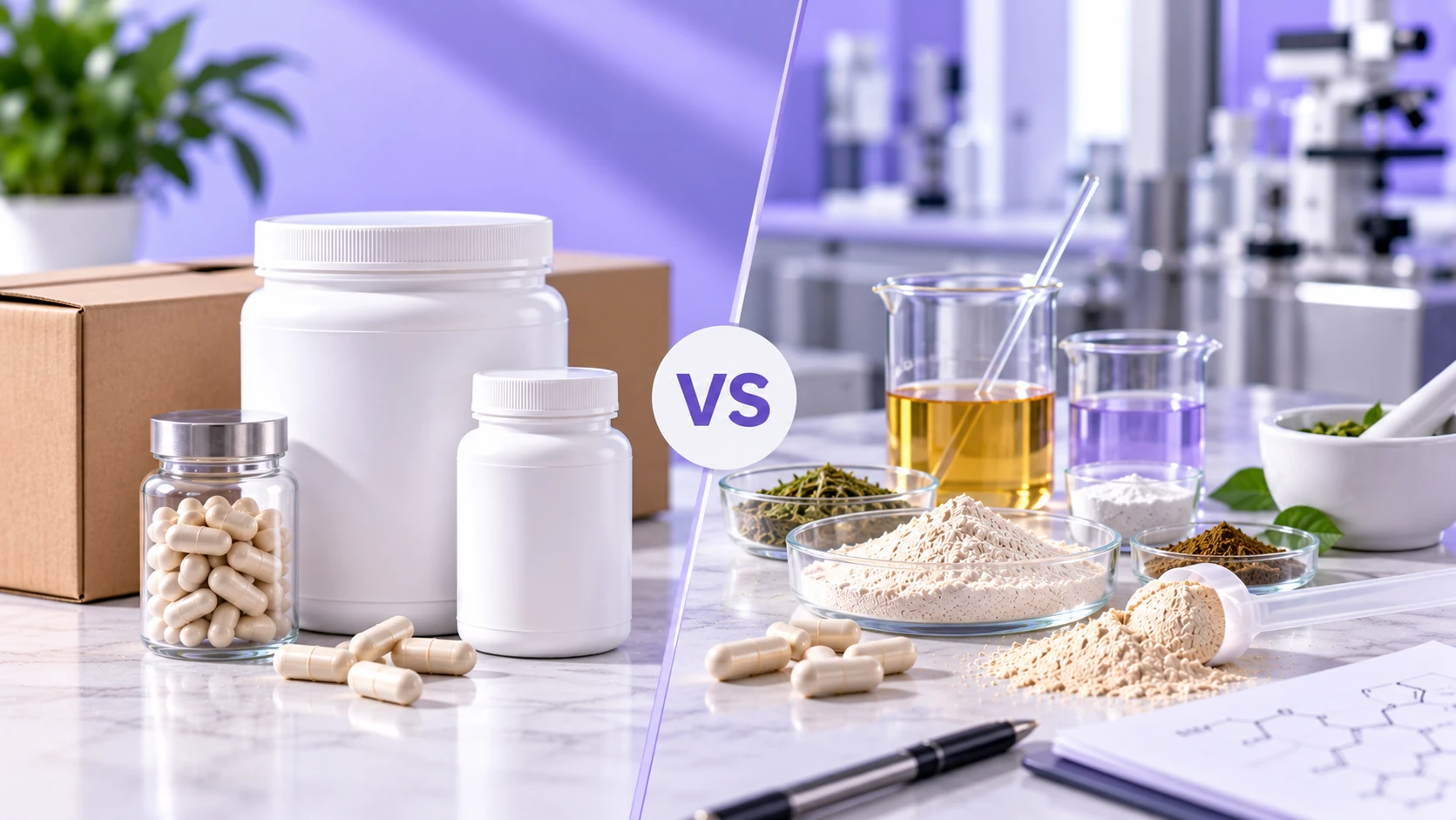
White label supplements use a manufacturer’s existing formula with your label applied. Private label supplements use a formula developed or adapted for your brand, often with exclusivity. White label is faster and cheaper to launch. Private label gives you more control over ingredients and differentiation.
Many suppliers use the two terms interchangeably. Do not assume. Ask what the quote includes, whether the formula is exclusive, and who owns it.
White label supplements
You choose a finished formula. You change the label. You own nothing about the formula itself. This is the lowest-cost, lowest-risk entry.
Private label supplements
You start from a base formula and adjust it. Changes can include ingredient forms, doses, flavors, or added ingredients. The result is closer to unique, and exclusivity terms vary by agreement.
Custom formulation
You commission a formula built for your brand. It carries the longest timeline and the highest upfront cost. It delivers full differentiation and the strongest claim position.
| Factor | White label | Private label | Custom formulation |
|---|---|---|---|
| Formula | Manufacturer’s existing | Adapted or exclusive | Built from scratch |
| Exclusivity | Usually none | Often partial | Full |
| Time to launch | Shortest | Moderate | Longest |
| Upfront cost | Lowest | Moderate | Highest |
| Differentiation | Branding and positioning | Formula adjustments | Formula and claims |
| Best for | First launches, market testing | Growing brands | Established brands |
Which model should you choose?
Use this decision guide:
- Choose white label if you are validating an idea, working with a limited budget, or launching quickly.
- Choose private label if you have proven demand and need a point of difference in the formula.
- Choose custom formulation if you have steady volume, a defined customer, and a claim position worth protecting.
Most brands start with white label supplements and move up as sales data justifies the investment.
Why do brands launch with white label supplements?
Brands choose white label supplements for speed, lower upfront cost, and reduced complexity. The formula already exists, so no research phase delays launch. Capital goes to brand building, marketing, and inventory instead of development. The model lets a new brand test demand before committing to a custom formula.
Speed to market
An existing formula removes the development phase. You approve specifications, finalize the label, and place the order. Time you save on formulation goes to brand, content, and channel setup.
Lower upfront cost
You skip formulation fees, stability studies, and pilot batches. Minimum order quantities still apply and vary by manufacturer and format. Your first order is smaller than a custom run, which protects cash.
A proven starting point
Established formulas have production history. The manufacturer already knows how the blend runs, which ingredients behave, and what the finished product tests to. That reduces batch failures and rework.
Simpler operations
One partner handles sourcing, production, testing, and packaging. You manage the brand and the customer. A small team can run a supplement line without a single piece of production equipment.
A low-risk way to validate demand
A first order tells you what the market wants. Sales data shows which product, format, and message convert. You then invest in private label or custom work with evidence, not assumptions.
Demand is shifting toward specific ingredients
Consumer interest moves. The 2024 CRN survey reported that ashwagandha use among supplement users rose to 8 percent, up from 2 percent in 2020. It also named energy and immune health as significant reasons people take supplements. Catalog-based sourcing lets a brand respond to these shifts faster than a custom build allows.
What are the limitations of white label supplements?
The limits of white label supplements are differentiation and control. Other brands can sell the same base formula. You cannot freely change ingredients or doses. Your edge comes from positioning, packaging, and customer experience, not from the formula itself. Plan for that from day one.
Limited differentiation
A shared formula means a shared product. Customers compare labels and prices. If your only difference is the logo, you compete on price. That is a weak position.
Less formula control
Ingredient forms, doses, and excipients are set. Adjustments are possible only within what the manufacturer offers. If your concept needs a specific ingredient form or dose, white label is the wrong starting point.
Dependence on one partner
Your supply depends on one facility. A delay, a capacity shortage, or a quality lapse hits your business directly. Evaluate capacity, communication, and track record before you commit.
Claim position is weaker
Claims backed by research on a specific formula are stronger than claims built on a generic one. A shared formula limits what you can substantiate. Keep marketing within what the ingredients and evidence support.
How can you differentiate a white label supplement?
Differentiation is possible without owning the formula:
- Positioning. Pick a narrow customer and speak to one need.
- Packaging and design. Premium presentation signals quality.
- Bundles and protocols. Combine products into a routine.
- Content and education. Teach the customer how to use the product.
- Service. Subscription options, fast shipping, and responsive support.
- Format choice. Select the format your competitors overlook.
Which formats are available for white label supplements?
The core white label supplement formats are powder, capsule, and liquid. Each suits a different product type, dose size, and customer habit. Format also sets your cost structure, shelf life, and packaging needs. Choose it before you choose a formula.
WB Blends manufactures in these three formats at its facility in Spanish Fork, Utah.
Powder
Powders carry larger doses. They suit greens, protein blends, electrolytes, and functional drink mixes. Customers scoop and mix. Packaging options include tubs, pouches, and single-serve sticks. Powders ask more of flavor and mixability, so evaluate samples carefully.
Capsule
Capsules deliver precise, portable doses. They suit botanicals, vitamins, minerals, and targeted formulas. They mask taste, which widens ingredient choice. They are the standard for daily regimens. Capsule count per bottle sets your price per serving and your repurchase cycle.
Liquid
Liquids offer flexible dosing and fast, familiar delivery. They suit tinctures, drops, and shots. They demand careful decisions on stability, preservation, and packaging. Dropper bottles and single-serve vials serve different customers.
How do the formats compare?
| Factor | Powder | Capsule | Liquid |
|---|---|---|---|
| Dose size | Large | Small to moderate | Flexible |
| Portability | Moderate | High | Moderate |
| Taste concern | High | Low | High |
| Typical packaging | Tubs, pouches, sticks | Bottles | Dropper bottles, vials |
| Best for | Greens, protein, electrolytes | Botanicals, vitamins, targeted blends | Tinctures, drops, shots |
How do you choose a format?
Match the format to the customer’s habit.
- Does the customer want a quick daily routine? Choose capsule.
- Does the ingredient require a large dose? Choose powder.
- Does the customer want fast, adjustable dosing? Choose liquid.
Then check the economics. Format changes your minimums, packaging cost, and shelf life.
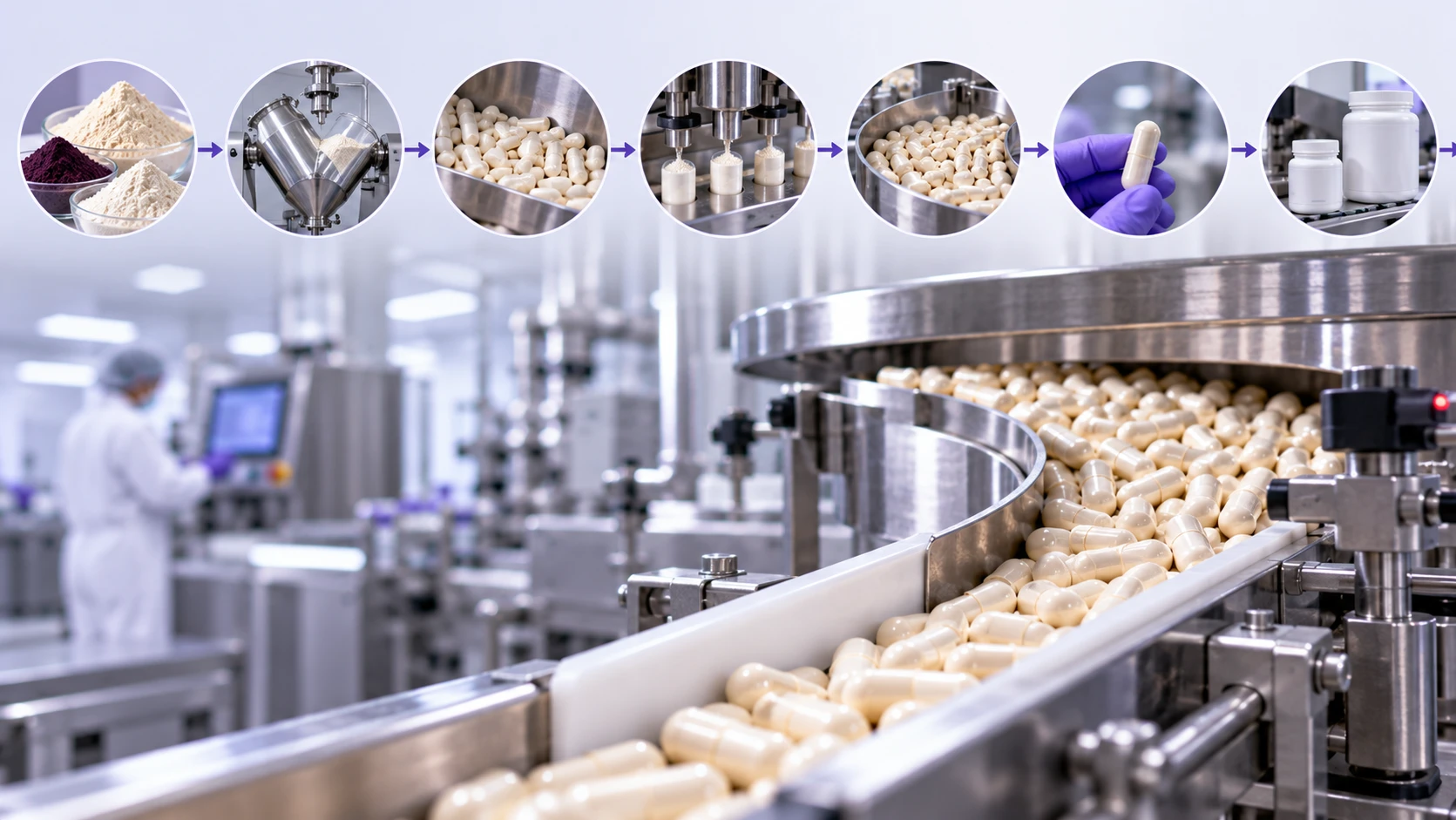
How are white label supplements made?
White label supplements move through six steps: formula selection, specification approval, ingredient testing, production, finished-product testing, and labeling. The manufacturer runs steps two through six. The brand approves at each gate and keeps the records. Every step produces documentation you should receive.
- Select the formula and format. Choose the product that fits your customer and review its supplement facts and ingredient list.
- Approve specifications. Confirm identity, purity, strength, and contaminant limits for the finished batch. Written specifications anchor every later test.
- Test incoming ingredients. The facility verifies identity before material enters production.
- Produce the batch. Blending, encapsulating, or filling follows a master manufacturing record. Each batch gets its own batch production record.
- Test the finished product. The batch is released only after it meets specification.
- Label, pack, and ship. Your approved label goes on. The order ships to you or your fulfillment partner.
What documents should you receive?
Ask for these with every order:
- Finished Product Specification (FPS). The written standard the batch must meet.
- Certificate of analysis (COA). Test results for the released batch.
- Ingredient and allergen statement. The full list, including any processing aids.
- Batch identification. Lot numbers that trace to the production record.
- Label proof. A final approval before printing.
What should a certificate of analysis show?
A useful COA lists the product name, lot number, test method, specification, and result for each test. Look for identity, potency of key ingredients, microbial limits, and heavy metals. Ask whether the lab uses ICP/MS for metals. A COA with no methods and no limits tells you little.
What regulations apply to white label supplements?
FDA regulates white label supplements under 21 CFR Part 111, the dietary supplement cGMP rule. It covers manufacturing, packaging, labeling, and holding. Brand owners remain accountable for compliance even when a contract manufacturer does the work. Verify your partner before you order.
The cGMP rules for dietary supplements took effect in 2007. Enforcement remains active. According to one industry testing provider, the most frequent inspection observations since 2009 fall under Subpart E, the requirement to establish a production and process control system.
Brand owner accountability
FDA states this position in warning letters. A firm that contracts out dietary supplement operations is still responsible for ensuring the product is not adulterated, regardless of who performs the work. A trade publication summarizing the rule puts it plainly: a brand owner cannot shift compliance blame onto its contract manufacturer.
Choosing a compliant partner reduces risk. It does not transfer liability.
Specifications are your job
Part 111 expects specifications for the finished batch. FDA has cited firms that failed to establish specifications for identity and strength of the finished batch, and for contamination limits. It has also cited firms for missing label and packaging specifications. A brand that relies on a manufacturer’s default paperwork without owning its own specifications carries real exposure.
Labeling requirements
Every label needs a Supplement Facts panel, an ingredient list, the net quantity, and the name and place of business of the responsible firm. Allergen declarations apply. Label review before print is a brand responsibility.
Claims
Structure and function claims require the standard FDA disclaimer. You notify FDA within 30 days of first marketing a claim. The FTC expects competent and reliable evidence for what you say in marketing. Disease claims are off limits for dietary supplements.
Complaints and adverse events
You need a process to receive and review product complaints. Part 111 requires a qualified person to investigate complaints related to cGMP, as described in 21 CFR 111.560. Serious adverse events must be reported to FDA under federal law. Build this process before your first sale.
This article is educational, not legal advice. Engage regulatory counsel before launch.
How do you choose a white label supplement manufacturer?
Choose a white label supplement manufacturer on verified quality systems, transparent testing, realistic minimums, and growth fit. Price comes last. A cheaper partner that fails an audit costs more than a fairly priced partner that passes. Verify every claim in writing.
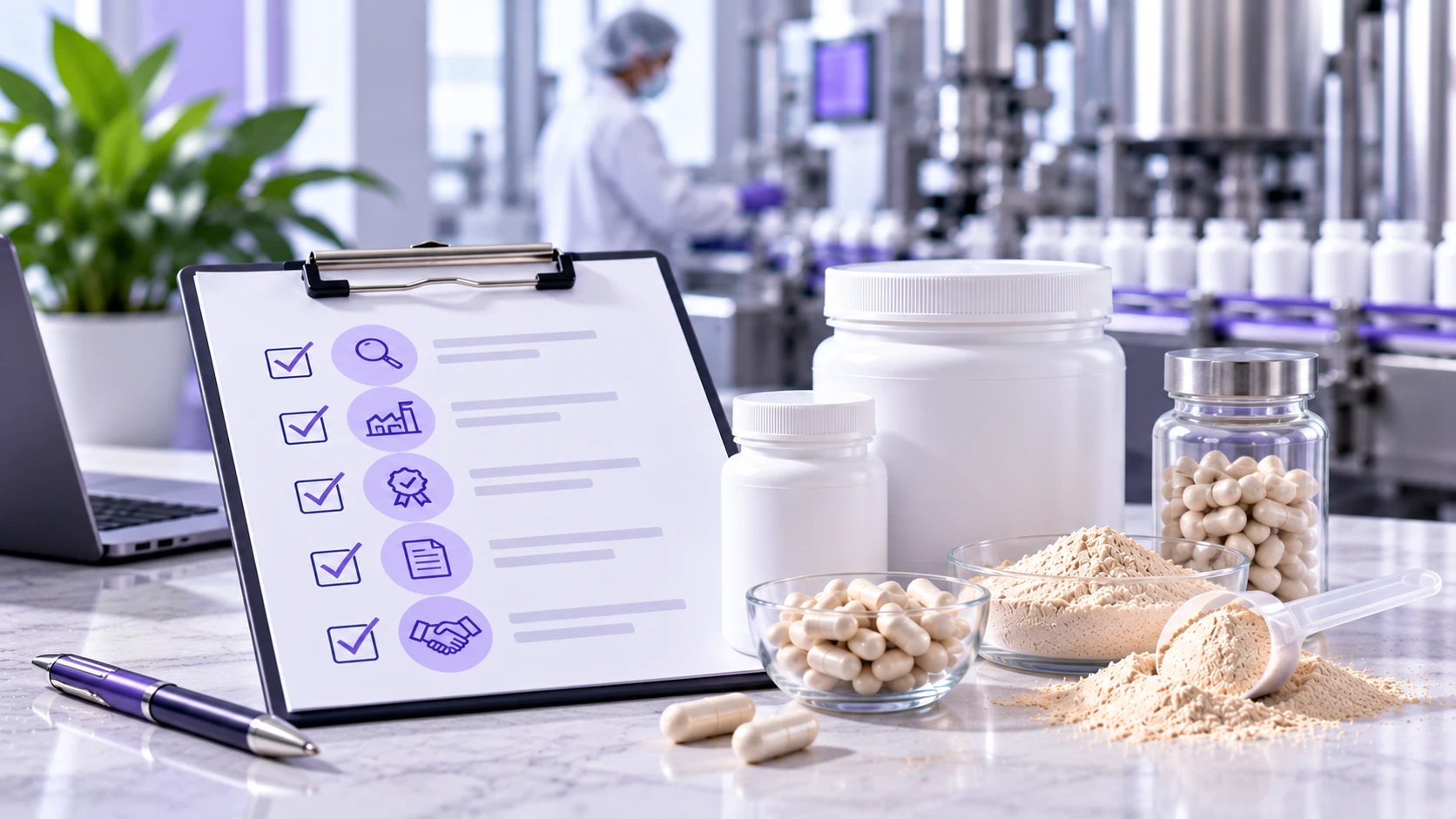
The core checklist
- Third-party GMP certification. WB Blends holds NSF/ANSI 455-2 GMP certification. Independent certification confirms a facility passes outside audits, not just its own.
- Testing transparency. Request COAs on identity, potency, microbial limits, and contaminants.
- Minimum order quantities. Get them in writing, by format and by SKU.
- Lead times. Request a written schedule from approval to shipment.
- Format range. Confirm the partner produces the format you need today and the one you may want next.
- U.S. facility and freight. A domestic partner shortens transit and speeds communication. Ask how orders ship, including LTL freight for pallet quantities.
- Communication. Test response speed during the quote stage. It predicts how production issues get handled.
- Growth path. Confirm support for private label and custom formulation later.
Questions to ask every manufacturer
- Which third-party certifications do you hold, and can I see the current certificate?
- What testing do you run on incoming ingredients and on finished batches?
- Can I receive a COA with every lot?
- What are your minimums by format?
- What is your standard lead time, and what delays it?
- Do you offer tolling, turnkey, or both?
- Who owns the formula, and is it exclusive?
- How do you handle a failed batch or a complaint?
Red flags
- No third-party certification and no willingness to be audited.
- COAs that omit methods and limits.
- Vague answers on minimums, lead times, or fees.
- Pressure to skip specification approval.
- Claims of FDA approval for the facility. FDA does not approve supplement facilities.
- A quote far below the market with no explanation.
How much do white label supplements cost?
White label supplement pricing depends on four variables: formula, format, order quantity, and packaging. Larger runs lower the per-unit cost. Premium ingredients and packaging raise it. Request itemized quotes so you can compare partners on equal terms and see every fee.
What drives the price?
- Formula. Ingredient quality and rarity set the base cost.
- Format. Powder, capsule, and liquid carry different production and packaging costs.
- Quantity. Higher volume lowers the per-unit price.
- Packaging and labeling. Bottles, pouches, and printed labels add to the total.
What costs do brands miss?
- Testing and COA fees.
- Label design and print runs.
- Freight and storage.
- Regulatory review and legal costs.
- Fulfillment, payment processing, and returns.
- Marketing, which often exceeds production cost.
How do you calculate unit economics?
Use this worksheet:
Landed cost per unit = (production price + packaging + labels + testing fees + freight) ÷ units
Gross margin = (retail price − landed cost) ÷ retail price
Hypothetical example, not a quote: a landed cost of $8 and a retail price of $32 yields a 75 percent gross margin. Marketing, fulfillment, and payment fees come out of that margin. Run the math before you place an order.
How do you launch a white label supplement brand?
Launching white label supplements takes seven steps: define the customer, choose the product and format, vet manufacturers, approve specifications and samples, finalize the label and claims, place the first order, and set up quality follow-up. Each step has an owner and a deliverable.
- Define the customer. Name one customer and one need. Narrow beats broad.
- Choose the product and format. Match the formula to the customer’s habit.
- Vet manufacturers. Use the checklist above. Request quotes from more than one partner.
- Approve specifications and samples. Review the FPS. Test samples for taste, mixability, or fill quality.
- Finalize label and claims. Complete the Supplement Facts panel. Review claims against evidence. Get counsel’s sign-off.
- Place the first order. Confirm minimums, lead time, and ship terms in writing.
- Set up quality follow-up. File COAs. Log lots. Create your complaint process.
Start small. A first order is a learning order.
When should a brand move beyond white label supplements?
Move beyond white label supplements when you need exclusivity, claim differentiation, or better volume economics. The next step is a custom formula. Tolling and turnkey are the two common production structures. Your sales data and customer feedback should guide the timing.
Signs you are ready
- Competitors sell the same base formula.
- Sales justify larger production runs.
- Customers ask for a specific ingredient or dose.
- You want claims tied to a specific formula.
Tolling vs turnkey
In tolling, you supply the ingredients and the manufacturer handles production. You control sourcing and carry the inventory. In turnkey, the manufacturer sources everything and delivers the finished product. Turnkey is simpler. Tolling offers more control and can reduce cost at scale.
What about co-packing?
Co-packing covers packaging and filling of product you already own. It suits brands with an established formula and supply chain. It is a different service from white label, which includes the formula.
What mistakes should you avoid with white label supplements?
The most common white label supplement mistakes are skipping specifications, ignoring certificates of analysis, choosing on price, and making unsupported claims. Each one is avoidable with a written process and a documented review at every stage. Each one shifts risk onto the brand owner.
- Skipping specifications. FDA expects them. Your batch needs a written standard.
- Ignoring COAs. A COA you never read does not protect you.
- Choosing on price. The cheapest quote often hides fees or quality gaps.
- Overclaiming. Marketing outruns evidence. Match every claim to support.
- No complaint process. You need one before the first sale.
- Ordering too much. A large first order ties up cash before demand is proven.
- Treating the partner as a vendor. The best results come from a working relationship.
What do white label supplement terms mean?
White label supplement manufacturing uses a short set of industry terms. Knowing them speeds quotes and prevents miscommunication. The table below defines the terms you will see in specifications, quotes, and contracts, from MOQ and COA to cGMP, tolling, and turnkey.
| Term | Meaning |
|---|---|
| White label | Existing formula, your label |
| Private label | Adapted or exclusive formula, your label |
| MOQ | Minimum order quantity |
| COA | Certificate of analysis for a released lot |
| FPS | Finished Product Specification |
| cGMP | Current Good Manufacturing Practice, 21 CFR Part 111 |
| Tolling | You supply ingredients, the manufacturer produces |
| Turnkey | The manufacturer sources and produces |
| Co-packing | Filling and packaging of your own product |
| ICP/MS | A lab method used to test for heavy metals |
| LTL freight | Less-than-truckload shipping for partial pallet orders |
FAQs
Are white label supplements legal?
Yes. White label supplements are legal when the product and label meet FDA requirements. The brand owner is accountable for compliance, so verify your manufacturer’s cGMP practices before you order.
Are white label supplements good quality?
Quality depends on the manufacturer. Look for third-party GMP certification, documented testing, and a COA for every lot. Ask to see the certification and the testing methods.
Can I customize white label supplements?
Customization is usually limited to branding, packaging, and select formula adjustments. Full formula changes move you into private label or custom formulation.
What is the minimum order for white label supplements?
Minimums vary by manufacturer and format. Confirm the figure in writing before you plan inventory or cash flow.
Does FDA approve white label supplements before sale?
No. FDA does not pre-approve dietary supplements. You must follow cGMP, label correctly, and notify FDA of structure and function claims within 30 days of marketing.
How long does it take to launch a white label supplement?
Timelines depend on the formula, packaging, and testing. Ask your manufacturer for a written schedule from order approval to delivery, and build label approval into your plan.
Who owns the formula in a white label supplement?
The manufacturer owns it. You license the right to sell the finished product under your brand. Exclusivity requires a private label or custom agreement.
What is the difference between white label and contract manufacturing?
Contract manufacturing is the broader service. A manufacturer produces a product to your specifications. White label is one version of it, where the formula is the manufacturer’s and you add the brand.
Is white label or private label better for a new brand?
White label suits most new brands because it is faster and lower cost. Choose private label when you have proven demand and need formula-level differentiation.