
Private label supplements are ready-made formulas produced by a contract manufacturer and sold under your brand name. Custom formulation is a proprietary formula developed to your exact specification, with ingredients, doses and format chosen by you. Private label optimizes speed. Custom formulation optimizes ownership.
The choice shapes your cost, your timeline, your margins and your competitive position. Founders who treat it as a packaging decision pay for it later. This guide covers both models, the middle ground between them, and the criteria that decide which one fits.
KEY TAKEAWAYS
- Private label supplements are existing stock formulas you brand as your own. Custom formulation is a proprietary formula built to your specification.
- Private label is faster and cheaper to launch. Custom formulation costs more upfront but gives you exclusivity and control.
- A middle option exists: semi-custom, where a stock formula is modified to fit your brief.
- Both routes leave you legally responsible for the finished product under FDA cGMP rules, labeling law and adverse event reporting.
- WB Blends manufactures capsules, powders and liquids under every model.
What Are Private Label Supplements?
Private label supplements are finished-product formulas that a manufacturer has already developed, tested and produced. You select a formula, add your branding and sell it as your own. The manufacturer handles production. You handle the brand, the marketing and the customer.
Private label is also called white label. The two terms describe the same core model. The formula belongs to the manufacturer’s catalog, and your label sits on top.
How Private Label Works
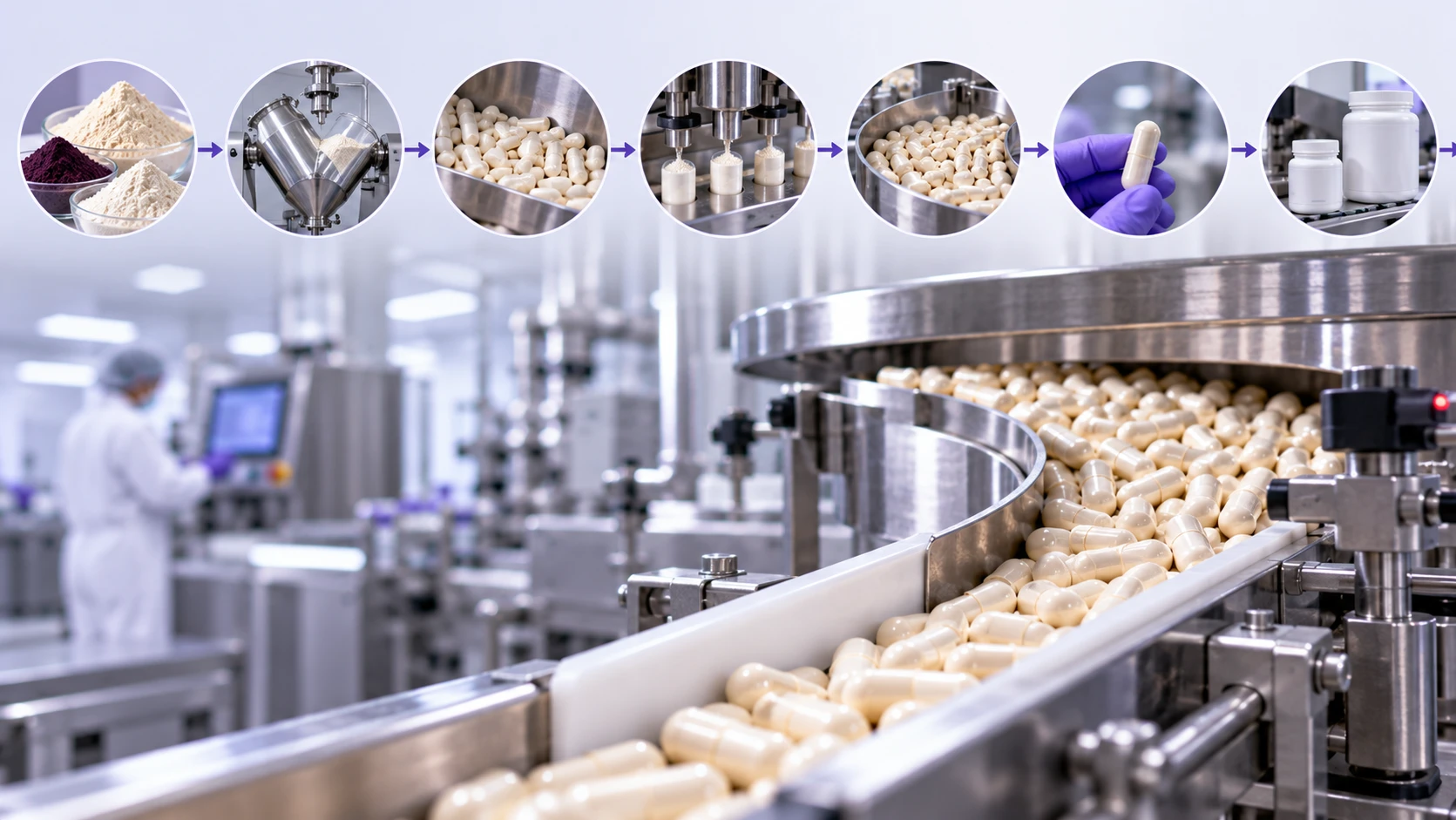
The process is short and predictable:
- You review the manufacturer’s catalog of stock formulas.
- You choose a formula and a format.
- You submit label content and packaging for review.
- The manufacturer produces the order at its minimum order quantity (MOQ).
- Finished goods ship to you or to your fulfillment partner.
Because the specification, raw material sourcing and test methods already exist, the manufacturer skips development. That is where the time and cost savings come from.
Why the Stock Formula Matters
A catalog formula has a track record. The manufacturer has run it through production, knows its flow behavior, stability and yield, and has validated test methods for it. That reduces batch failures and surprises in early runs.
Stock formulas also come with defined ingredient forms. A magnesium product, for example, can use glycinate, citrate or oxide. Each form carries a different cost, elemental magnesium yield and tolerability profile. In private label, the manufacturer has already made that choice. Read the Supplement Facts panel before you commit, because that choice becomes your product.
Where Private Label Fits Best
Private label suits four situations:
- You are testing demand in a new category.
- Your advantage is audience, distribution or branding rather than formulation.
- You need to add a proven staple to a range anchored by a signature formula.
- You are launching with a limited budget and need inventory fast.
Limits of Private Label
Competitors can order the same formula from the same catalog. Your ingredient story is not exclusive. Your ability to adjust doses, ingredient forms or excipients is limited. When two brands sell the same formula, price becomes the main lever, and price competition erodes margin.
What Is Custom Formulation?
Custom formulation is the development of a unique supplement formula for one brand. A formulator selects ingredients, forms and doses to your brief. The result is a proprietary product that no other brand can order from the manufacturer.
This is the model behind most premium supplement brands. In custom projects, the formula is the asset.
How Custom Formulation Works
Development follows a defined sequence:
- Brief. You define the target consumer, health category, format, serving size and price position.
- Formulation. The manufacturer’s team drafts a formula and sources candidate ingredients.
- Sampling. You review prototypes for taste, flow, dissolution, appearance and mixability.
- Stability review. The formula is evaluated for shelf life under expected storage conditions.
- Specification. The approved formula becomes a Finished Product Specification (FPS) covering identity, purity, strength and composition.
- Production. The manufacturer scales the formula under cGMP controls.
What You Control
You control the active ingredients, the dose per serving and the ingredient forms. You control the excipients, flavor systems and sweeteners. You control which ingredients and claims anchor your marketing. Dose control matters most. Many stock formulas under-dose key ingredients to hit a price point. A custom formula lets you dose to the level your claim requires.
Ingredient Rules That Apply to Custom Work
Custom formulas can include ingredients that carry extra regulatory weight. An ingredient that was not marketed in the United States as a dietary supplement before October 15, 1994 is a new dietary ingredient (NDI). It may require a premarket notification to FDA at least 75 days before marketing. Your formulator should screen every ingredient for NDI status before development starts.
Limits of Custom Formulation
Development takes longer. Costs begin before the first unit ships. MOQs are often higher because raw materials are sourced to your formula. A vague brief produces a vague product, so you need a clear position before you start.
What Is Semi-Custom Formulation?
Semi-custom formulation modifies an existing stock formula to fit your brief. The manufacturer adjusts doses, swaps ingredient forms or adds an active. You get partial differentiation without a full development cycle.
This option sits between the two main models and is underused.
Common Semi-Custom Changes
- Raising or lowering the dose of a key ingredient
- Switching to a higher-quality ingredient form
- Adding a complementary active to a base formula
- Changing the flavor system in a powder
- Adjusting capsule size or fill weight
When Semi-Custom Makes Sense
Semi-custom works when a catalog formula is 80% right. It shortens timelines compared with full custom work. It also gives you a documented, differentiated specification that competitors cannot order. Confirm in writing what changes make the formula yours alone.
Private Label Supplements vs Custom Formulation: Side-by-Side Comparison
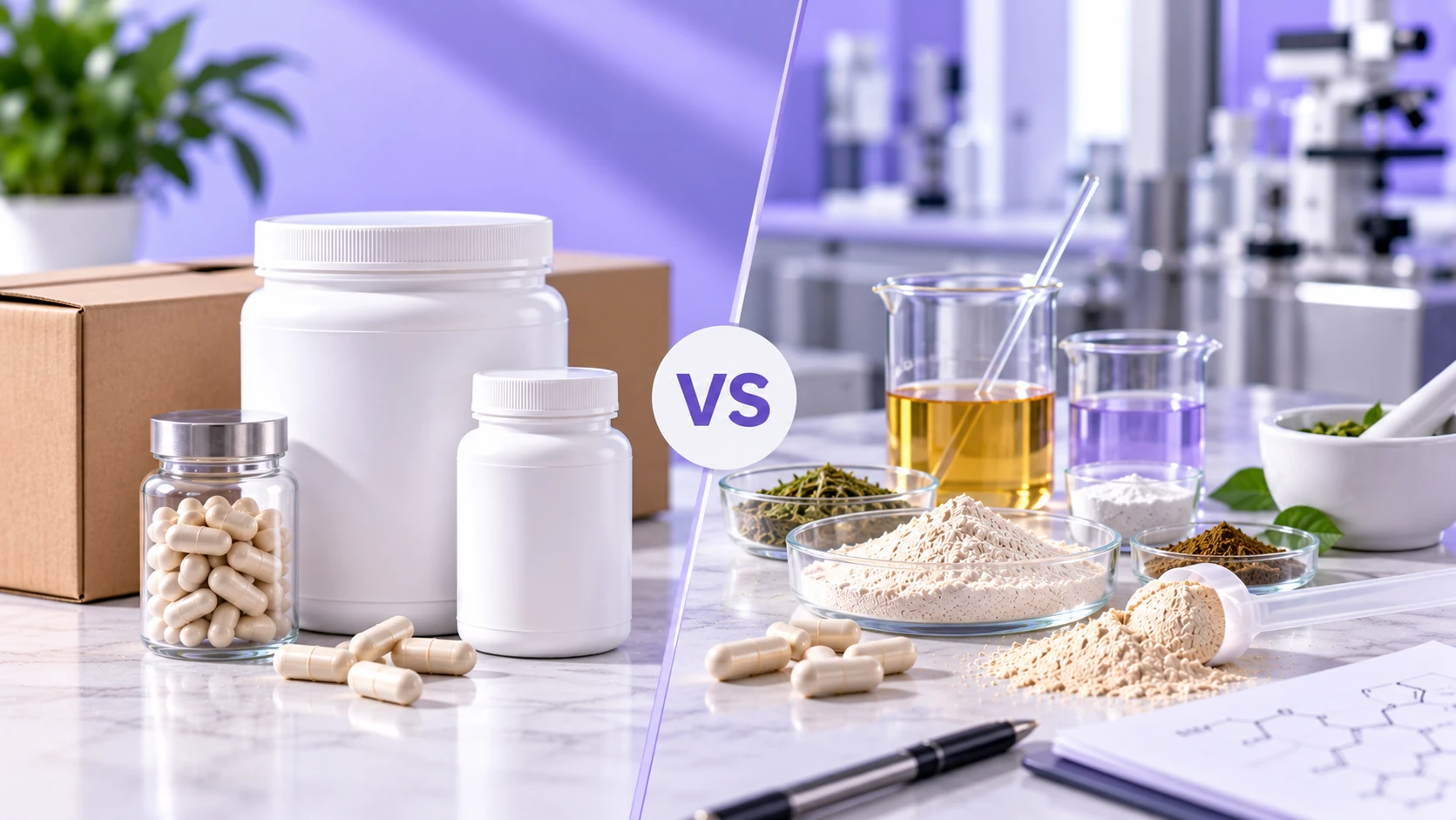
The models differ on seven factors. Speed and cost favor private label. Exclusivity, dose control and differentiation favor custom formulation. Regulatory responsibility is identical.
| Factor | Private Label | Semi-Custom | Custom Formulation |
|---|---|---|---|
| Formula ownership | Manufacturer’s catalog | Modified catalog formula | Yours (per contract) |
| Exclusivity | Shared with other buyers | Varies by agreement | Exclusive to your brand |
| Time to market | Shortest | Moderate | Longest |
| Upfront cost | Lowest | Moderate | Highest |
| MOQ | Generally lower | Moderate | Often higher |
| Ingredient and dose control | Limited | Partial | Full |
| FDA cGMP responsibility | Yours | Yours | Yours |
Which Model Costs Less?
Private label costs less to launch. You skip development fees, trial batches and formulation time. Custom formulation costs more upfront but can improve long-term margin through exclusive positioning and premium pricing.
Cost Drivers in Every Model
Six inputs move your price:
- Raw material selection and grade
- Dose per serving
- Format (capsule, powder or liquid)
- Packaging and label complexity
- Order volume
- Third-party testing scope
Hidden Costs to Price In
Quotes rarely show the full picture. Budget for label design and legal review, third-party lab testing, freight, storage and insurance. Product liability insurance is standard for supplement brands and often required by retailers and marketplaces.
Where Custom Formulation Pays Back
A clinically supported or visibly differentiated formula supports a higher retail price. It reduces direct price comparison. It also builds repeat purchase, because customers cannot find the same product from another brand. Brands that compete on formula rarely compete on discount.
Which Model Is Faster?
Private label is faster. The formula exists, the specification is set and production can start once packaging and labels are approved. Custom formulation adds development, sampling and stability stages before production begins.
What Slows a Custom Project
Delays almost always trace to the brief. Four causes recur:
- Unclear target consumer or claim
- Doses that change between sampling rounds
- Late changes to the flavor or format
- Slow approvals on your side
A locked brief is the fastest way to shorten a custom timeline.
What Slows a Private Label Order
Private label delays come from packaging and labels. Artwork revisions, claim edits and component lead times add days. Approve label content early and confirm packaging availability before you place the order.
Who Is Responsible for Compliance?
You are. In both models, the brand owner carries ultimate responsibility for the finished product. FDA has stated that a firm can contract out manufacturing but cannot contract out its responsibility to ensure the product is not adulterated or in violation of cGMP.
The governing rule is 21 CFR Part 111, the FDA’s current good manufacturing practice regulation for dietary supplements. FDA does not approve dietary supplements before they reach the market. Product safety and accuracy stay with the brand.
The Three Layers of Brand Owner Responsibility
1. Manufacturing quality. You must ensure that production follows cGMP, even when a contract manufacturer performs it. That means qualifying your manufacturer, reviewing their documentation and auditing their performance.
2. Labeling and claims. Your label must carry an accurate Supplement Facts panel and truthful structure/function claims. A structure/function claim must carry the standard FDA disclaimer, and you must notify FDA of the claim within 30 days of marketing. Disease claims turn a supplement into an unapproved drug.
3. Adverse event reporting. The company named on the label is the responsible party for serious adverse event reports under federal law. You must forward serious adverse event reports to FDA within 15 business days. Your manufacturer does not file these for you unless your contract says so.
What to Verify Before You Sign
- Current cGMP certification from an independent body
- Written specifications for identity, purity, strength and composition
- Certificates of analysis (COAs) for raw materials and finished lots
- A documented complaint, recall and deviation process
- Label and claim review procedures
- Supplier qualification records
WB Blends holds NSF/ANSI 455-2 GMP certification. Ask any manufacturer you evaluate for equivalent documentation.
How Do You Choose Between Private Label and Custom Formulation?
Choose private label if you need speed, a lower entry cost or a market test. Choose custom formulation if you need exclusivity, specific dosing or a defensible brand position. Many brands start with private label and move to custom as volume grows.
Choose Private Label If:
- You are validating demand for a category
- Your edge is distribution, audience or branding
- You need product within a short window
- Development spend exceeds your budget
Choose Custom Formulation If:
- Your claim depends on a specific ingredient, form or dose
- You sell through channels that penalize look-alike products
- You want a formula story you can trademark or defend
- You need a format or delivery system no catalog offers
Choose Semi-Custom If:
- A catalog formula is close but under-dosed or poorly formed
- You want differentiation without a full development timeline
- You plan to move to a full custom formula later
A Four-Question Decision Test
- Does your claim depend on a dose or ingredient form that stock formulas do not offer?
- Will competitors be able to find the identical product at lower prices?
- Can your budget absorb development and a higher MOQ?
- Can you wait through development and sampling?
Two or more “yes” answers on questions 1 and 2 point to custom or semi-custom. Two or more on questions 3 and 4 point to private label.
The Hybrid Path
Hybrid is common. A brand launches a private label staple, learns what its customers repeat-buy, then commissions a custom formula to replace or extend it. This reduces early risk and sharpens the later brief.
What Formats Are Available for Each Model?
Both models are available across capsules, powders and liquids. Format affects cost, stability, shelf life and consumer experience more than the model does. Match the format to the active ingredient and the customer.
Capsules
Capsules suit precise dosing, taste-sensitive ingredients and multi-ingredient blends. They protect ingredients from taste and moisture exposure and hold stable shelf lives. Fill weight limits cap how much of each ingredient fits in a serving, so high-dose ingredients may need several capsules per serving.
Powders
Powders suit high-dose ingredients such as proteins, greens, amino acids and electrolytes. They allow large serving sizes and flexible flavor systems. Powders require attention to mixability, flow, moisture control and flavor masking. Layered or complex powders benefit from custom development.
Liquids
Liquids suit tinctures, extracts and fast-delivery formats. They demand careful decisions on preservation, stability, viscosity and packaging. Liquid formulations are less forgiving of ingredient changes, which makes development rigor important.
Matching Format to Ingredient
| Ingredient Type | Strong Format Fit |
|---|---|
| High-dose amino acids, proteins | Powder |
| Botanical extracts, herbal concentrates | Liquid or capsule |
| Taste-sensitive minerals and vitamins | Capsule |
| Electrolyte and hydration blends | Powder |
| Tinctures and fast-delivery formulas | Liquid |
How Do Intellectual Property and Ownership Work?
Formula ownership depends on your contract, not on the model name. In private label, the manufacturer owns the formula. In custom work, ownership, confidentiality and transfer rights must be written into the agreement before development starts.
Terms to Define in Writing
- Formula ownership. Who owns the final specification.
- Confidentiality. Whether the manufacturer can use your formula or its elements for other clients.
- Transfer rights. Whether you can move the formula to another manufacturer.
- Exclusivity period. How long the manufacturer will not produce the same formula for others.
- Raw material commitments. Whether you owe minimum purchases of ingredients sourced for your formula.
Why This Matters
A formula you cannot move is a formula you do not fully own. If your manufacturer raises prices or misses delivery, transfer rights decide whether you can leave. Negotiate them early, when both sides expect to work together.
What Should You Ask a Manufacturer Before You Commit?
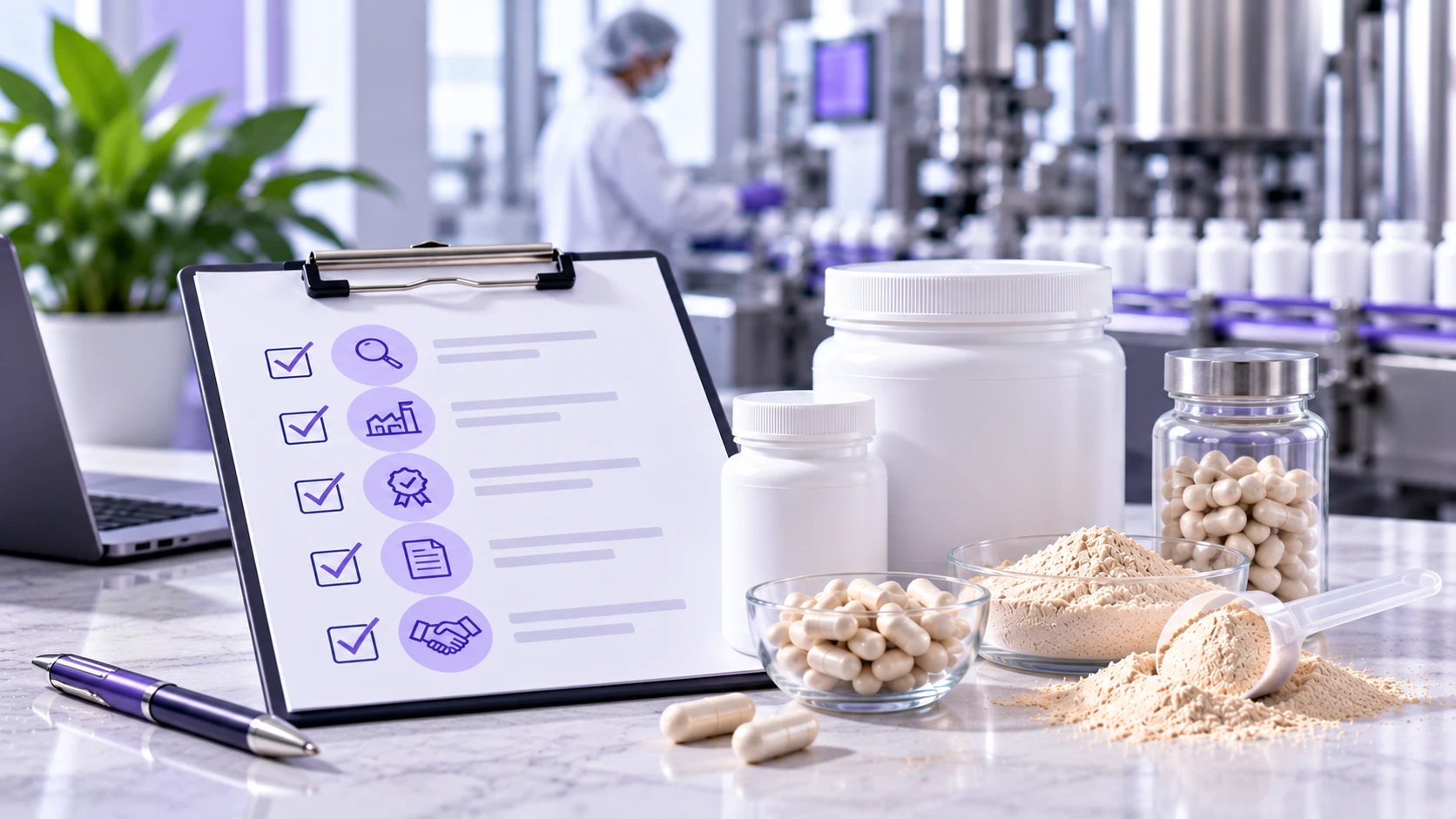
Ask about certifications, MOQs, development process, ownership terms and testing. A credible supplement contract manufacturer answers each question in writing. Vague answers signal operational risk.
Ten Questions to Ask
- Which cGMP certifications do you hold, and can I see them?
- What is your MOQ by format?
- Who owns the formula in a custom project?
- Can I move my formula to another manufacturer?
- How do you test raw materials and finished lots?
- What is your typical timeline from brief to first production run?
- Do you offer both tolling and turnkey services?
- How do you handle label and claim review?
- What is your recall and complaint process?
- Who is my day-to-day contact?
Tolling vs Turnkey
Tolling means you supply some or all materials and the manufacturer processes them. Turnkey means the manufacturer sources, produces and packages the finished product. Both can apply to private label or custom work. Turnkey simplifies operations. Tolling gives you control over raw material sourcing.
Red Flags
- No written specifications
- Refusal to share certifications or COAs
- Guarantees of FDA approval, which does not exist for supplements
- Pressure to skip testing to cut cost
- No clear answer on who owns the formula
Is the Supplement Market Large Enough to Justify Either Model?
Yes. Demand is broad and stable. The Council for Responsible Nutrition’s 2024 consumer survey, conducted by Ipsos, found that 75% of U.S. adults take dietary supplements. A large user base leaves room for both catalog products and distinctive formulas.
What Crowded Categories Mean for You
Popular categories such as magnesium, greens, sleep support and sports nutrition attract many brands. In crowded categories, shared stock formulas blur together. Formula quality, ingredient transparency and positioning decide who wins. That pushes serious brands toward semi-custom or custom work once a category proves itself.
Reading Demand Before You Commit
Validate demand before you pay for development. Check search volume, marketplace listings, review language and competitor positioning. Launch a private label version to confirm repeat purchase, then invest in a custom formula for the winners.
FAQs
What is the difference between private label and white label supplements?
Nothing material. Both terms describe a manufacturer’s stock formula sold under your brand. Some buyers use white label for the most generic version, with minimal branding options. The production model is the same.
Can I switch from private label to custom formulation later?
Yes. Many brands do. Use sales and review data to identify the product customers repurchase. Then brief a custom version that improves its dose, ingredient form or format.
Do I own a custom formula?
Ownership depends on your contract. Define formula ownership, confidentiality and transfer rights in writing before development begins.
Is a private label supplement lower quality than a custom one?
No. Quality depends on the manufacturer’s raw material controls, testing and cGMP systems. A well-made stock formula can outperform a poorly specified custom formula. Differentiation is the real gap between the two, not quality.
What is the minimum order for private label supplements?
It varies by manufacturer, format and packaging. Capsule, powder and liquid runs have different equipment and material requirements. Request MOQs in writing by format before you compare quotes.
Does FDA approve my supplement before I sell it?
No. FDA does not pre-approve dietary supplements. You are responsible for safety, accurate labeling and cGMP compliance under 21 CFR Part 111.
How long does custom supplement formulation take?
It takes longer than private label. Timelines depend on brief clarity, sampling rounds, ingredient sourcing, stability review and your approval speed. A finalized brief shortens the cycle.
Who handles adverse event reports for a private label product?
The company named on the label. Confirm in your contract whether the manufacturer assists with intake and documentation, because the legal duty stays with you.
Start Your Product With WB Blends
WB Blends is a custom dietary supplement manufacturer in Spanish Fork, Utah, producing capsules, powders and liquids for nutraceutical brands. Bring a brief or a catalog question. We will tell you which model fits.