
Creatine powder is made by chemical synthesis. Manufacturers react sodium sarcosinate with cyanamide in water, crystallize the creatine monohydrate, then separate, dry, and mill it into a fine powder. Each lot is tested for identity, potency, microbes, and heavy metals before release.
Brands that understand this process choose better ingredients and ask better questions. This guide walks through each stage of the creatine manufacturing process and shows where quality is won or lost. For a broader look at the ingredient itself, read our creatine powder overview.
KEY TAKEAWAYS
- Creatine powder is made by chemical synthesis, not extracted from meat or fish.
- Two raw materials drive the reaction: sodium sarcosinate and cyanamide.
- Crystallization, centrifugation, drying, and milling turn the reaction liquid into powder.
- Mesh size controls how well creatine dissolves and mixes.
- HPLC identity and potency, microbial, and heavy metal testing decide whether a lot ships.
What Is Creatine Made Of?
Creatine is an organic compound that the body builds from three amino acids: arginine, glycine, and methionine. Supplement creatine is not harvested from those sources. It is synthesized from sodium sarcosinate and cyanamide, which produces a molecule identical to the one made in the body.
Creatine in the Body
The liver, kidneys, and pancreas make roughly 1 gram of creatine per day. About 95% is stored in skeletal muscle, where it supports rapid energy turnover during short, intense effort. The Mayo Clinic describes this role in its creatine overview.
Creatine in Food
Red meat and fish contain creatine, at about 2 grams per pound of raw beef. Reaching a 3 to 5 gram daily dose from food would mean eating over a pound of meat every day. That volume is impractical, and extracting creatine from meat is not commercially viable at scale.
Synthesis is the industry standard for that reason. It is consistent, scalable, and free of animal inputs.
How Is Creatine Powder Made Step by Step?
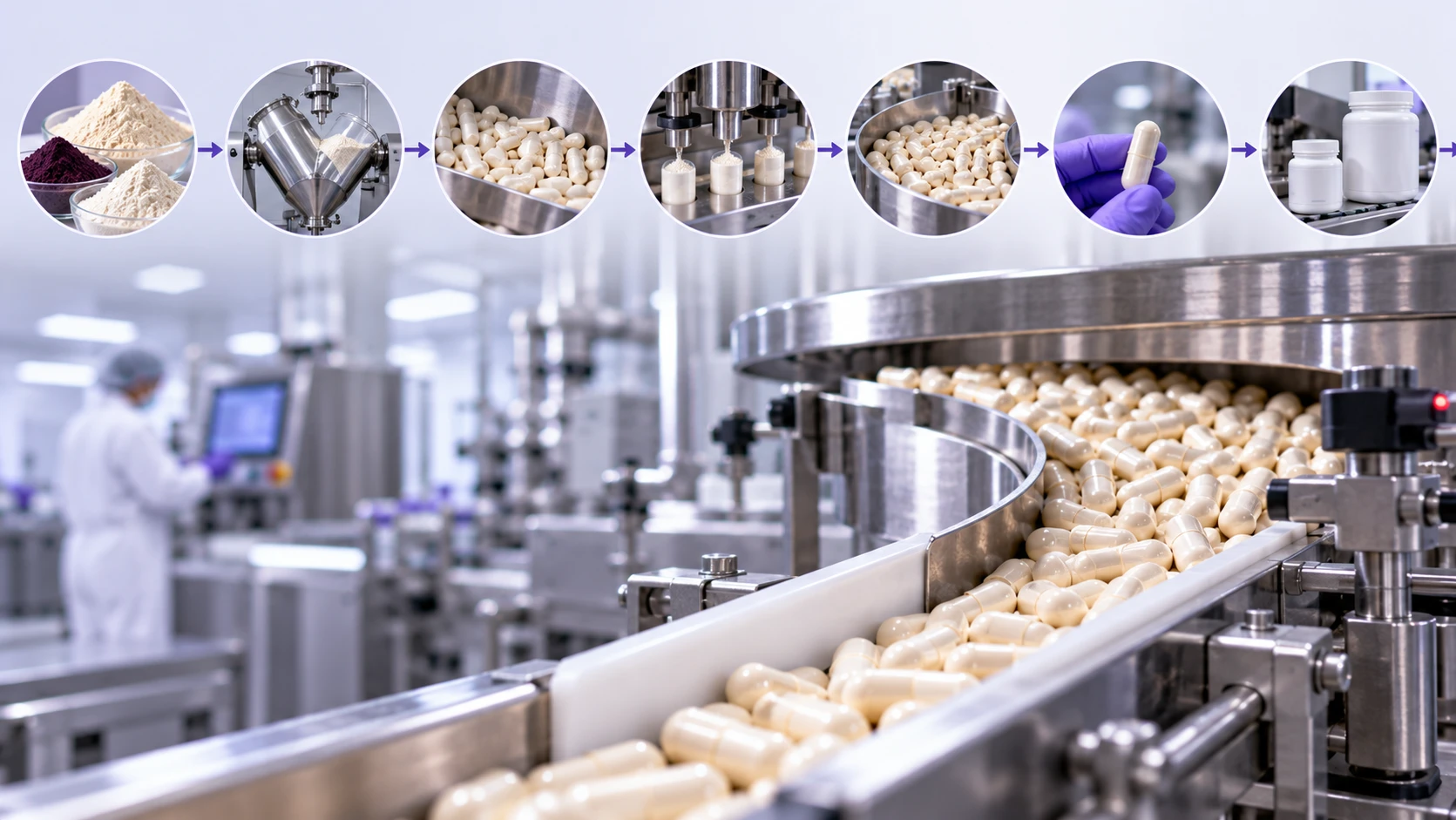
Creatine powder is made in six stages: raw material selection, reaction, crystallization, separation, drying and milling, and testing. Each stage affects purity, particle size, and cost. The sequence below applies to creatine monohydrate, the most studied and most widely used form.
Step 1: Raw Material Selection
Sodium sarcosinate is the salt of sarcosine, an amino acid derivative that serves as the backbone of the molecule. Cyanamide is a small nitrogen-containing compound that supplies the guanidino group creatine needs. Both inputs are held to purity specifications before use.
Cyanamide is not cyanide. The two compounds are chemically distinct. Cyanamide is a standard industrial reagent, and the finished creatine contains no cyanamide when the process is controlled.
Step 2: The Reaction
The two materials react in water in a controlled reactor. Temperature, pH, and reaction time are managed closely. These variables decide how much creatine forms and how many by-products appear alongside it.
Process control matters here. Poorly managed reactions leave behind impurities that are hard to remove later.
Step 3: Crystallization
The reaction liquid is cooled. Creatine monohydrate crystallizes out of solution as solid crystals. Slow, controlled cooling produces cleaner, more uniform crystals than fast cooling.
Step 4: Centrifugation and Washing
A centrifuge separates the crystals from the mother liquor. The crystals are washed to remove residual reaction materials. This is the main purification step in creatine monohydrate production.
Step 5: Drying and Milling
The washed crystals are dried under controlled conditions to a target moisture level. They are then milled and sieved to a specific particle size. Standard grades run coarser. Micronized creatine is milled finer, often around 200 mesh.
Step 6: Testing and Release
Finished powder is held until testing is complete. Only lots that meet specification move on to packaging, blending, or encapsulation.
What Are the Two Raw Materials in Creatine?
The two raw materials in creatine are sodium sarcosinate and cyanamide. Sodium sarcosinate provides the amino acid backbone. Cyanamide provides the reactive nitrogen group. Together they form creatine in a single synthesis route used across the industry.
| Raw Material | What It Is | Role in Creatine Synthesis |
|---|---|---|
| Sodium sarcosinate | Salt of an amino acid derivative | Provides the molecular backbone |
| Cyanamide | Small nitrogen-containing compound | Supplies the guanidino group |
| Water | Reaction medium | Carries the reaction and enables crystallization |
Is Creatine Vegan?
Synthetic creatine monohydrate contains no animal-derived ingredients. Neither raw material comes from animals. Brands that need a formal vegan claim should still request supplier documentation for the specific lot and facility.
Is Creatine Natural?
No. Supplement creatine is a synthesized ingredient. It is chemically identical to the creatine found in meat and the creatine made in the body. Brands should avoid “natural” claims on creatine labels.
Why Does Particle Size Matter in Creatine Powder?
Particle size controls how fast creatine dissolves and how it feels in a drink. Finer powder disperses faster, settles less, and leaves less grit. Coarser powder flows better and costs less. The right choice depends on the product format.
| Grade | Typical Mesh | Best For | Trade-off |
|---|---|---|---|
| Standard monohydrate | About 80 mesh | Capsules, bulk blending | Slower to dissolve |
| Micronized monohydrate | About 200 mesh | Ready-to-mix powders, stick packs | Can flow poorly and clump |
Flowability and Clumping
Fine powders pack tightly and resist flow. Humidity worsens the problem. Brands running scoop-fill or stick pack formats should discuss flow aids and storage conditions with their manufacturer early. Our guide to stick packs vs. canisters vs. gusset bags covers how packaging format affects powder handling, and our post on common powder supplement complaints explains how to prevent clumping and poor mixability.
Mixability and Mouthfeel
Consumers judge a creatine drink by how it mixes. Micronized creatine reduces sediment. It does not change efficacy. The ISSN position stand supports creatine monohydrate as effective regardless of mesh size.
How Is Creatine Powder Tested for Quality?
Creatine powder is tested for identity and potency, microbial safety, and heavy metals. High-performance liquid chromatography (HPLC) is the standard method for measuring creatine content and detecting impurities. Lots that fail any test are rejected or reworked.
Identity and Potency Testing
HPLC confirms the material is creatine and measures how much is present. It also detects creatinine and dicyandiamide, two impurities tied to the synthesis route. A 2022 study in Talanta Open validated an LC method with UV detection for this purpose.
Microbiological Testing
Microbial testing screens for total plate count, yeast and mold, and pathogens such as E. coli and Salmonella. Dry powders are low-risk, but testing confirms it.
Heavy Metal Testing
Testing covers lead, arsenic, cadmium, and mercury. Brands selling in California should also check results against Proposition 65 limits, which are stricter than many federal benchmarks.
Third-Party Verification
Independent certification adds a second layer of proof. WB Blends operates under NSF/ANSI 455-2 GMP certification, which audits documentation, testing, and process control across the facility. See our certifications page for details. For the regulatory framework behind these requirements, read are supplements regulated by the FDA.
Which Creatine Forms Do Brands Use?
Creatine monohydrate is the dominant form because it carries the deepest research base and the lowest cost. Alternatives such as creatine hydrochloride, creatine ethyl ester, and buffered creatine are marketed on solubility or dosing claims. Few have matched the monohydrate evidence.
| Form | Evidence Base | Cost | Common Positioning |
|---|---|---|---|
| Creatine monohydrate | Extensive | Low | Performance, strength, lean mass |
| Creatine HCl | Limited | Higher | Solubility, smaller serving |
| Buffered creatine | Limited | Higher | Gentler on digestion |
The ISSN position stand, published in 2017, concluded that creatine monohydrate is the most effective and safe form for improving high-intensity exercise capacity and lean mass. Brands building on that evidence stand on firm ground.
What Is the Creatine Market Opportunity for Brands?
The creatine supplements market was valued at roughly $1 billion in 2024. Grand View Research projects growth to about $2.8 billion by 2030, a compound annual growth rate near 18%. Demand now extends beyond bodybuilding to women, older adults, and cognitive health audiences.
Where Brand Differentiation Comes From
Creatine monohydrate is a commodity ingredient. Differentiation comes from sourcing transparency, third-party testing, flavor systems, packaging, and format. A brand that publishes lot-level certificates of analysis earns trust that a generic competitor cannot copy quickly.
Which Formats Work Best
Creatine sells in three formats WB Blends manufactures: powder, capsule, and liquid. Powder dominates because the 3 to 5 gram dose is too large for most capsules. A single serving of creatine monohydrate needs several capsules, which is why powder wins on cost and convenience. Brands planning capsules should review capsule sizes explained to calculate fill weight and capsule count.
How Do You Choose a Creatine Manufacturer?
Choose a manufacturer on documentation, testing depth, and format fit. Ask for certificates of analysis, GMP certification, supplier qualification records, and heavy metal results. A capable partner answers these questions with documents, not promises. Our guide on how to choose a supplement contract manufacturer gives the full evaluation checklist.
- Request the raw material specification and a sample certificate of analysis.
- Confirm which tests run in-house and which go to an outside lab.
- Ask about minimum order quantities and lead times for your format.
- Verify GMP certification and ask for the audit scope.
- Confirm the manufacturer can match your target mesh size and flow requirements.
Decide early whether you need turnkey or tolling manufacturing, because that choice sets who sources the creatine and who owns the specification.
WB Blends manufactures powder, capsule, and liquid supplements from Spanish Fork, Utah, for brands that need documented quality and predictable timelines. Review our process or request a quote to start your creatine project.
FAQs
How is creatine monohydrate made?
Creatine monohydrate is made by reacting sodium sarcosinate with cyanamide in water. The solution is cooled to crystallize creatine monohydrate. Crystals are separated by centrifuge, washed, dried, and milled to the target particle size.
Is creatine made from meat or fish?
No. Supplement creatine is synthesized from chemical inputs. It is not extracted from animal tissue. The result is chemically identical to the creatine found in meat and made by the body.
Is synthetic creatine safe?
Yes, for healthy adults at recommended doses. The 2017 ISSN position stand reviewed the safety literature and found no evidence of harm in healthy people at typical intakes. Anyone with kidney disease should consult a physician first.
What is the difference between micronized and regular creatine?
Micronized creatine is milled to a finer particle size, often about 200 mesh. It dissolves faster and mixes more smoothly. Regular creatine is coarser and flows better. Both contain the same molecule.
What impurities can appear in creatine powder?
Creatinine and dicyandiamide are the most common process-related impurities. HPLC testing detects both. Reputable manufacturers set limits for each and reject lots that exceed them.
Can creatine be made into capsules or liquids?
Yes. Capsules suit lower-dose formulas and stacks. Liquid creatine is less common because creatine degrades to creatinine in solution over time. Powder remains the most stable and cost-effective format.
How long does creatine powder last?
Dry creatine monohydrate is stable and commonly carries a shelf life of two to three years when stored sealed, cool, and dry. Moisture is the main threat. It causes clumping and, over time, conversion to creatinine in solution.