
Creatine powder is a dietary supplement made from creatine, a compound the body uses to supply energy to muscle and brain tissue. It is one of the most studied ingredients in nutrition, and demand is spreading beyond athletes to women, older adults, and wellness buyers. For CPG brands, it is a proven category with a widening audience.
This guide covers the benefits, the buyer trends, the formulation decisions, and the manufacturing standards that decide whether a creatine product succeeds. It is written for brand owners working with a powder supplement manufacturer.
KEY TAKEAWAYS
- Creatine powder is a single-ingredient, research-backed supplement with the broadest evidence base in sports nutrition.
- The category is expanding beyond male athletes to women, adults over 40, and consumers focused on cognitive and healthy aging support.
- Creatine monohydrate is the most studied form and the practical default for new launches.
- Powder quality is decided by particle size, solubility, flavor, packaging, and testing. These are manufacturing choices.
- Brands that treat creatine as a daily wellness product, not a gym product, reach the widest audience.
What Is Creatine Powder?
Creatine powder is a supplement that delivers creatine, usually as creatine monohydrate, in a scoop-based format. The body makes some creatine and gets more from foods such as meat and fish. Supplementation raises muscle creatine stores, which supports high-intensity performance.
Why does powder dominate the category?
Powder allows flexible dosing, low cost per serving, and a single-ingredient formula consumers already recognize. A typical serving is a few grams, which suits a scoop. Powder also lets brands add flavor, blend with other ingredients, or keep the product unflavored.
What Are the Benefits of Creatine Powder?
Creatine powder supports strength, power, lean mass, and recovery in people who train. Research also points to benefits for healthy aging, and cognitive health is an active research area. Evidence is strongest for exercise performance and weaker, but growing, for brain-related outcomes.
What does the evidence support most strongly?
The International Society of Sports Nutrition (ISSN) published a position stand in 2017 reviewing more than 200 studies. It found that creatine supplementation raises muscle creatine and phosphocreatine stores, which helps explain gains in high-intensity exercise performance and training adaptations. It also noted potential benefits for recovery and several clinical areas.
What about cognitive and healthy aging benefits?
Interest in cognitive support is rising. Industry coverage in 2026 notes that doses studied for brain-related outcomes tend to be higher than doses used for muscle support, and that more research is needed to set optimal dosing in healthy people. Brands should word claims within structure/function rules and avoid promising disease outcomes.
Is Creatine Powder Safe?
Creatine monohydrate has a long safety record in the research literature. The ISSN position stand concluded that creatine is safe and beneficial across populations ranging from children to older adults when used appropriately. Brands should still follow label, dosing, and claims rules, and advise consumers to consult a healthcare provider.
What do brands need to include on the label?
Clear serving size, an accurate Supplement Facts panel, and directions that match the serving. Quality of the raw material and testing of the finished product protect the label claim.
How Big Is the Creatine Market?
Industry analysts estimate the global creatine market at about $1.11 billion, growing at a compound annual rate near 25% toward roughly $4.2 billion by 2030, according to Grand View Research as reported by FoodNavigator. Consumer search interest has grown alongside it. Forecasts vary by source, so brands should treat figures as directional.
Who is buying creatine now?
| Buyer segment | What they want | Positioning angle |
|---|---|---|
| Athletes and gym users | Strength, power, recovery | Performance, purity, third-party testing |
| Women | Body composition, cognitive support, wellness | Daily wellness, clear guidance, honest formats |
| Adults over 40 | Healthy aging, muscle maintenance | Longevity, simple formulas |
| General wellness buyers | An add-on to an existing routine | Convenience, stacking with other basics |
What Trends Are Shaping Creatine Products?
Four trends are shaping product development: women entering the category, cognitive and stress-support positioning, healthy aging, and demand for transparency in testing. Each one changes how a brand names, flavors, doses, and markets a creatine powder.
Are women a real growth segment?
Yes. Brightfield Group’s Q2 2026 snapshot reports that female creatine buyers have nearly doubled in two years. A survey of 2,094 creatine users published in the journal Nutrients found that women made up more than 60% of users with under six months of use and that women were more likely to cite healthy aging than athletic performance. Nutraceuticals World reported these findings in September 2026.
Is creatine moving beyond the gym?
Brightfield data shows creatine conversation expanding into cognitive health, sleep, healthy aging, and stress support, with stress support the fastest-growing use case in its Q2 2026 snapshot. Brands still positioning creatine only as a gym product risk missing where growth is happening.
What do these buyers expect from the product?
Taste, easy mixing, clean ingredient decks, and published test results. A gritty or clumpy powder loses a new category entrant fast. Our guide to common powder supplement complaints covers the issues that drive returns and bad reviews.
Why Does Creatine Powder Belong in Your Portfolio?
Creatine powder fits a portfolio because it has proven demand, a simple formula, daily-use repeat purchase potential, and a widening audience. It also pairs naturally with other wellness products. The risk is not demand. The risk is execution.
- Proven science. Brands can build claims on a deep research base.
- Simple formulation. A single-ingredient product is easy to specify, test, and scale.
- Repeat purchase. Daily use supports subscription and replenishment models.
- Range extension. Creatine can anchor a stack with other everyday supplements.
- Audience breadth. One ingredient can serve several buyer segments with different positioning.
Which Form of Creatine Should Brands Choose?
Creatine monohydrate is the right starting point for most brands. It is the most studied form and the most cost-effective. Other forms, such as hydrochloride and magnesium chelate, are marketed on solubility or novelty but lack the same depth of evidence.
| Form | Evidence base | Solubility and taste | Typical use |
|---|---|---|---|
| Monohydrate | Deepest | Lower solubility, mild taste | Default for most launches |
| Micronized monohydrate | Same compound, finer particle | Mixes more easily | Better mixability without changing the active |
| Hydrochloride | Limited by comparison | Higher solubility claimed | Premium positioning |
| Magnesium chelate | Limited by comparison | Varies | Niche blends |
Does micronized creatine matter?
Micronized creatine monohydrate is the same compound with a smaller particle size. A finer particle disperses more readily in liquid. It helps with a common complaint, but it does not remove the need for good flavor and mixing design.
What Manufacturing Challenges Does Creatine Powder Present?
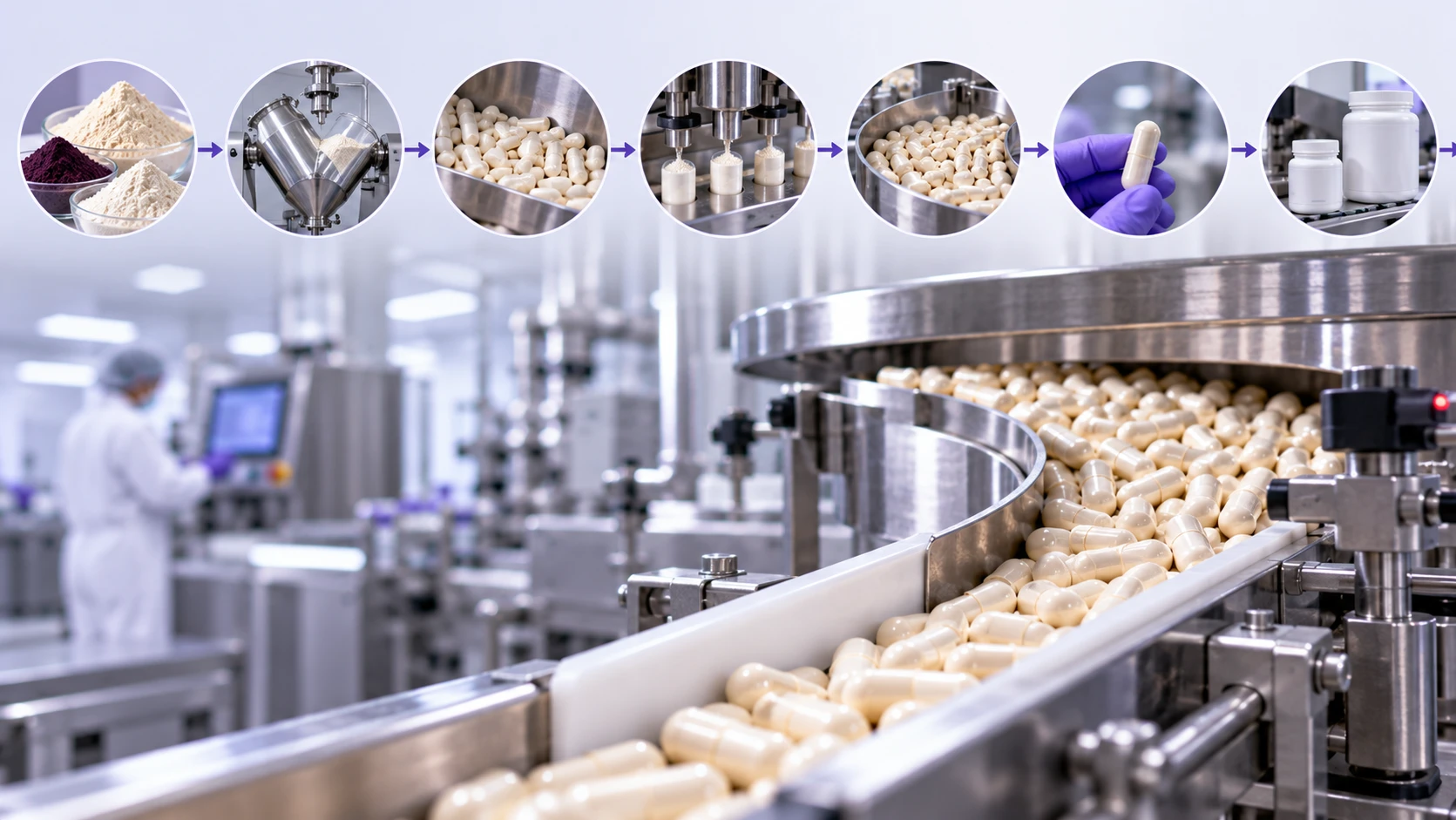
Creatine monohydrate dissolves slowly and can settle in the glass. Unflavored product can taste flat, and flavored product must mask any off notes. The powder can also absorb moisture, so packaging and filling conditions matter. Quality depends on raw material purity and finished product testing.
What should brands require from a manufacturer?
- Identity and purity testing of incoming creatine.
- Heavy metal and microbial testing on finished lots.
- Potency testing that supports the label.
- Particle size control and mixability trials.
- Moisture-controlled filling and barrier packaging.
WB Blends operates under NSF/ANSI 455-2 GMP, and the certifications page has the details. The R&D team handles flavor and mixability trials, and the manufacturing process documents each step from specification to shipment.
How Should a Brand Launch a Creatine Powder?
A brand should launch a creatine powder by choosing its audience, locking the form and serving size, piloting the formula, and testing the finished product before scaling. Each step reduces the risk of a failed launch.
Step-by-step launch plan
- Pick the audience. Athletes, women, adults over 40, or general wellness. Positioning drives flavor, naming, and claims.
- Choose the form and dose. Monohydrate or micronized monohydrate in a defined serving.
- Decide flavored or unflavored. Unflavored suits stacking. Flavored suits standalone use.
- Run a pilot batch. Check mixability, taste, and scoop weight.
- Select packaging. Match container format to moisture control and shelf life.
- Test and document. Confirm identity, purity, and potency on the finished lot.
- Choose a production model. Compare turnkey and tolling based on how much of the process you want to own.
Brands comparing partners can use our guide on how to choose a supplement contract manufacturer.
Is a capsule version worth considering?
Some consumers prefer capsules, but creatine doses are large and fill volume limits the format. Check the capsule sizes guide before committing, and speak with a capsule supplement manufacturer about whether it fits your dose.
FAQs
What is creatine powder used for?
Creatine powder is used to support strength, power, lean mass, and recovery in people who train. Interest is growing for healthy aging and cognitive support. Evidence is strongest for exercise performance.
Is creatine monohydrate better than other forms?
Monohydrate is the most researched and the most cost-effective. Other forms are sold on solubility or novelty claims but have a thinner evidence base. Most brands launch with monohydrate or micronized monohydrate.
How much creatine is in a typical serving?
Many products use a serving in the range of 3 to 5 grams, a commonly studied maintenance range. Brands should set the serving based on their formulation and claims, and match the label directions to the Supplement Facts panel.
Why does creatine powder sometimes taste gritty or settle?
Creatine monohydrate has limited solubility, so coarse particles can feel gritty and settle. Micronized creatine and careful blend design improve mixability.
Can creatine powder be marketed to women?
Yes. Women are one of the fastest-growing buyer groups. Brands should position around daily wellness, healthy aging, and clear guidance, and keep claims within structure/function rules.
What testing should a creatine powder have?
Identity and purity testing of the raw material, plus heavy metal, microbial, and potency testing on the finished lot. Certificates of analysis should be retained for each batch.
How do I start a creatine powder project?
Define your audience, form, and serving size, then request a quote with your specification. The request a quote page is the place to begin.