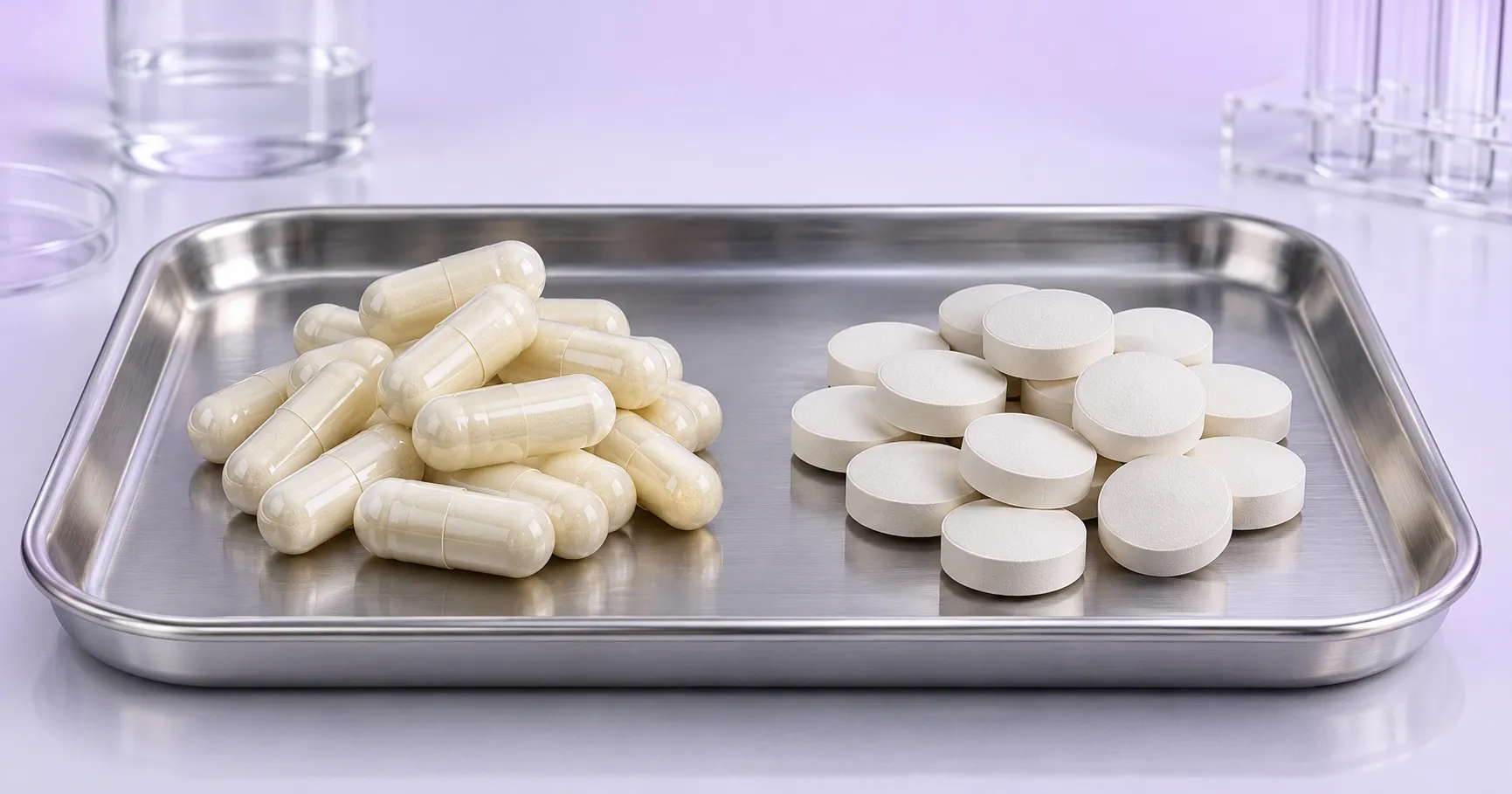

A capsule is a measured powder fill sealed inside a two-piece shell, while a tablet is powder pressed into a solid under high pressure. The capsule vs tablet choice sets your excipients, the dose each unit can carry, your shell options and the way your production run is planned, so make it early.
Key Takeaways
- Capsules hold a loose powder fill. Tablets are compressed, so the blend must bind and hold its shape.
- Tablets usually need more functional excipients, such as binders and disintegrants. Capsules mainly need a blend that flows and fills evenly.
- Capsule shells come in gelatin, HPMC and pullulan, which gives plant-based options without changing the fill.
- Neither format is better in general. The right one depends on your dose, ingredients, positioning and channel.
What is the difference between a capsule and a tablet?
The difference is how the dose is held together. A capsule contains the powder inside a shell. A tablet is the powder itself, pressed into a fixed shape.
That one difference drives most of the manufacturing decisions. A capsule filler doses a set volume of powder into the shell body, then closes it with the cap. The blend has to flow well enough to fill every capsule to the same weight. A tablet press compacts the blend between punches. The blend has to flow, compress, hold together after ejection and then break apart as intended.
So the format is not just a packaging choice. It changes what goes into your formula, how the blend is tested and which equipment runs it. Our guide to the capsule manufacturing process walks through each capsule step in order.
How do capsules and tablets compare for a brand?
Capsules and tablets differ in how they are made, what the formula needs, how much fits in one unit and how they look on shelf. Use this table to compare them for your product.
| Factor | Capsule | Tablet |
|---|---|---|
| How it is made | Powder is filled into a two-piece shell | Powder is compressed under pressure |
| Excipients | Mainly flow agents and fillers so the blend doses evenly | Binders, fillers, disintegrants and lubricants so the tablet holds together and breaks apart |
| Dose per unit | Limited by shell size and powder density | Compression packs more material into a unit, so higher doses per unit are often possible |
| Plant-based options | HPMC and pullulan shells | Depends on the excipients and any coating |
| Heat and pressure | No compression step | Compression adds pressure and some heat, which matters for sensitive ingredients |
| Taste and odor | The shell covers the fill | A coating may be needed to cover taste or odor |
| Look and feel | Clear or colored shells, uniform shape | Many shapes, sizes, colors and coatings; can be scored |
Read the table as trade-offs, not a scorecard. A row that favors tablets for one product can favor capsules for another.
When does a capsule fit a formula better?
A capsule usually fits better when the formula is sensitive, hard to compress or needs a plant-based shell. Common cases include:
- Botanical powders and blends that do not compress well. A capsule only needs the blend to flow and fill, not bind.
- Ingredients you want to keep away from compression. There is no press step, so pressure and the heat it creates are not part of the process.
- A shorter excipient list. Capsule blends often need fewer functional excipients than tablet blends, which can keep the Other Ingredients line shorter.
- Plant-based positioning. HPMC and pullulan shells let a brand pursue Vegan or Vegetarian claims, which are confirmed during quoting.
- Strong taste or odor. The shell keeps the fill away from the tongue without a separate coating step.
The shell itself is a decision. See gelatin vs HPMC vs pullulan capsules for how each shell affects your label and positioning.
When does a tablet fit better?
A tablet can fit better when the dose per unit is high, the blend compresses well, or the product needs a shape or coating a capsule cannot give. Be honest about these cases when you plan a line:
- High doses per unit. Compression packs more material into one unit, so some formulas need fewer tablets per serving than capsules.
- Dense mineral blends. Some minerals compress well and would need large or multiple capsules.
- Coatings and shapes. Tablets can be coated, scored or shaped for a specific product look.
- Chewable formats. Chewables are a tablet format, not a capsule format.
If your serving needs several large capsules, test whether the formula can be reworked first. A change in powder density or excipients can change how many capsules a serving needs. Our capsule formulation guide covers how fill weight and density interact.
Where do softgels fit?
Softgels are a third format, built for liquid and oil fills. A softgel is a one-piece sealed shell around a liquid, so it suits oils and oil suspensions rather than dry powders.
If your formula is a dry blend, the real choice is usually capsule or tablet. If it is an oil, compare a softgel with a liquid format in a bottle. Each uses different equipment, so confirm which formats a manufacturer runs before you design around one.
What should a brand ask before choosing?
Ask these questions before you commit a formula to either format. Each answer narrows the choice.
- Dose: What does one serving need to deliver, and how many units are acceptable per serving?
- Ingredients: Does the blend flow, compress, or both? Are any ingredients sensitive to pressure or moisture?
- Label: How many excipients are you willing to list in Other Ingredients?
- Claims: Do you need Vegan or Vegetarian claims? Those affect the shell or coating choice.
- Look: Do you want clear, colored, coated or shaped units?
- Packaging: What count and bottle size fits your channel?
- Manufacturer: Which formats does your manufacturer actually run in-house?
Capsule size is part of the same decision. Our capsule sizes guide explains how sizes 1, 0, 00 and 00EL compare.
How WB Blends handles this
WB Blends makes capsules, powders and liquids. Capsules are the solid dose format we run, at about 150 million capsules a month and 3,000,000+ bottles a month. We fill sizes 1, 0, 00 and 00EL at about 200 to 900 mg, in gelatin, HPMC or pullulan shells, clear or colored. Bottles run from 100 to 500cc in HDPE, PET or glass.
Projects run from 20,000 units to 100,000+ unit programs. Your Finished Product Specification is approved before production, and a Certificate of Analysis ships with every lot. See our capsule supplement manufacturer page for full capabilities.
Frequently Asked Questions
Are capsules better than tablets?
Neither is better in general. Capsules suit blends that flow but do not compress well, sensitive ingredients and plant-based shells. Tablets suit dense blends, higher doses per unit, coatings and chewables. The right format depends on your dose, ingredients, label and channel, so decide case by case.
Do capsules need fewer excipients?
Often, yes. A capsule blend mainly needs to flow and fill evenly, so it may only need a flow agent or filler. A tablet blend also needs to bind and then break apart, which usually adds binders and disintegrants. The exact list depends on your ingredients.
What capsule size holds the most?
Of the sizes WB Blends runs, 00EL is the largest, followed by 00, 0 and 1. How many milligrams fit depends on the density of your powder, so the same size holds different weights for different blends. Confirm fill weight with a test on your actual formula.
Can capsules be vegan?
Yes. HPMC and pullulan shells are plant-based alternatives to gelatin. A Vegan claim also depends on every ingredient in the fill, not just the shell. At WB Blends, Vegan and Vegetarian claims are confirmed during quoting, and a claim added later needs a re-quote.
Planning a launch? Request a quote. Preliminary quotes take 5-6 business days.